Our Fundamental first Investment process

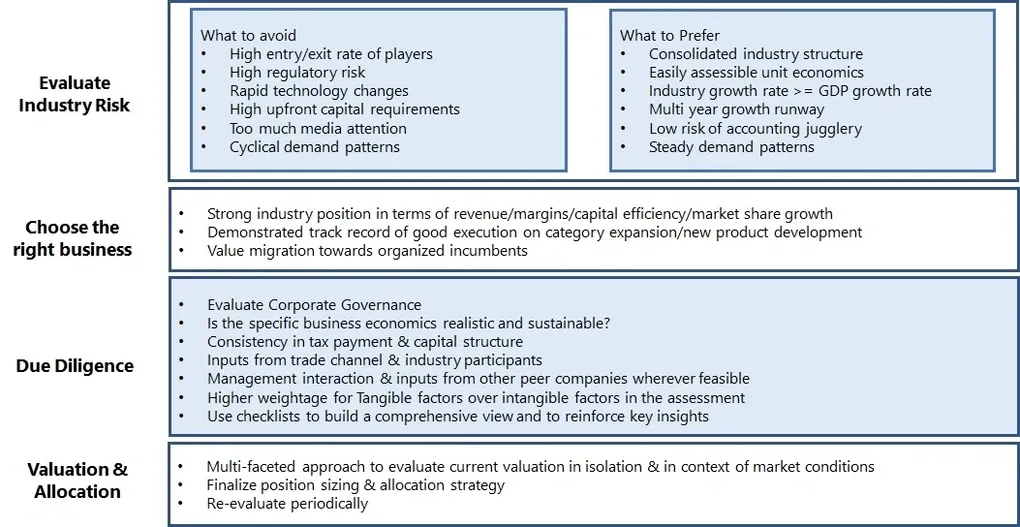
Table summarizing the investment process with industry risk, business selection, due diligence, valuation and allocation steps

Investment Process Summary

Process Step What Congruence Advisers Evaluates
Evaluate Industry Risk Congruence Advisers evaluates industry risk, demand visibility, competitive structure, regulatory risk, entry barriers and long-term business economics.
Choose the Right Business The business is evaluated based on industry position, competitive strength, track record, execution capability, scalability and long-term durability.
Due Diligence The due diligence process reviews corporate governance, management quality, disclosures, financial consistency, capital allocation and business risks.
Valuation and Allocation Valuation and allocation are reviewed based on business quality, valuation comfort, risk, opportunity size and portfolio-level suitability.

Leave the swinging deliveries outside the off stump and duck the bouncers 

As a rule, define the kind of businesses you will consider and the kind you will not consider. Without a clearly defined rejection process in place, investors run the risk of being all over the place. Use principles of reduction to eliminate most avoidable mistakes

Obsessively focus on the fundamentals 

The process works because it starts from first principles and not with questions like

  • “What is the capital efficiency?”
  • “What is the earnings growth rate”?

The process instead answers why the growth rate and capital efficiency are what they are and for what possible reasons they might change going forward. Fundamentals reveal the method behind the madness

Understand the nuances of the game 

Making money in the market comes down to the following sequence more often that not

  • Having a view that differs from the prevalent market consensus on a business
  • Your view turning out to be the correct one
  • The market eventually coming around to your view and pricing the business likewise

Rinse and repeat with a good strike rate (> 70%) over a long period of time

Play the asymmetric odds

What also matters is how much money you make when you are right and how much do you lose when you are wrong. This asymmetry in outcomes is a very important aspect of compounding wealth.

Do not underestimate behavioral aspects

The process is incremental, iterative, drives off inferential reasoning and can be unbelievably boring for most people. Investing was never meant to be entertaining. It is simple but never easy.

There is no holy grail in investing

There are multiple ways to succeed but there is no holy grail. Find an approach that you can consistently and reliably execute over time and stick to that. Any other answer is a plain old sales pitch. The Fundamental Vs Technical debate is like asking who is a better batsman – Dravid or Sehwag? The bigger question is who can you be? Not who is better

Accessibility Text Summary for Process Diagram

Investment Process

Congruence Advisers follows a structured investment process consisting of four major stages: evaluating industry risk, selecting the right business, performing detailed due diligence and determining valuation together with portfolio allocation.

Evaluate Industry Risk

The first stage evaluates industry structure, competitive intensity, demand outlook, regulation, cyclicality, entry barriers and long-term sustainability before analysing an individual company.

Choose the Right Business

Businesses are shortlisted based on competitive advantages, management quality, capital allocation, financial strength, scalability and long-term growth potential.

Due Diligence

Detailed due diligence includes studying annual reports, financial statements, management commentary, industry dynamics, governance standards, risks and competitive positioning.

Valuation & Allocation

Investment decisions are based on valuation, margin of safety, expected returns, downside risk and overall portfolio allocation. Position sizing depends on conviction level and risk-reward characteristics.