SG Mart Ltd operates as a comprehensive B2B marketplace and trading platform specializing in steel and construction materials. Its core business model bridges the gap between large primary metal producers and a highly fragmented downstream market that includes MSMEs, contractors, traders, and OEMs.
SG Mart Ltd is one of the group companies of the APL Apollo Group, a group that has made a name for itself within the construction materials sector in India over the past decade. Along with APL Apollo Tubes, Apollo Pipes and SG Finserve, SG Mart completes the foray of this group into the growing building and construction materials industry, with a special focus on downstream steel manufacturing and distribution segments.
The steel sector has large businesses in India that are now able to compete at a global level, but the path to respectable cash flows and good unit economics has been very volatile. The sector needs massive capital, a strong distribution ecosystem and access to raw materials to survive. One of the key points we have noticed as part of our ongoing research activity is that the large steel OEMs in India (TATA Steel, JSW Steel, Jindal Steel) are all likely to generate significant operating cash flows into the next five years that will suffice for the next round of capex. However, the steel OEM segment is very competitive with the bulk of the product portfolio reduced to a commodity with minimal pricing power. The Government has been supportive with tariffs and duties on imports; this has provided the much needed price stability that the industry craves.
While the OEM part of the value chain is organized, the steel conversion, distribution and trading segments have been disaggregated for decades. APL Apollo Tubes Ltd emerged as the largest value-added steel converter over the past 10 years due to a combination of aggressive risk taking, some element of luck and exceptional execution skills of the management team. So, when the same promoter threw its hat into the ring to build an organized business in the downstream steel processing value chain, we were curious to say the very least.
SG Mart Ltd is now trying to carve out its own space within the downstream steel processing segment, a segment that has traditionally been disaggregated outside of the captive entities of the large OEMs. With no pan India players, the downstream steel processing segment is a very difficult business to run unless one carves out segments of value addition and scales quickly. We see initial signs of success in this endeavour of SG Mart, especially with the quarterly numbers since Q4 FY26 showing a lot of progress on the margin and cash flow fronts.
SG Mart Ltd Company Summary
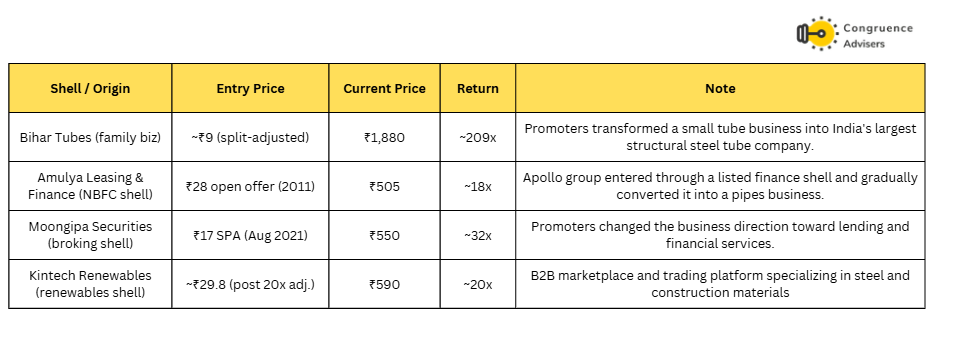
SG Mart was Kintech Renewables, a dormant renewable energy shell listed on BSE since the 1990s with virtually no business. Dhruv Gupta and Meenakshi Gupta acquired it in April 2023 via an SPA at ₹115/share and an open offer at ₹450/share.
Within months, the company:
- Raised ₹1150 Cr via preferential allotment at ₹5,000/share (Nov 2023), with marquee investors including Mukul Agarwal, Abakkus (Sunil Singhania), 360 ONE, SageOne, Plutus, QRG, and Vallabh Bhanshali
- Did a 10:1 stock split + 1:1 bonus in Feb 2024 and Pivoted entirely into B2B building materials distribution and co-branded with the APL Apollo name
- Hit ₹6,315 Cr revenue in FY26 across steel products, service centres, renewable structures, and steel profiling
The business is thin-margin by nature but the thesis is scale and brand i.e organise an unorganised market, build a distribution moat, and let operating leverage do the work.
Why Does This Business Exist ?
The promoter group operators of APL Apollo Tubes Ltd (India’s largest steel tube manufacturer) spent 4 decades as steel buyers. They experienced the same structural frustration every manufacturer in India does: no large, organised trading intermediary between the steel mill and the end market.
In Japan, South Korea, and China, trading giants like Marubeni, Sumitomo, Mitsubishi, ITOCHU, and Hanwha sit between mills and markets and absorb bulk supply, holding inventory, and distributing nationally and globally. India has no equivalent. The market is served by thousands of small, undercapitalised distributors who can hold steel for barely 5 days before they are forced to offload, often disrupting prices in the process.
India’s steel production is set to grow from 152 MT (FY25) to 250 MT by FY30, a 65% increase. A blast furnace runs 24x7x365 and cannot be switched off; that steel has to go somewhere. Add the China+1 tailwind pulling global manufacturers to India, and the need for a well-capitalised trading house has never been more acute.
Why Steel First ?
The group brought three advantages to the table from day one: four generations of domain knowledge in steel, deep direct relationships with every major mill (JSW, Jindal, NMDC, SAIL, Hindustan Zinc), and APL Apollo’s credibility as one of India’s largest single consumers of flat steel. They did not need to build mill access as they inherited it. Steel is the beachhead and other construction materials are the long-term expansion.
The Value Proposition ?
The offer to customers is straightforward: the same products they already buy, at lower cost, because SG Mart Ltd aggregates demand at a scale no individual trader can match.
The margin is generated two ways. First, by lifting manufacturer utilisation i.e taking a mill from 50% to 70-80% capacity reduces their cost of production, and that saving is shared. Second, by extracting a small brand premium on downstream products co-branded with the APL Apollo name.
The operational model that makes thin margins work is high inventory turns (15-20x per year) and low working capital day which together deliver a targeted 25-30%+ ROCE on a thin absolute spread.
SG Mart Ltd Management Details
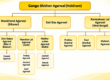
SG Mart Ltd is promoted by the Sanjay Gupta family, one of India’s most respected capital allocators, best known for building APL Apollo Tube Ltd from a small pipe trader into a ₹60,000 crore large-cap compounder. Sanjay Gupta runs APL Apollo Tubes Ltd (steel), while Sameer Gupta, his brother runs Apollo Pipes (PVC). The next-gen Sameer’s son Dhruv runs SG Mart Ltd and Sanjay’s sons Rahul & Rohan run SG Finserve.
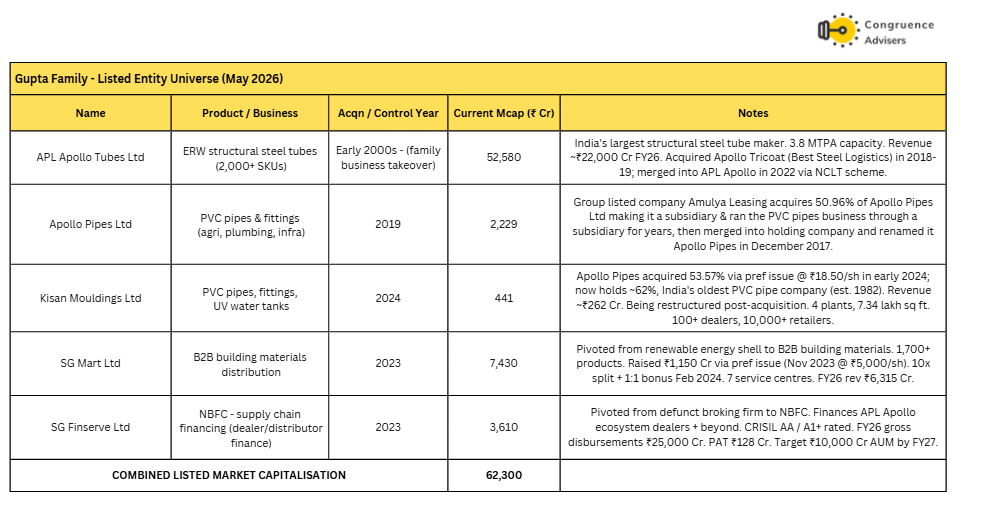
Promoter Playbook – Acquire, Rebrand, Scale
Every new entity in this family follows the same template:
- Find a dormant or near-dead listed shell
- Buy control at single or double-digit prices via SPA & open offer
- Inject capital via preferential allotment at a premium, bringing in institutional money. Often a set of familiar names who initially backed the APL Apollo story
- Rebrand and pivot the business entirely
- Leverage the APL Apollo brand, network, and distribution to accelerate
- Scale aggressively
Shareholding – In June 2026, Sameer Gupta transferred his entire 35.07% stake to his brother Sanjay Gupta by gift. Control has moved from Sameer Gupta’s family (Apollo Pipes) to Sanjay Gupta’s family (APL Apollo Tubes). Promoter and promoter group now hold 57.9% (Sanjay Gupta 35.07%, Rohan Gupta 8.89%, Neera Gupta 8.85%, Vinay Gupta 0.32%), with no pledge.
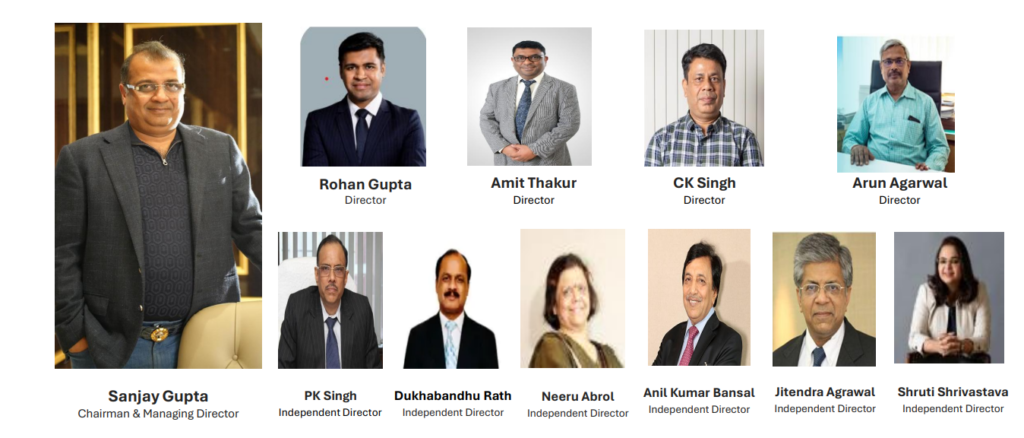
Sanjay Gupta, founder and CMD of APL Apollo Tubes, joined SG Mart as Chairman & Managing Director for a 5-year term, and his son Rohan Gupta joined as Whole-Time Director.
The active participants from management on the concall are Rohan Gupta, Amit Thakur, Suraj Kumar (CFO), Anubhav Gupta (Group CSO), Archit Arora (VP, Service Centres & Distribution) and Anamika Gulati (Sr. GM, Renewables).
SG Mart Ltd – Business Details
SG Mart Ltd B2B steel platform. It buys steel in bulk from large mills and sells it raw, processed, or as finished value-added products to dealers, fabricators, OEMs and EPC contractors across India.
The business is divided into four verticals:
- B2B Metal Trading – Bulk buying of HR coils, billets and zinc from primary mills and selling to dealers and industries.
- Network of Service Centres – large processing hubs that cut, slit and form steel to customer requirements, close to industrial clusters.
- Renewables & Steel Profiling Products – solar mounting structures, purlins, cable trays, racking and other profiles made on machines installed inside service centres.
- Downstream Distribution Products – TMT (royalty model) and structural products like angles, channels and wire mesh, sold under the APL Apollo brand through its dealer network.
- Online Marketplace – Optionality
SG Mart Ltd is moving away from low-margin trading toward processing and value-added products. That’s why revenue is flat to down but EBITDA margin has gone from 2% in FY26 to 4.6% in Q2 FY27.
B2B Metal Trading
India’s steel sector suffers from a structural distribution problem that has existed for decades. Steel mills run blast furnaces 24x7x365 and cannot throttle production, and they have historically depended on thousands of small, fragmented distributors to absorb and distribute their output.
The largest distributor SG Mart Ltd could identify when it started was doing a volume of just 25,000 tonnes per month. India’s crude steel production reached 168 mn tonnes in FY26, and capacity is set to reach 300 mn tonnes by FY30 under the National Steel Policy. There is simply no way these small SME traders can absorb the incremental supply. A small distributor can hold steel for barely 5 days before he is forced to offload it into the market, often at distressed prices, which disrupts pricing for everyone.
The gap was clear: India had no large, well-capitalised trading intermediary who could sit between the mills and the market, absorb bulk volumes, and distribute systematically.
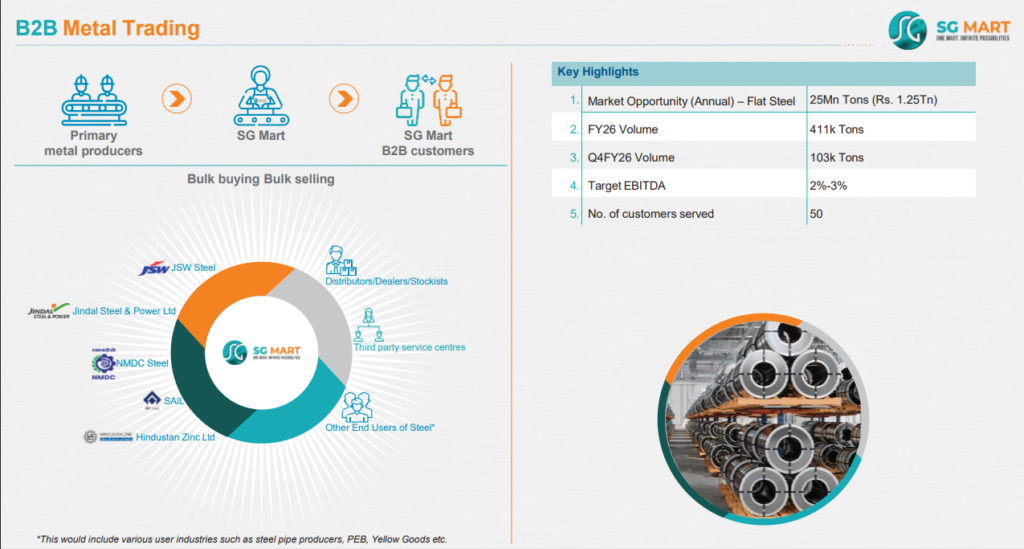
The Model – SG Mart Ltd stepped into that gap. The model is straightforward: bulk buying from primary steel producers and bulk selling to dealers, distributors, and end-user industries. The key differentiator is scale. Management claims its trading capacity is 20 times larger than India’s next largest steel trader. This scale matters because mills, when under pressure to push sales as new capacity comes online, will naturally prefer to deal with a single large counterparty rather than managing hundreds of small distributors. SG Mart Ltd effectively becomes the largest offtaker that the mills never had.
Products traded include Hot Rolled Coils (flat steel), Steel Billets (long steel), and Zinc Ingots (Zinc is now a small line).
Current mill partners include JSW Steel, Jindal Steel and Power, NMDC Steel, SAIL, and Hindustan Zinc, with NMDC and JSOL added in FY26.
Sourcing – Purchases from trading houses rose to 18.3% of total in FY26 vs 4.9% in FY25. Most likely this is due to lower steel availability. The AR points to gas supply disruptions at domestic mills causing coated steel shortages, and the Middle East conflict hitting steel supply chains. To keep service centres running, SG Mart Ltd had to buy from traders to fill the gap. Need to track if this comes back toward 5% in FY27 as supply normalises.
Selling side – 40.5% of sales go to 112 dealers/distributors, and the top 10 of them account for 60% of dealer sales. That means a fair amount of concentration in this channel. The rest of sales go directly to end-user industries, OEMs and EPC contractors.
Unit Economics – The margin target for B2B Metal Trading is ₹500-1,000 per tonne of EBITDA, which translates to a 1-2% EBITDA margin at current steel prices of around ₹50,000/tonne. Critically, this business runs on a per-tonne spread basis, not a percentage margin basis. So if steel prices fall, the percentage margin optically rises, and vice versa. The ₹1,000/tonne spread is the steady-state target, and it has been approximately achieved in most quarters barring the sharp steel price correction in Q2FY26.
Working capital requirement is 0-10 days (average 5 days) because trades are back-to-back. SG Mart Ltd lifts on credit from the mill and sells on cash-and-carry to its customers, with 3-4 days debtor credit being the maximum offered. With near-zero net working capital and an inventory churn of 15-25 times per year, this business delivers 30-40% ROCE on very limited capital employed.
Current Status and Outlook
FY26 volume came in at 411k tonnes (₹1,956 Cr), a decline from the 632k tonnes achieved in FY25. This was deliberate and explained by two factors. First, as the service centre network scaled up, management actively redirected available steel away from plain B2B trading toward processing, because the same tonne of steel earns ₹2,000/tonne in a service centre versus ₹500-1,000/tonne in B2B.
Second, domestic steel supply was constrained in Q1 and parts of Q2 FY26 due to lower mill production, which limited available volumes.
From FY27, B2B is no longer reported separately. It has been merged with service centres. H1 FY27 merged volume is 383k tonnes (770k tonnes annualised) vs 1,048k tonnes combined in FY26 (411k B2B + 637k service centres). So basically, plain trading volume is being cut further, and this is why Q2FY27 revenue fell 8% YoY while EBITDA more than doubled. Steel prices rising 25-30% over the last 6-7 months and weak demand in construction, auto and white goods have also made management cautious on low-margin trading.
Earlier, management had said B2B volume can scale to almost unlimited levels as steel supply increases, and had targeted ₹6,000-7,000 Cr of annualised B2B revenue over the next couple of years. Given the current mix shift, this target looks outdated, and the recent calls don’t repeat it. B2B now works more as the sourcing base and mill relationship for service centres than as a growth engine. It will remain important for procurement scale, but it is unlikely to grow meaningfully as a standalone revenue line.
The total addressable market for flat steel alone is 25 mn tonnes annually (₹1.25 trillion), with another 10 mn tonnes for steel billets. SG Mart Ltd’s current penetration is a small fraction of this, so the headroom is there whenever management chooses to use it.
Network of Service Centres – (From FY27, B2B trading is merged with service centres in company reporting.)
India’s steel-consuming industries like auto, white goods, construction and fabrication don’t buy raw steel in coil form. They need steel that has already been processed i.e cut to a specific length, slit into narrower strips, or made into chequered plates. This processed steel goes directly into their factory production lines to make washing machines, refrigerators, automobile bodies, bridges, and industrial equipment.
Today, this processing is done by thousands of small, unorganised, mom-and-pop service centres scattered across the country. These centres suffer from three structural problems. First, they don’t have reliable raw material supply, so they can never offer just-in-time delivery to their manufacturing customers. Second, their machinery is typically outdated, leading to inconsistent quality. Third, and most importantly, there is no pan-India, national-level organised chain of service centres. This means a large manufacturer like Havells, with factories in Neemrana, Baddi, and Bangalore, is forced to deal with a different local processor at each location, with no consistency of quality, pricing, or service levels.
The freight cost gap compounds the problem further. A factory in Ludhiana needing processed steel currently buys from a service centre in Ghaziabad and pays ₹1,000–1,200 per tonne in freight on the finished processed product. If SG Mart Ltd sets up a service centre in Ludhiana, the raw HR coil arrives at the same freight cost as it would to Ghaziabad, but the customer saves the ₹1,000-1,200/tonne freight on the processed output entirely. This is a direct, quantifiable cost saving that drives customer acquisition in every new geography.
Model – SG Mart Ltd’s service centres are large, organised, purpose-built processing hubs equipped with high-precision modern machinery i.e Cut-to-Length (CTL) lines, slitting lines, and chequered plate lines. The centres buy HR coils from steel mills (the same raw material SG Mart Ltd trades in B2B), process it on-site, and deliver it to industrial customers i.e OEM manufacturers, auto-component makers, white goods companies, construction equipment firms, fabricators, and PEB companies.
Management wants to create a national-level service centre brand with locations near every major industrial cluster. That way a large OEM can sign a single head-office procurement agreement with SG Mart Ltd covering all its factories across India, rather than managing dozens of local suppliers. No such national-level player exists in India today.
The model also includes a Stock & Sell component. The centres double up as HR coil warehousing hubs from which smaller dealers and distributors in the region can buy material in smaller quantities without going directly to a mill. The centres are also used as warehouses for the downstream distribution products, so no separate capex is needed there.
New product addition – each centre is now adding CRCA sheets (1,000-2,000 tonnes/month, sold at ₹2,000–3,000/tonne above HR coil) and pre-galvanised sheets (2,000–3,000 tonnes/month). This lifts throughput per centre and moves the product mix further up the value chain. CRCA is traded from 3rd party factories initially, with in-house lines to follow at scale.
Unit Economics – The target EBITDA for service centres in India is ₹2,000 per tonne, and this has held steady quarter on quarter. Dubai is targeted at ₹5,000+ per tonne given the premium market dynamics there. On an owned centre this translates to a 3-4% EBITDA margin at current steel prices. On leased centres, where rent is paid to the facility owner, the margin is slightly lower but no capex is deployed.
Capex per owned service centre has gone up. Earlier it was ₹40 cr of total capital employed: ₹25 crores gross block (1-2 acres of land, shed and machinery) and ₹15 cr of working capital.
As per the Q2 FY27 call, a new owned centre now costs ₹70-80 cr, of which ₹50 cr is land for 10 acres, ₹10 cr is the industrial shed and ₹5 cr is plant & machinery. Land is now the biggest cost, as the company is buying larger plots to house CRCA, pre-galvanised and profiling lines in the same campus.
At full ramp-up, each centre does 12,000-13,000 tonnes/month (8,000 HR coil + 1,000-2,000 CRCA + 2,000-3,000 pre-galvanised). That is ₹70–80 cr of monthly revenue and ₹25-35 cr of annual EBITDA. Management guides ROCE of 25%+ per centre with 18 days of working capital.
This is still the only vertical where steel price movement creates real P&L exposure. The sharp 15% steel price correction in Q2FY26 resulted in inventory losses that were entirely absorbed within the service centre books. Now, with steel prices up 25-30% over the last 6–7 months, management says lean inventory protects them on both sides. The margin gain is from product mix, not inventory gains.
Guidance Evolution – Fewer Centres, Same Volume
Management’s original guidance of 100 service centres by 2030 was based on an assumption of 4,000-5,000 tonnes/month per centre. Operating experience has proven that assumption wrong in a positive direction. Once operational, each service centre has demonstrated throughput of 8,000-12,000+ tonnes/month, now going to 12,000–13,000 with CRCA and pre-galvanised. So fewer centres are needed for the same volume target.
The current target is 25+ centres by 2030, possibly 30-35 given better-than-expected ramp-up. 25 centres at 12,000-13,000 tonnes/month means 3.5 mn tonnes/year.
Current Status – 8 service centres are operational as per the Q2FY27 call: Ghaziabad (North), Jaipur (North), Bangalore (South), Pune (West), Raipur (Central), Dubai (UAE), and rented facilities in Indore and Ahmedabad. The rented locations will be shifted to owned facilities once company-owned sites are established. Total installed processing capacity is 85,000 tonnes/month across CTL, chequered, slitting and profiling lines (excluding Stock & Sell volumes).
FY26 full-year volume from service centres reached 637k tonnes, making it the largest revenue segment at ₹3,214 Cr. Q4 FY26 delivered 190k tonnes. From FY27, the company reports service centres and B2B trading together. Q1 FY27 merged volume was ~177k tonnes (of which ~160k from service centres, as per the Q1 call, and ~17k from trading). Q2 FY27 merged volume was 206k tonnes (+16% QoQ). The split for Q2 is not disclosed, but given trading is being cut, most of the growth is likely from service centres. and The segment serves 300+ customers, and the company overall has 2,550 registered customers as of H1 FY27.
In the merged reporting, Service Centres (including B2B) did ₹2,294 Cr revenue on 383k tonnes in H1FY27, 80% of group revenue. Q2 FY27 revenue for this segment was ₹1250 Cr vs ₹1359 Cr in Q2 FY26, lower because low-margin trading volume is being cut.
Expansion – Management has declared a decisive shift to aggressive expansion, after spending 3-4 quarters they unit eco can be consistently delivered. Land acquisition is already underway in Jammu, Punjab, Rajkot, Coimbatore, Chennai, Vizag and Bhubaneswar. Land at Palwal (Haryana), 10 acres was bought for ₹85 Cr by acquiring Tanwar Cargo Solutions. Other identified locations include Hyderabad, Hubli, Kolhapur, Kanpur, Ranchi, Patna, Siliguri and Guwahati. These are all industrial clusters that are currently underserved and buy processed steel from metro cities at a significant freight premium.
Expansion into Tier 2 and Tier 3 industrial towns is planned as Stage 2 after the current pipeline is established. The key risk here is land acquisition delays slowing the rollout.
Dubai – Management saw significant opportunity in the UAE, where processed steel demand from construction and industry is robust and competition is less crowded and has higher EBITDA/tonne. But the Middle East conflict since March 2026 has disrupted operations. Port disruptions have kept volumes flat QoQ, though margins improved slightly due to steel scarcity. Further UAE/Gulf expansion is on hold until the situation normalises.
Renewables & Steel Profiling Products
This vertical was born as a natural extension of the service centre business. Once SG Mart Ltd had established its service centre network with precision machinery and a reliable raw material supply chain, management realised the same infrastructure could be used to install light profiling machines at zero incremental land or shed cost and manufacture value-added steel sections for entirely new end markets. The first product chosen was solar mounting structures, riding on India’s massive government-backed renewable energy expansion.
The raw material (coated steel and HR coil) was already being procured from the same mills, the service centre sheds were available, and the group’s existing relationships with EPC contractors and Independent Power Producers (IPPs) provided immediate customer access.
Products
Ground-mounted solar utility structures are the steel frames on which solar panels are installed in large solar parks. There are 3-4 types of open steel sections used: channel sections, angle sections and purlins. They are made by buying coated flat steel from mills and running it through a rolling/profiling machine to form the required shape. The processing is relatively mild compared to CTL or slitting, but it demands precision and consistent quality at scale. The brand launched for this product is Sun Steel. Beyond utility solar, SG Mart Ltd has expanded the product portfolio under this vertical into Steel Profiling Products.
Products include Solar Structures (Utility and Residential) under the Sun Steel brand, Z/C Purlins (for PEB and warehouse construction), Strut Channels, Racking Profiles (for warehousing and packaging companies), Cable Trays (for data centres and infrastructure projects) and Door Frames. Fasteners and other construction-related products are planned next, and Puff Panels (insulation for cold storage and energy-efficient buildings) are in the pipeline.
These are manufactured by installing different profiling machines at existing service centres. Steel profiles are sold under the APL Apollo brand through the group’s dealer network. As the business scales, part of the volume is also made through a white-label/franchise model, where partner manufacturers produce under the APL Apollo brand.
Advantages – First, procurement power: the same mill relationships that give SG Mart Ltd preferential pricing on HR coils also apply to coated steel and other flat steel inputs. Smaller solar structure manufacturers buy raw material at spot prices from distributors, while SG Mart Ltd buys directly from mills at bulk rates. That creates a cost advantage of ₹2,000–3,000/tonne on input costs.
This edge will get stronger once the Raipur coated steel plant is up (expected in 9–12 months).
Second, geographic reach via existing service centres: solar parks are spread across Gujarat, Rajasthan, Madhya Pradesh, Chhattisgarh, Andhra Pradesh, Tamil Nadu and Telangana. SG Mart Ltd’s centres in Ghaziabad (feeding North/Central), Raipur (Central belt), Pune (West), and upcoming centres in Chennai/Coimbatore/Vizag (South, land acquisition underway) allow proximity-based supply to these parks. That saves freight and enables faster delivery, which is critical for EPC contractors working on tight commissioning timelines.
Unit Economics
- Solar structures – ₹3,000-4,000 per tonne
- Steel profiles sold through distribution – ₹4,000-5,000 per tonne
This is significantly higher than vs other 2 vertices and reflects the value-added nature of the product. Profiles earn more because they are branded products sold through APL Apollo’s dealer network at a premium. Today profiling delivers the highest EBITDA per tonne among all segments.
Target – management expects EBITDA/tonne to go up to ₹6000-7000 once the new manufacturing line and the Raipur coated steel plant (backward integration) are in place. Since the machines are installed in existing service centres, the incremental capex is only the cost of the machine.
Current Status
FY26 was the first full year of operations, with the business starting in April 2025. FY26 volume from Renewables reached 39.9k tonnes generating ₹306 Cr in revenue, and Steel Profiling Products contributed another 6.8k tonnes at ₹45.5 Cr. Both are new additions to the segment mix with zero prior-year comparatives. In FY26, solar volumes were held back by coated steel shortages arising from gas supply disruptions at steel mills.
FY27 so far is a story of two halves:
- Steel Profiling is taking off – volume jumped from 6.8k tonnes in full FY26 to 18k tonnes in Q1 FY27 and 40k tonnes in Q2 FY27 (+20% QoQ). H1 FY27 revenue of ₹344 Cr is already 8x full-year FY26.
- Solar is lagging – 11k tonnes per quarter (H1 FY27: 22k tonnes, ₹171 Cr), roughly flat vs the FY26 run-rate. Order booking was deferred due to rising steel prices and land acquisition delays at IPPs. Management says both issues are now resolved, with significant new orders booked in October. The order book is 50k+ tonnes, i.e 1 year of visibility, and H2 should pick up.
Management claims SG Mart Ltd is already the #2 player in India in ground-mounted solar structures, with 1-1.5 GW of structures installed since inception. SG Mart Ltd is empanelled with 20–25 large OEMs and IPPs, including major solar project developers.
Operationally, profiling machines are installed and running at Ghaziabad/Dujana, Raipur and Pune. Installed capacity as per the Q1 FY27 call is 400k tonnes/year (200k profiles + 200k solar), with profiles capacity going to 500k tonnes/year as per the Q2 call. Targeted capacity across all products is 500k tonnes (solar utility 270k, residential solar 65k, racking 36k, purlins 18k, cable trays 54k, puff panels 84k). Management targets 3.5-4x growth in this vertical over the next 2-3 years. Current utilisation is low: H1 FY27 combined volume is only 66k tonnes, so there is plenty of headroom without new capex.
TAM – The total addressable market across all profiling products in India is 2.5 million tonnes annually (₹150 Bn), with another 200k tonnes of export potential. The solar utility market alone is 800k tonnes/year domestically and growing rapidly on the back of India’s 500 GW renewable target. Critically, this entire market is currently served by highly fragmented, unorganised players with no national-level brand. It is exactly the same white space SG Mart Ltd identified in B2B trading and service centres. The APL Apollo brand on trade products (residential solar struts, cable trays, racking) gives SG Mart Ltd instant credibility and pricing power in a market where no organised brand currently exists.
Raipur Coated Steel Plant (Backward Integration)
Both the solar structures and steel profiles businesses use special coated steel (zinc + aluminium for solar, zinc for profiles). Today SG Mart Ltd buys this coated steel from third parties, which leaves it dependent on outside suppliers for its highest-margin products. In FY26, coated steel shortages caused by gas supply disruptions at steel mills held back solar volumes, so this dependence has already cost the company.
To fix this, SG Mart Ltd is setting up its own coated steel line at Raipur. It will be a centralised facility supplying all service centres and profiling lines across India, not a plant at each centre.
Management said on the Q1FY27 call that backward integration can improve margins by ₹3000-4000/tonne in the solar and profiling business. That would take EBITDA/tonne for this vertical from ₹3000–5000 today to ₹6000–7000 and Commissioning is expected in 9-12 months i.e roughly Q3–Q4 FY28.
Downstream Distribution Products
This is the distribution play built on SG Mart Ltd’s most powerful inherited advantage, i.e APL Apollo’s 30-year distribution network: 800 dealers serving 50,000 retail shops and reaching 200,000 fabricators. SG Mart Ltd itself now serves 1,200 dealers and distributors.
These dealers do APL Apollo pipes as only 28% of their business. The remaining 72% is TMT rebars, MS angles, channels, bars, wire mesh and welding rods, which they source from a fragmented, unorganised universe of small manufacturers. SG Mart Ltd’s job is to plug organised, quality-assured supply into that visible and existing demand.
TMT – Royalty-Based Model (from Q4 FY25 onwards): Initially, SG Mart Ltd was buying TMT from manufacturers and booking the full revenue and cost of materials through its P&L. Management recognised this was inflating revenue without meaningfully improving EBITDA quality, and it also put working capital on SG Mart Ltd’s books unnecessarily. So from Q4FY25, the TMT business was restructured into a pure royalty model. SG Mart Ltd now charges the manufacturer a royalty of ₹500/tonne for the right to sell under the APL Apollo SG TMT brand through SG Mart Ltd’s dealer network. The manufacturer handles production, logistics and billing directly. This makes TMT a near-zero capital, near-zero risk, pure brand monetisation business. The royalty is expected to rise to ₹750-1,000/tonne as the brand gains deeper market acceptance and pricing power. The manufacturer benefits from higher utilisation (50% to 70–80%), lower unit costs, and the premium the APL Apollo brand commands in the market, which effectively absorbs the royalty cost.
Non-TMT – Direct Distribution Model: Products like MS angles, channels, bars, wire mesh, binding wire and other downstream items continue to be sold through direct distribution, where SG Mart Ltd books the full revenue. These products are 90% steel and 10% non-steel by value. Margins vary from 1-3% depending on the product, with a blended EBITDA target of ₹1,000–1,500/tonne. They use an existing warehouse of service centre network, so no separate warehouse capex is needed, 5 accessories already launched with 2–3 more in the pipeline, and an online sales channel expected in 6 months.
Contribution of this segment to revenue is >2% of FY26 revenue
TAM – TMT alone is 58 million tonnes annually (₹2.9 trillion), while light structurals add another ~800k tonnes annually (₹40 Bn) in the addressable segment.
Online Marketplace – SG Mart Ltd July 2026 investor presentation lists an Online Marketplace, described as a one-stop digital marketplace for sourcing building and infrastructure materials, and management expects the online channel to launch in 6 months. With 8 service centres acting as fulfilment hubs and 2,550 customers already on board, the platform can scale without new capex.
SG Mart Ltd Corporate Governance Analysis
Board composition – The board has 6 directors: 1 Whole-Time Director (Amit Thakur), 1 Non-Executive Non-Independent Director (Arun Agarwal, who is also Joint MD of Apollo Pipes) and 4 Non-Executive Independent Directors, including one woman independent (Neeru Abrol, ex-Director Finance and Chairperson of SAIL). Independents are 2/3 of the board. There is no regular Chairperson; a chair is elected at each meeting, all directors attended all board meetings, and the independents hold no shares. FY26 saw two exits. Shiv Kumar Bansal (Joint MD) resigned in July 2025 for personal reasons, and Arihant Chopra’s 3-year term ended in May 2025.
A point to note here is that the board is closely linked to the APL Apollo group. Neeru Abrol is also an independent director at Apollo Pipes. Dukhabandhu Rath is an independent director at APL Apollo Tubes and SG Finserve and sits on 6 other listed boards, close to the limit of 7. Independence on paper looks fine, but group companies overlap is high.
Post the July 2026 restructuring, the board has 11 directors: 3 Executive (Sanjay Gupta as Chairman & MD, Rohan Gupta as WTD, Amit Thakur as WTD), 2 Non-Executive Non-Independent (Arun Agarwal, Chakram Kumar Singh) and 6 Independent Directors, including two women (Neeru Abrol, Shruti Shrivastava). Independents are 55% of the board, meeting the 50% requirement when the Chairman is an executive promoter. Sanjay Gupta, founder of APL Apollo, taking direct charge is a strong signal of commitment and execution. But management bandwidth is a point to watch.
Board restructuring (20 July 2026) – The board appointed Sanjay Gupta as Chairman & Managing Director for a term of 5 years w.e.f. July 20, 2026, along with Rohan Gupta as Whole-Time Director, Chakram Kumar Singh as Non-Executive Non-Independent Director, and Shruti Shrivastava as Independent Director.
Committees – The board has 5 statutory committees i.e Audit, Nomination & Remuneration (NRC), Stakeholders’ Relationship, Risk Management and CSR. The Audit Committee is chaired by an independent director (Prakash Kumar Singh), is 4 of 5 independent, and includes the WTD as a member. The NRC and Stakeholders’ Relationship committees are chaired by an independent director, and the Risk Management Committee is fully independent. The CSR Committee is chaired by an independent (Neeru Abrol). Composition is sound overall.
Promoter/management remuneration – Total KMP compensation was ₹2.63 Cr in FY26 vs ₹2.50 Cr in FY25. The WTD (Amit Thakur) drew ₹1.11 Cr, with a 9% increase and a ratio of 17x the median employee. Shiv Bansal drew ₹0.76 Cr for 4 months. The CFO got ₹0.56 Cr (+15%) and the CS ₹0.20 Cr (+25%). KMPs also hold 70,000 ESOPs.
The promoters (Gupta family) draw no remuneration. The promoter family has given personal guarantees of ₹2,680 Cr for the company’s bank facilities, at no fee. That is a strong signal of promoter backing.
New changes post 41st AGM on September 19, 2026 – The new CMD, Sanjay Gupta, will not draw any remuneration from SG Mart Ltd. From FY27, Rohan Gupta (WTD, promoter group) gets a ₹1 Cr salary with a ₹3 Cr ceiling, Amit Thakur’s ceiling is raised to ₹2 Cr, and Chakram Kumar Singh gets 1.25 lakh ESOPs vesting over 5 years.
Related party transactions – RPTs with group companies are minimal: sales to Apollo Pipes of only ₹0.19 Cr in FY26, and zero purchases from related parties. The main RPTs are with the wholly-owned Dubai subsidiary SG Marts FZE i.e sales of ₹222.5 Cr (4% of standalone sales), ₹167 Cr equity investment in FY25, and a ₹162 Cr loan given in FY25, of which ₹148 Cr was repaid in FY26.
Contingent liabilities – As of FY26, claims not acknowledged as debt are just ₹0.99 Cr (<0.1% of net worth).
Dividend – No dividend was recommended for FY26, to conserve resources for growth. That is appropriate given ₹1,500 Cr of planned capex. Small legacy unclaimed dividends from the Kintech era remain.
Audit & auditor – The statutory auditor is Walker Chandiok & Co LLP (Grant Thornton Bharat), appointed in Sept 2024 for a 5-year term till 2029. Moving to a large reputed firm is a positive. The audit fee is modest at ₹0.35 Cr plus ₹0.04 Cr for other services.
There are no qualifications and no frauds reported. The Key Audit Matter is ₹90 Cr of PPE additions, where certain machinery was bought from specific vendors without multiple quotations, citing the proprietary nature of the machinery.
There is one audit trail exception: the payroll software is run by a third-party provider without a Type 2 controls report, so the auditor could not confirm the audit trail at database level. This is a minor IT-control observation.
Compliance – The only lapse is a BSE fine of ₹35,400 under Reg 19 (NRC composition) for a clerical omission in the Q1 FY25 governance report. It was rectified, and the company has asked for the fine to be withdrawn. There have been no SEBI penalties or strictures in the last 3 years. Some land at Bangalore and Raipur (₹14 Cr) is still registered in the old name Kintech Renewables, which is cosmetic.
CSR – The FY26 CSR obligation of ₹1.41 Cr was entirely unspent and transferred to the Unspent CSR Account for an ongoing project, which is allowed. For FY27 the company has partnered with APL Apollo Foundation, a group entity. The money stays within the group ecosystem, which is not unusual but worth noting.
A detailed corporate governance check would entail looking at these additional factors, if and when we get to writing a detailed initiation note on this business
- Intangibles involved in the business, do they form a big part of the balance sheet?
- Unit economics – do they fit into the normal range for a business of this nature?
- Is accounting complicated or simple? consistent or changes every few years?
- Consistency in disclosing FX losses/gains and MTM impact?
- Consistency in tax outgo in the cash flow statement and the P&L?
- Is the promoter family actively investing outside of the business- real estate, VC Funds?
- What other organizations are the promoters and directors associated with? Any history of defaults or frauds there?
- Any history of over the top speak by promoters/management in the media?
- Analysis of audit committee notes
- History of change/retention of statutory auditors & auditor remuneration trend
- Insights from credit rating reports
- Pending litigation against company & promoters?
It has been our endeavour over the years to enhance the scope and details of the corporate governance checks we conduct. However, the entire scope of this analysis would be an overkill at this stage of business analysis. This will be appropriate for a deep dive if and when a business is considered for inclusion in the portfolio.
SG Mart Ltd Financial Performance
Total revenue grew 118% from ₹2683 Cr in FY24 to ₹5856 Cr in FY25, driven almost entirely by the B2B Metal Trading ramp-up and the launch of the Service Centres vertical. FY26 saw revenue growth moderate to just 8% at ₹6,315 Cr partly because the TMT business shifted to a royalty model (removing gross revenue from the P&L) and more because B2B volumes declined as steel was redirected toward the higher-margin service centre processing route and low availability of steel.
Margin compressed from 2.3% in FY24 to 1.8% in FY25 (steel price crash impact) before recovering to 2.2% in FY26. The absolute EBITDA trajectory is more important than the percentage it shows the business is compounding earnings in absolute terms even through a difficult commodity environment. The margin recovery from FY25 to FY26 despite flat revenue is a positive signal that the mix shift toward higher-margin verticals is beginning to work through the P&L.

Realization of Renewable Structures at ₹76.63/kg and Steel Profiling at ₹65/kg are already commanding premium realisations versus the core B2B and service centre businesses at ₹47–50/kg confirming that the margin improvement journey runs through these newer, value-added segments.
SG Mart Ltd Comparative Analysis
To understand SG Mart Ltd investment potential, we have conducted a comprehensive analysis. This analysis includes comparing SG Mart Ltd to its competitors (peer comparison) on various fundamental parameters and SG Mart Ltd share performance relative to relevant benchmark and sector indices.
SG Mart Ltd Peer Comparison
No listed competitors as of now but the space is seeing good interest.
TATA Steel Downstream Products Ltd was the pioneer in this space since the TATA group wanted to control the downstream part of the supply chain too. The business today has the largest network of Steel service centres and has easy access to finished steel products from TATA Steel. As per the FY25 annual report the business reports revenue of more than 7,500 Cr and does PAT margin of > 3% p.a.
Infra.market is a technology-driven construction materials marketplace broader than steel. It covers structural products (concrete, construction materials i.e 60%+ of revenue), finishing products (plumbing, roofing, plywood, laminates), and lifestyle products (modular kitchens, paints, appliances). It also does construction services, equipment rental, and exterior painting. It is positioned as a full-stack building materials platform with digital procurement at the core. It has acquired 5 companies including Metro Group (July 2025) and is backed by Tiger Global, Accel, Nexus, and Zerodha co-founder Nikhil Kamath’s NKSquared. Revenue has nearly tripled in three years, with FY26 estimated to cross ₹20000 Cr. Do note that this business cuts across construction categories and isn’t limited to steel alone. Infra.market has plans to launch a 5000 Cr IPO in the next 12 months.
OfBusiness is a tech platform for raw material procurement and embedded financing for SMEs. Its model is fundamentally different. It combines commerce (procurement of steel, chemicals, polymers) with credit (lending to the same SMEs it supplies). The NBFC arm (Oxyzo) is as important as the trading arm and carries the margin. OfBusiness is arguably more of a fintech-trading hybrid than a pure B2B materials platform. It achieved ₹19,296 crore in revenue in FY24 while empowering 1M+ SMEs.
While large corporate houses are also showing interest in this space i.e Birla Pivot has plans to emerge as a large construction materials marketplace. JSW One MSME is a relatively new foray in this segment.
High level Comparative Snapshot
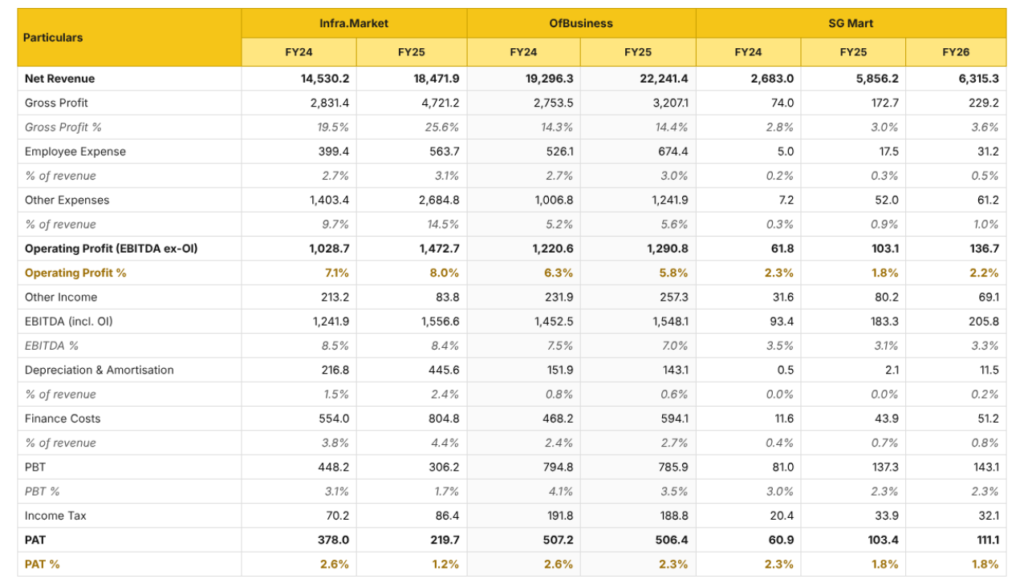
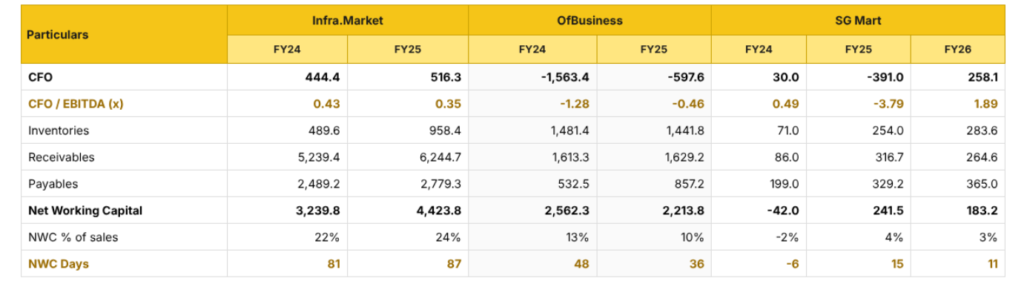
Infra.market and OfBusiness earn 14-25% gross margins because their products mix where the brand and design premium dominates the cost structure. SG Mart Ltd earns 3% because it sells commodity steel where 97% of the cost is the steel itself; the margin structure is a product characteristic and not a reflection of business quality.
The more relevant comparison is working capital and cash conversion. SG Mart Ltd’s CFO/EBITDA of 1.89x in FY26 (versus 0.36x for Infra.market and negative for OfBusiness in FY25) is the standout number. SG Mart Ltd actually converts its thin EBITDA into real cash, something both peers struggle with at scale because of their working capital-intensive models. Which is why SG Mart Ltd is generating more ROCE even on a thinner margin.
Valuation

Very few distributor entities are listed in India with Redington Ltd & Entero Healthcare being the prominent ones across other sectors. While Redington trades at a low PE of 14-15x due to the market being an oligopoly in spite of a healthy 15% growth, Entero Healthcare trades at 50x+ PE due to the possibility of 20%+ growth for many years. Entero Healthcare is one of the largest pharma distributors in the country at unit economics expected to get progressively better over the next 2 years. We believe the reason for this high valuation is the market view that the market will turn organized over the next 10 years, giving Entero Healthcare a long cycle tailwind from here.
Given that the market size is large, SG Mart Ltd can show above average growth for the next 5-6 years that can result in a healthy PE multiple for the business over this time frame.
Summary of our View
Clearly there is interest from the large business houses and well-funded new age businesses in the steel and construction materials marketplace business model. We believe that SG Mart Ltd can succeed so long as it is clear about which segments to operate in – Tier 2 cities and below where a large Steel service centre network can make a difference to end consumers without competing with the likes of TSDPL Ltd in their core markets. It will also now be easy to wean away the large steel OEMs from their captive & loyal (but not captive) distribution network.
SG mart Ltd will also need to stay away from the temptation to take credit risk in an effort to grow fast. This is where the APL Apollo pedigree & knowledge of the distribution network becomes critical. At the same time, have an approach that is focused on value addition and not just trading, minimize inventory risk with scale & size.
We see clear evidence from the management communication that their growth strategy is coherent, risk management driven and has clarity on the pockets they want to avoid.
Competition is clearly monitorable but none of the new entrants are excessively steel focused, thereby reducing the possibility of a market share war within steel. In fact, a successful IPO of Infra.market may lead to renewed investors in SG Mart Ltd.
Why should you consider investing in SG Mart Ltd ?
SG Mart Ltd offers compelling reasons to track closely, and warrants consideration for investors seeking exposure to India’s organised steel distribution and value-added processing opportunity.
Steel price stability (anti-dumping duty) – With the imposition of ADD (Anti-Dumping Duty) on Steel by the Indian Govt in January 2026, steel price has found a great degree of stability. Q3 FY26 saw a bottom in steel prices with a spike of more than 7-8% since then. Given that the ADD falls only by 50 bps each year till 2028, we believe that volatility in steel pricing will be contained to a good extent. Large inventory losses are unlikely from here for the rest of FY27 since the base year is favourable. We also believe that operating cash flow generation by steel OEMs will be very strong over the next 4-5 years, barring any unnecessary adventures on the M&A front
Value-added scale-up – SG Mart Ltd has demonstrated through FY26 its ability to scale up volumes in the value-added segments quickly while keeping B2B trading volume down to a hygienic level. The management guidance is of aggressive volume growth in renewables structures and steel profiles for 3.5-4x growth in 2-3 years using existing capacity. We believe that this tangibly changes the EBITDA and the EBITDA per MT trajectory of the business compared to FY26. The EBITDA margin of 3% printed in Q4 FY26 could become the baseline for FY27 and beyond.
This is now already reflecting in the last 2 quarters. Value-added volume (solar + profiles) rose from 21k tonnes in Q4 FY26 to 29k tonnes in Q1 FY27 and 37k tonnes in Q2 FY27, and it now makes up 19% of revenue vs 4% a year ago. EBITDA margin expanded to 4.5% in Q1 and 4.6% in Q2 FY27,
Working capital discipline & sustained positive cash flow – The business has optimized its working capital cycle to 20 days by the end of FY26. Our assumption is that the working capital cycle is unlikely to deteriorate significantly from here and should be contained at > 25 days through FY27 and FY28. This has the effect of the business generating more than 90 Cr ex other income on a sustainable basis every year from here. While the 240 Cr OCF of FY26 is unlikely to be replicated in FY27 & FY28, negative operating cash flow is unlikely from here
Self-funded growth – With 750 Cr of cash on the balance sheet and positive operating cash flow from FY27, the business will be able to fund capex of > 600 Cr over FY27-28 without any incremental capital raise, either through debt or equity. Running the numbers, it looks likely that capex till FY29 can be executed through internal accruals. In case of growth rate that exceeds expectations (and hence depletes current cash balance faster due to working capital expansion), the business may need to raise debt in FY29 to keep growth going
Business model is now proven and growth phase ahead – SG Mart Ltd has tested its product market fit and is moving to a zone of accelerated growth, going by the management guidance of EBITDA CAGR of 50% p.a. over the next 3 years. We believe that this is a very aggressive projection and that the real business outcome may fall short, given the geopolitical uncertainty of FY27. However, our belief is that execution will be focused and not aggressive in a risk management point of view
Peer listing (potential re-rating trigger) – If Infra.Market gets a good listing and creates investor excitement, our thesis is that the market will start taking a more favourable view of SG Mart Ltd than it has historically.
What are the Risks of investing in SG Mart Ltd ?
Investors need to keep the following risks in mind if they choose to invest into this business. Risks needs to be weighed in combination with the advantages listed above to arrive at a decision that is optimal for your portfolio construct
Steel price volatility – Excessive steel price volatility for whatever reason can make a significant dent to the business PAT due to inventory losses. Q3 FY26 saw inventory loss of 20 Cr while Q4 saw an inventory gain of 6 Cr.
Steel supply availability – Availability of enough volume of steel can turn out to be a significant challenge if the geopolitical uncertainty affects the production schedule of the steel OEMs. The price of fuel and coking coal spiking may affect the unit economics of the entire supply chain, though we believe that such a situation would be transient. At the same time, we cannot envisage a situation where steel OEMs prioritize SG Mart Ltd over their captive downstream steel processing verticals. This is the largest risk to the thesis in our opinion, delivering aggressive volume growth will be next to impossible if anything affects supply
Competitive intensity – Any of the large competitors becoming ultra-aggressive for any reason. This can significantly dent the terminal value of SG Mart, though we believe that ultra-aggressive pricing in Steel is very unlikely in the marketplace segment
Management overpromising (Group-level risk) – The risk of the management overpromising and under delivering has gone up compared to historical levels in all APL Apollo group stocks. APL Apollo, Apollo Pipes, SG FinServ & SG Mart stock price have all been subject to volatility due to this factor. While we believe that numbers will eventually come in, there is always the risk of too much getting priced in when management guidance is aggressive
Earnings volatility – Steel is a difficult industry with many moving parts. Our ability to model quarterly financials is very limited. You never know when such businesses can deliver a horror quarter due to factors well beyond their control. We would in fact not be surprised if a bad quarter occurs every now and then in the steel sector. The journey is unlikely to be linear for investors. Please be prepared for a high beta ride in such stocks.
SG Mart Ltd Future Outlook
SG Mart Ltd is an interesting business on the cusp of a new growth orbit. It is shifting from low-margin trading toward value-added, higher-margin products. It started as a trading-led platform, and management has now found the growth template: service centres, steel profiles and solar structures.
Latest Guidance
- FY27 EBITDA – ₹300 Cr (H1 already at ₹131 Cr; H2 needs ₹85 Cr/quarter vs ₹72 Cr in Q2)
- Growth – 50%+ EBITDA CAGR over the next 3-4 years
- Service centres – from 8 today to 25+ by 2030 (possibly 30-35), adding 5-6/year
- Solar + Profiles – 3.5-4x growth in 2-3 years, using existing 0.5 mtpa capacity
- Margins – Raipur coated steel plant (9-12 months) to add 200-300 bps; long-term EBITDA margin target of 6-7%
- Capex – ₹1500 Cr over 2-3 years, fully funded from internal accruals and cash, with no debt or dilution
- Vision 2030 – 4 MT+ steel volume, ₹25000-35000 Cr revenue, ₹1000 Cr+ EBITDA
Track record on guidance – management has learnt the business
SG Mart Ltd has fallen short of guidance in the past. In its first concall (2024), management guided for FY25 revenue of ₹7000-8000 Cr and FY26 of ₹12,000 Cr and 2030E to 50000 Cr. Actuals were ₹5856 Cr in FY25 and ₹6315 Cr in FY26. The plan of 100 service centres by 2030 was cut to 25-35, the Vision 2030 revenue target was reset to ₹25000-35000 Cr and the FY27 EBITDA guidance has moved from ₹300-350 Cr to ₹300 Cr. Management realised low-margin trading volume adds little value and shifted focus to value-added products with higher EBITDA/tonne. Each service centre also turned out to do 2-3x the volume originally assumed, so fewer centres are needed for the same output. Although, the 2030 EBITDA target has stayed at ₹1,000 Cr even as the revenue target was halved.
The early misses should be seen in context. When the guidance was given, SG Mart Ltd was barely a year old, and its business model was still evolving from pure trading to an integrated platform. Management was guiding on assumptions, not experience. Now, with 2+ years of operating data, 8 service centres running and four verticals generating revenue, management understands the unit economics far better. It has moved from aspirational revenue targets to conservative, profit based guidance, a sign of a maturing management team.
The leadership change in July 2026 adds another layer of confidence. Sanjay Gupta, the founder who built APL Apollo Tubes into India’s largest structural steel tube maker, has taken direct charge as Chairman & MD, with his son Rohan Gupta as Whole-Time Director. With the group’s most proven operator now running the business, execution and guidance delivery should only get stronger from here.
SG Mart Ltd Technical Analysis
We consider technical analysis to be a useful input in taking medium-term investment decisions. Many a time price action tends to lead to fundamental developments; this is too important an aspect to be ignored by retail investors who do not have access to management outside of common forums like investor calls & AGM.
At Congruence Advisers we like to consider both the long-term weekly chart and the daily chart to arrive at a view on price action. Combined with our understanding of fundamentals, we usually end up being better placed to be able to judge both the business cycle and the stock cycle. Playing the stock cycle right is extremely important for investors looking to extract significant alpha over the medium term.
SG Mart Ltd Price Charts
We will start with the day chart
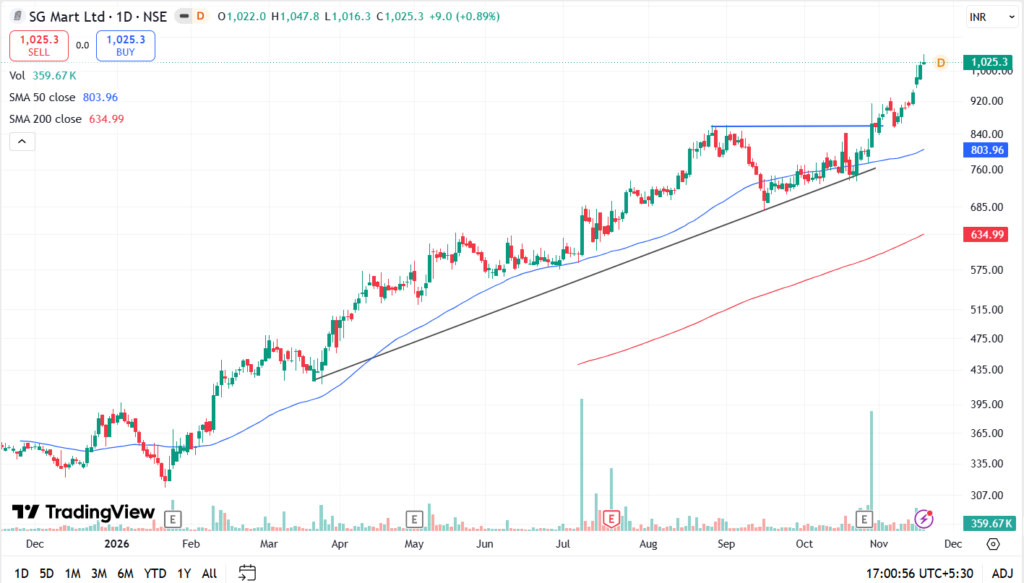
A clean uptrend, with high relative strength through the recent small cap volatility. The price did correct during the September – October small cap correction but this was one of the first stocks to recoup the previous high and has gone on to make a new ATH since.
If anything, investors will need to check if the price trend is overheated right now rather than see if the trend is healthy.
SG Mart Ltd Latest Latest Result, News and Updates
SG Mart Ltd Quarterly Results
While revenue fell and volume fell YoY, The underlying EBITDA profitability jumped 157% to ₹72 Cr, and the EBITDA% increased from 1.6% to 4.6%. PAT doubled to ₹54 Cr (+104% YoY, +18% QoQ). Consol EBITDA/tonne went from ₹990 to ₹2,870 YoY. as management deliberately cutting low-margin trading and focusing on value added business. Value-added products (Solar + Profiles) are now 19% of revenue vs 4% a year ago. Solar was flat at 11k tonnes, but the 50k+ tonne order book and October bookings should lift H2.
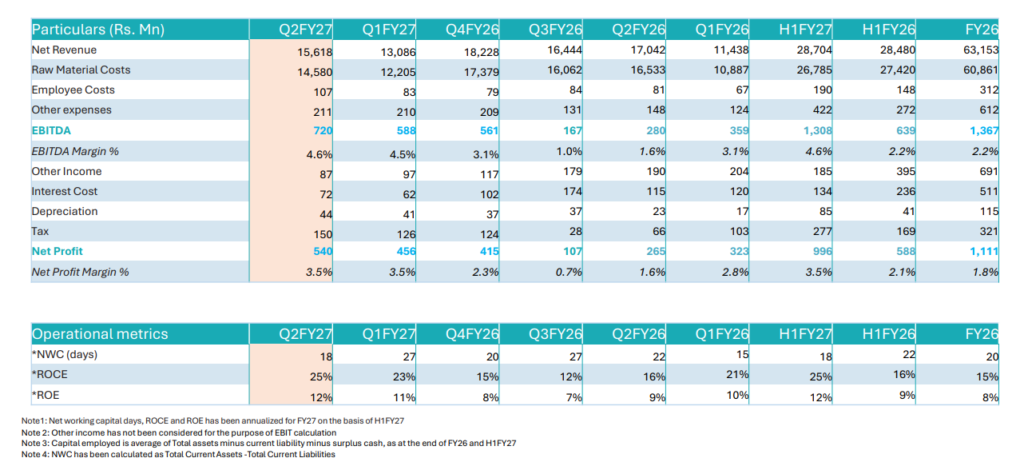
Management says there were no inventory gains. But back-calculating from segment volumes is pointing out that merged service-centre EBITDA is ₹2600-2800/tonne vs mgt no of 2000/tonne. This suggests there is likely ₹10-15 Cr Inventory Gain
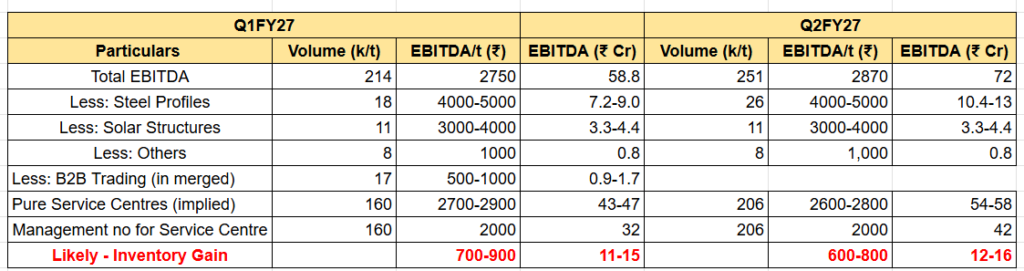
Q2FY27 – Trading volume is taken as zero, which is the conservative case.
Final Outlook On SG Mart Ltd
SG Mart Ltd is pivoting into a valued added steel service center plus manufacturing from being a trading heavy entity 12 months ago. The traction seen from service centers is already pushing the management team to execute faster than initially planned and to become more aggressive in their 5 year outlook. Value added segments like profiles, purlins and other products that fit into emerging industries like renewables, Pre Engineered Buildings and other structural elements. While top line growth will look muted for FY27 due to this business pivot, bottom line growth should be good and we expect to see FY27 PAT of > 200 Cr. With 700 Cr of cash on books, expansion won’t need further capital for at least another 18 months. The management team has indicated that the EBITDA margin is likely to increase by 150-200 bps from the current level of 400-450 bps over the next 3-4 years as the business pivots into higher manufacturing and value addition from the current levels. Risks to the business model emerge more from material availability rather than price fluctuations or from irrational competition.
SG Mart Ltd ticks our boxes on these parameters – long growth runway, right to win in the sector, limited organized competition, a capable management team and improving unit economics. If the management team is able to scale to 25 service centers by 2030, they would have built a capacity of > 3.5 mn MT. This is clearly a business where execution momentum has picked up steam over the past 3 Q’s with improving unit economics and cash flow. The business is expensive no doubt but that is because the market is pricing in the improved guidance for the next 2-3 years.
Investors will need to have clarity on their investment timeframe since the stock has seen a steep run up from 500 off to CMP > 1000 within 8 months since the beginning of FY27.
Disclosure: The stock has been part of one of our offerings (Emerging Business research) for a few months now. Our acquisition price is lower than CMP. We may hence be biased in our views on the business and the stock.
Disclaimer – This note is part of a business research & analysis series on small companies, there is no BUY/SELL recommendation or target price issued as part of this to a general audience. There is no assurance that this stock makes for a good investment, there is no guarantee that this stock will continue/be included in the coverage universe of Congruence Advisers. The note contains some forward-looking statements and insights drawn from the historical results, annual reports and investor presentations; they are to be viewed only within this context and not as a prediction of future performance of the business or the stock covered.
While due care has been taken to ensure that the information here is as accurate as possible, Congruence Advisers disclaims any liability in case of any unintentional inaccuracies.
The content does not constitute investment advice.