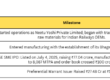
Krishna Defence & Allied Industries Ltd is a defence company, providing critical systems and components to the Indian Navy and Commercial shipping industry. Krishna Defence & Allied Industries Ltd was initially started as a small dairy equipment manufacturer and has become a niche defence manufacturing company focused on high-end, import-substitution products. Krishna Defence & Allied Industries Ltd was initially listed on NSE Emerge platform and has been migrated to NSE main board in FY26
TABLE – T1
Krishna Defence & Allied Industries is one of the few listed niche plays on India’s Navy indigenisation, commercial shipbuilding and other niche defence programmes. It holds a leading position in its existing products, and the new ventures look promising, but execution needs to be tracked closely. If these are executed well, we believe the story could offer a long runway of growth.
Krishna Defence & Allied Industries Ltd Company Summary
Krishna Defence & Allied Industries Ltd started in 1997 as a small engineering business founded by Late Ashwin Shah, who had expertise in both mechanical and electrical engineering. It began as a very small setup with just ₹10 lakh of capital, approx 12 employees and a small 2,000 sq. ft. shed in Kalol, Gujarat (which is about 40 kilometers from Mumbai)
In its early years, Krishna Defence & Allied Industries Ltd focused only on the dairy industry and started manufacturing products like stainless steel milk cans (Improves milk hygiene), milk cooling tanks, and milking machines. Even though the end market was dairy, the core strength of Krishna Defence & Allied Industries Ltd was always engineering and manufacturing capability.
The turning point came when Krishna Defence & Allied Industries Ltd decided to enter the Defence Sector and their trajectory changed significantly around 2006-2008 when they got an opportunity to indigenize a product for the Indian Navy. They took on the highly complex challenge of developing DMR249A grade steel “bulb bars”. These are specialized steel profiles used as stiffeners in the hull construction of naval warships, providing a strength-to-weight ratio three times higher than normal structural steel. Prior to this development, these critical components like bulb bars were solely imported from Russia. It took Krishna Defence & Allied Industries Ltd about 4 years of continuous research and development to successfully create the product. By doing so, they achieved the first successful indigenous production of bulb bars in India, which solved a major import dependency for the Indian Navy
After successfully entering defence, Krishna Defence & Allied Industries Ltd continued to expand its product portfolio into more complex, niche and high value areas. It developed products like zero magnetic permeability steel used in naval vessels, complex alloy weld consumables for high-strength applications, and also took technology transfers from DRDO for products like high-altitude heating systems used in extreme conditions. Krishna Defence & Allied Industries Ltd is also working on new opportunities such as modular barriers, launch systems, and even ammunition development for naval applications.
Today, Krishna Defence & Allied Industries Ltd has completely transformed its business. Around 96% of its revenue comes from defence, while the dairy segment contributes only a small portion.
Funding history: 3 Fund raises in Under 2 Years
Across the IPO and two preferential rounds, the company has raised about ₹97.7 Cr (headline value, including warrants).
1. IPO (March 2022)
The ₹11.89 Cr issue was entirely fresh with no promoter selling. Of this, ₹9 Cr was used for working capital and the balance for general corporate purposes.
The issue was priced at ₹39 and drew an overall subscription of about 75x. Demand came mostly from non-institutional investors (159.9x) and retail (132.1x), while the QIB portion was subscribed 8.84x. The market maker took 5.11% of the issue. Hem Securities was the lead manager and Bigshare Services the registrar.
Krishna Defence & Allied Industries Ltd stock listed on April 5, 2022 at ₹75, a premium of roughly 92% over the issue price, valuing Krishna Defence & Allied Industries Ltd at about ₹86 Cr.
2. Preferential Allotment 1 (January 2023)
9 months after listing, Krishna Defence & Allied Industries Ltd issued 12,00,000 convertible warrants at ₹140, raising ₹16.80 Cr. The price was about 3.6x the IPO price.
Promoter group members took 3,54,000 warrants (about 30% of the issue); Mrs. Preyal Ankur Shah (2,52,000) and Mrs. Pallavi Ashwin Shah (1,02,000).
The other 8,46,000 warrants went to non-promoter investors, led by Mr. Ashish Ramesh Kacholia (4,20,000). Four others, Mr. Sumesh Parasrampuria, Mr. Dilip Chheda, M/s Zyana Developers LLP and M/s Credent Asset Management, took 99,000 each, and Mr. Mitul Mehta took 30,000.
3. Preferential Allotment 2 (January 2024)
In January 2024, Krishna Defence & Allied Industries Ltd again raised capital (its biggest in terms of quantum) at ₹304/share, about 2.2x the Pref 1 price and nearly 8x the IPO price. The round was split into two parts, with a combined headline size of about ₹69 Cr.
(a) Convertible warrants: ₹26.14 Cr
Krishna Defence & Allied Industries Ltd issued 8,60,000 convertible warrants at ₹304 to 8 investors, with an 18-month window for conversion. Promoters participated in this round also. Mr. Ankur Ashwin Shah subscribed to 2,00,000 warrants, about 23% of the tranche.
The remaining 6,60,000 warrants were subscribed by other investor like Mr. Arun Kumar Ganeriwala: 1,50,000, Mr. Shlok Savjani, Mr. Shaurya Jagesh Savjani, Bhagyoday Oil Industries, Mr. Vivekkumar Mahesh Jalan and Zyana Developers LLP: 1,00,000 each & Mr. Jay Mukesh Shah: 10,000
(b) Direct equity: ₹42.89 Cr
Krishna Defence & Allied Industries Ltd also allotted 14,11,026 equity shares at ₹304/share, raising ₹42.89 Cr in cash. This tranche went to 24 non-promoter investors. The largest allottees were Monika Garware (3,50,000 shares), Vineet Kaul (2,00,000), Rajat Goenka (1,50,000) and Shalu Aggarwal (1,48,026), followed by Mehak Finpro India and Archna Khatri at 1,00,000 each. The rest were smaller allotments, including a few corporates and an HUF.
While the decision to raise equity is a function of the business model and growth rates. Defence supply carries long working capital cycles, so working capital absorbs a large part of every incremental growth With growth rate at north of 30%, internal accruals alone cannot fund this need and the management has chosen to meet the gap through staged equity raises rather than debt on the balance sheet.
Although one can debate on frequent fund raises, what we find encouraging is that promoters participated in both preferential rounds and decided to put their capital alongside outside investors, and in the second round too at nearly 8x the IPO price.
Krishna Defence & Allied Industries Ltd – Management Details
Krishna Defence & Allied Industries Ltd is a promoter led and promoter run company, with a layer of professional management supporting the founding family. The business was launched by Late Mr. Ashwin N. Shah in 1997, and the 2nd generation is now at the helm.
Mr. Ankur Ashwin Shah (Promoter and Managing Director) is a Production Engineer from the University of Bombay. He joined the business in June 2000 and has over 24 years of hands-on experience in specialised steel alloy processing, smelting, rolling, drawing and heat treatment. He is responsible for overall corporate strategy and business operations.
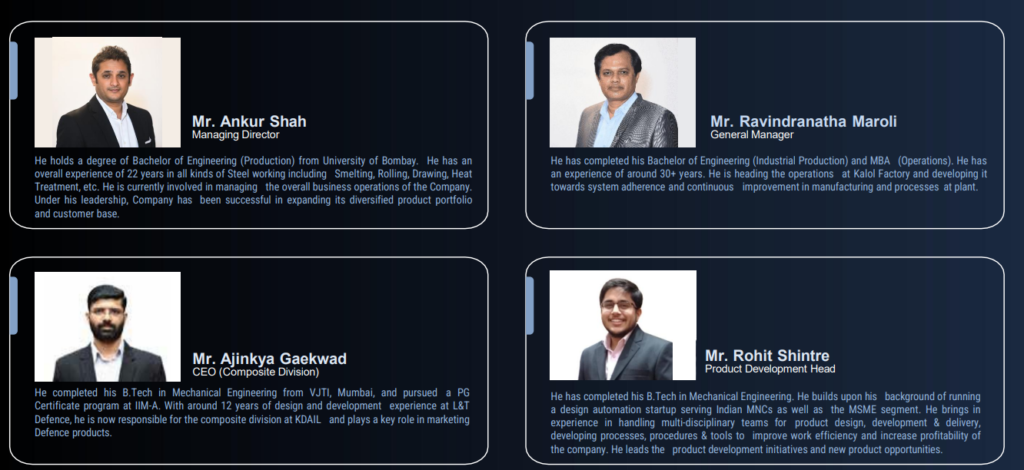
Mr. Manish Shah (Chief Financial Officer) is a Chartered Accountant, appointed on April 11, 2026, following the resignation of Mr. Piyush Patel on April 7, 2026.
Both Mr. Ankur Shah and Mr. Manish Shah take part in the earnings calls actively. The calls are coordinated and moderated by Krishna Defence & Allied Industries Ltd investor relations partner, Kaptify Consulting.
Krishna Defence & Allied Industries Ltd – Industry Analysis
Global Marinetime
Modern global economic dominance is fundamentally anchored in maritime power. Across the Asian economic corridor, industrial dominance has historically been defined not just by the volume of goods traded, but by the sovereign control of the vessels that transport them. Industrial powerhouses like China, Japan, and South Korea have seamlessly integrated their trade ecosystems by capturing the global shipbuilding market and commanding massive merchant fleets. Collectively, these nations control nearly 97% of global shipbuilding, transforming maritime logistics from a transactional cost into a strategic economic moat.
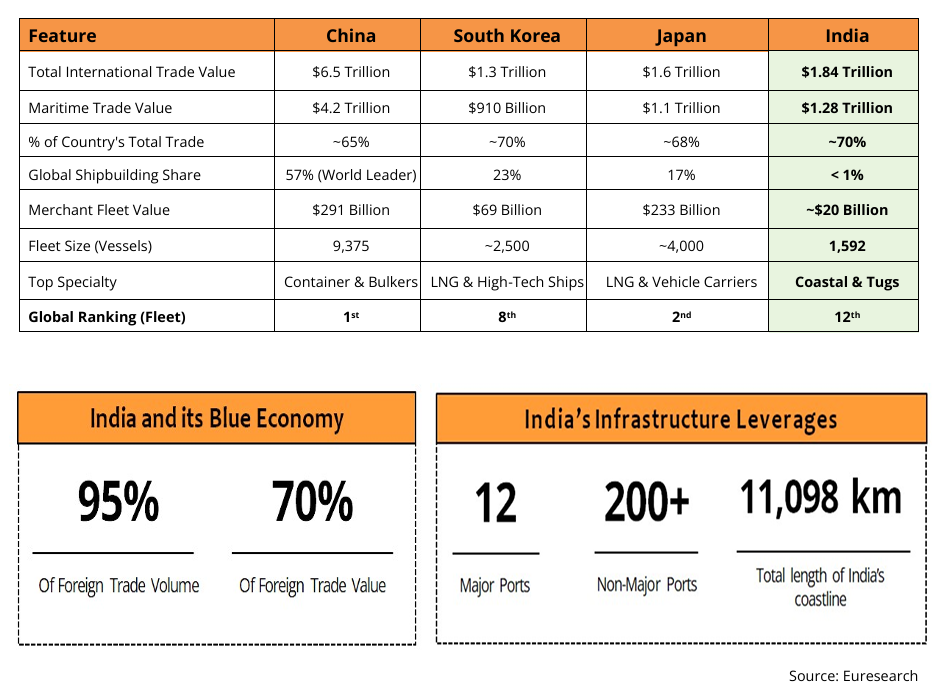
India has an 11,098 km coastline, 12 major ports and over 200 non-major ports. Yet its shipbuilding capacity is very small compared with the trade it supports. India depends on the sea more than most people assume. About 95% of foreign trade by volume and 70% by value moves by sea. Yet India contributes less than 1% of global shipbuilding output and carries only ~5% of its own EXIM cargo on Indian-flagged vessels. This dependence has resulted in significant freight outflows and exposed the need to build greater domestic maritime capacity.
INDIA DEFENCE INDUSTRY OVERVIEW
India has one of the world’s largest militaries, and the government is trying to move it from buying equipment abroad to making it at home. Indigenous production of defence equipment is central to “Make in India” and “Aatmanirbhar Bharat”. Since the sector was opened to private players, their share of manufacturing has kept growing, and the large defence manufacturers are now focused on designing and developing indigenous weapons and other essential products.
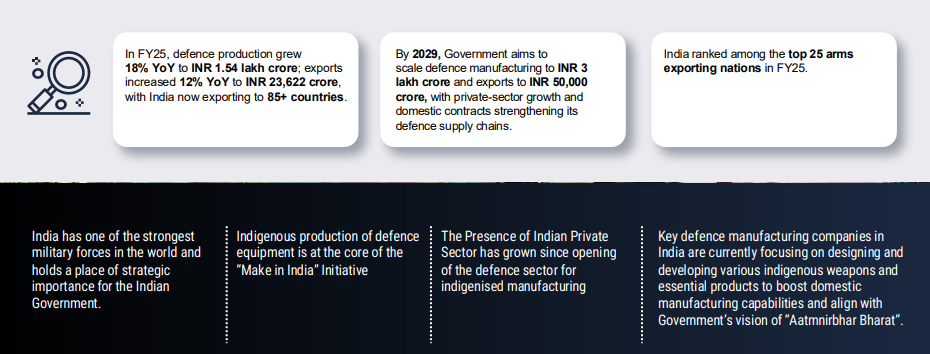
Govt Aims to double production from ₹1.54 lakh Cr to ₹3 lakh Cr needs roughly 18% CAGR over four years (FY25 to FY29). Exports need roughly 20% CAGR to go from ₹23,622 Cr to ₹50,000 Cr. Larger participation means more work for tier-2 and tier-3 suppliers of materials and components, which is where Krishna Defence & Allied Industries Ltd sits.
Within Indian defence, the three largest market segments are military fixed-wing aircraft, naval vessels and surface combatants, and missiles and missile defence systems. Other segments include military rotorcraft, submarines, artillery, tactical communications, electronic warfare and land vehicles.
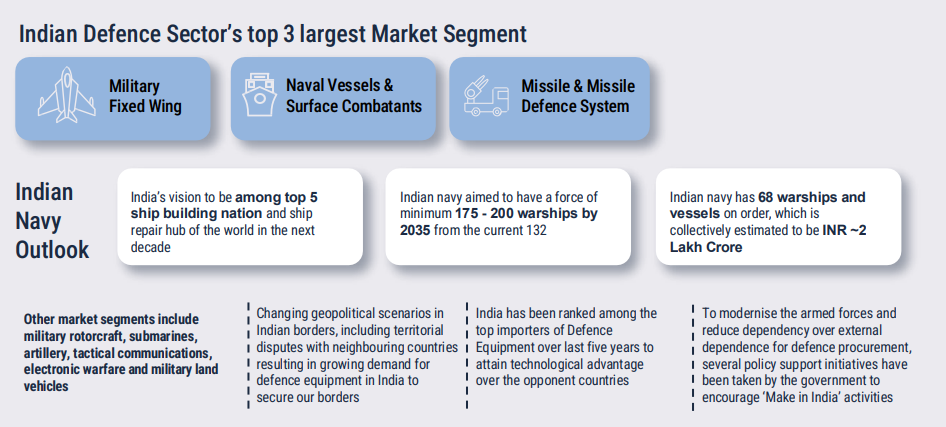
Demand is driven by geopolitical issues like territorial disputes with neighbouring countries that have raised the need to secure borders and sea lanes. The second is import dependence: India has been among the world’s top defence equipment importers over the last five years, and the government has introduced several policy measures to encourage “Make in India” and cut that dependence.
The Indian Navy is planning for a much larger fleet. It currently operates about 132 warships and aims to reach 175-200 by 2035, which implies adding roughly 43-68 vessels in under a decade, before counting replacements for ageing ships.
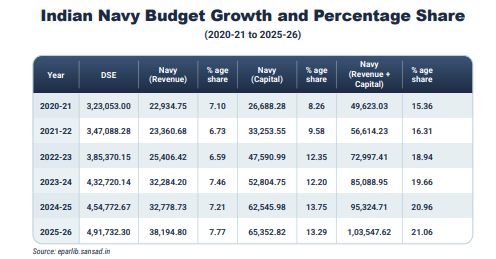
The Navy’s budget has doubled from ₹49,623 Cr in FY21 to ₹1,03,548 Cr in FY26. Its share of that budget has risen from 15.4% to 21.1%. Capital spending, which funds new ships and is what drives orders to the shipyards, has led the growth. It rose about 2.4x from ₹26,688 Cr to ₹65,353 Cr (about 20% CAGR) and now makes up roughly 63% of the Navy’s budget, against 54% in FY21. Capital growth moderated in FY26 but on an absolute level is high and the direction supports the warship pipeline. While revenue spending grew more slowly relative to capital.
Capacity Expansion Projects by major Indian Shipyards
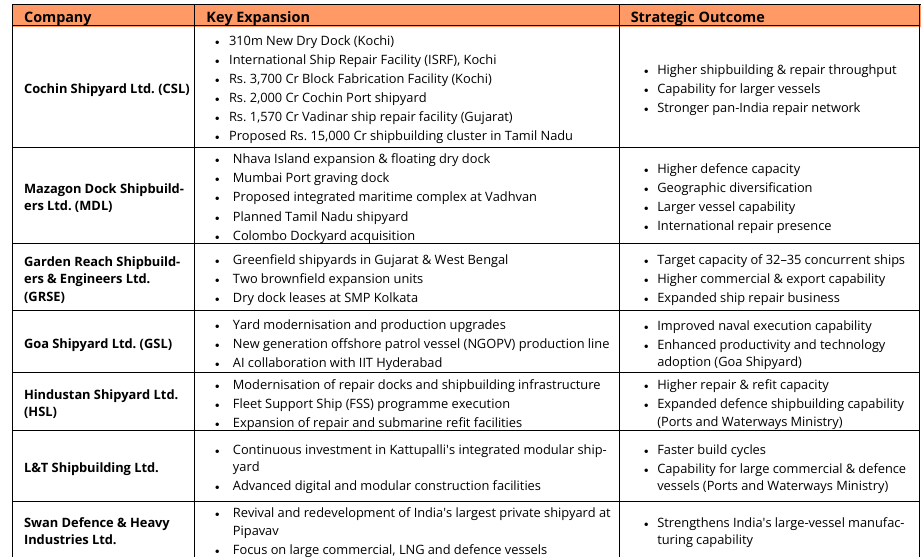
Major Indian shipyards, including Cochin Shipyard, Mazagon Dock, GRSE, Goa Shipyard, Hindustan Shipyard, L&T and Swan Defence, are adding dry docks, greenfield yards and fabrication capacity to build more ships at once.
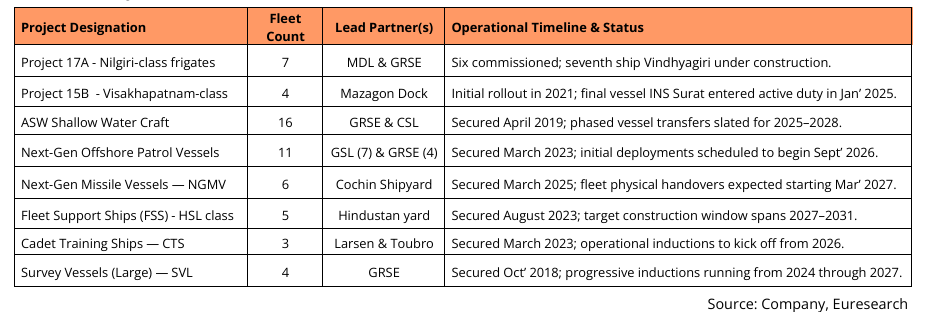
MAJOR ONGOING SHIPBUILDING PROGRAMMES OF THE INDIAN NAVY
Eight major programmes covering about 56 vessels are under way across MDL, GRSE, CSL, GSL, HSL and L&T, with orders secured between 2018 and 2025 and deliveries running to 2031. Several of the newer ones (the next-generation offshore patrol vessels, missile vessels and fleet support ships) are early in their build.
MAJOR PLANNED SHIPBUILDING PROGRAMMES OF THE INDIAN NAVY
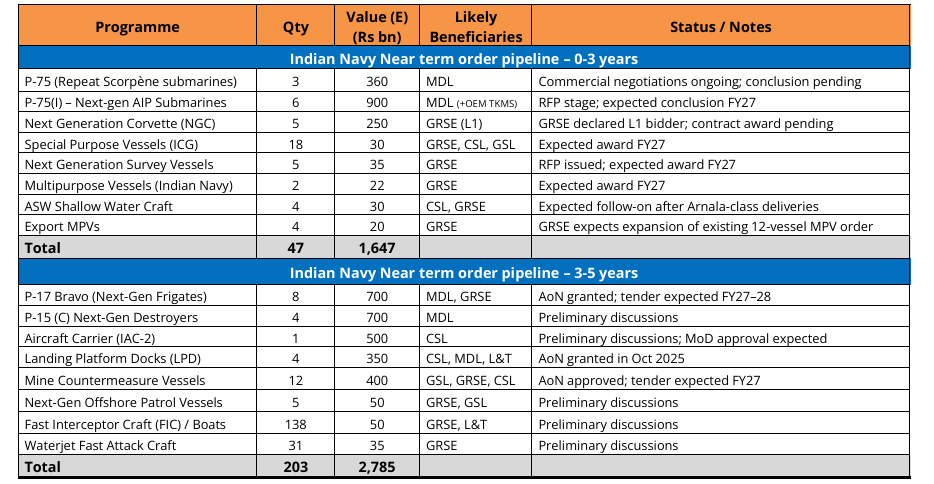
Beyond ships already under construction, the Navy has a planned pipeline of about 250 vessels. The near-term bucket (0-3 years) has 47 vessels worth about ₹1.6 lakh Cr, including the P-75(I) submarines, five next-generation corvettes where GRSE is the L1 bidder, and several awards expected in FY27.
The 3-5 year bucket adds 203 vessels worth about ₹2.8 lakh Cr, led by next-generation frigates and destroyers, landing platform docks, mine countermeasure vessels and an aircraft carrier. Taken together, that is more than ₹4 lakh Cr of potential orders, mostly flowing to MDL, GRSE, CSL and GSL
The three listed PSU shipyards have steadily raised their output of defence vessels. Between March 2021 and March 2026, Mazagon Dock’s warships delivered rose from 25 to 33 (and submarines from 5 to 8), GRSE’s from 107 to 118, and Cochin Shipyard’s defence vessels from 20 to 33, with its small and medium vessels up from 83 to 129.
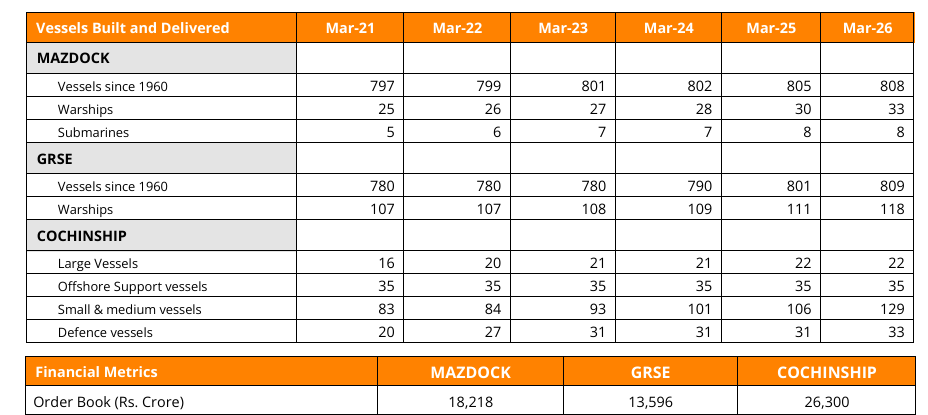
Together they hold an order book of about ₹58,000 Cr (MDL ₹18,218 Cr, GRSE ₹13,596 Cr, CSL ₹26,300 Cr), which is the work still to be built over the coming years.
Every indicator in the above points to rising naval ship construction and Krishna Defence & Allied Industries Ltd sits at the start of that chain. Its main product, the bulb bar, is the hull stiffener, which is needed in the first two years of a build. Management says it receives its purchase order within about a month of a yard winning a ship order, so Krishna Defence & Allied Industries Ltd is paid early in the cycle, well before a ship is delivered. That makes the shipyards order books, their capacity expansions and the Navy’s pipeline of programmes leading indicators of its own order flow.
Krishna Defence & Allied Industries Ltd – Business Details
Krishna Defence & Allied Industries Ltd operates two business segments: Dairy Segment, the legacy business, which now contributes >10% of revenue and Defence Segment, the future growth engine, which accounts for the majority of revenue and is scaling rapidly.
Dairy Segment – Krishna Defence & Allied Industries Ltd initially by manufacturing dairy equipment to improve hygienic milk collection and storage in India.
The dairy equipment is exclusively manufactured at Krishna Defence & Allied Industries Ltd’s older unit located in Kalol, Gujarat. This dedicated facility spans approximately 40,000 square feet.
Revenue contribution is around >10% now ( it used to be 50%) The dairy segment operates with an EBITDA margin in the range of 7-10%.
Product portfolio
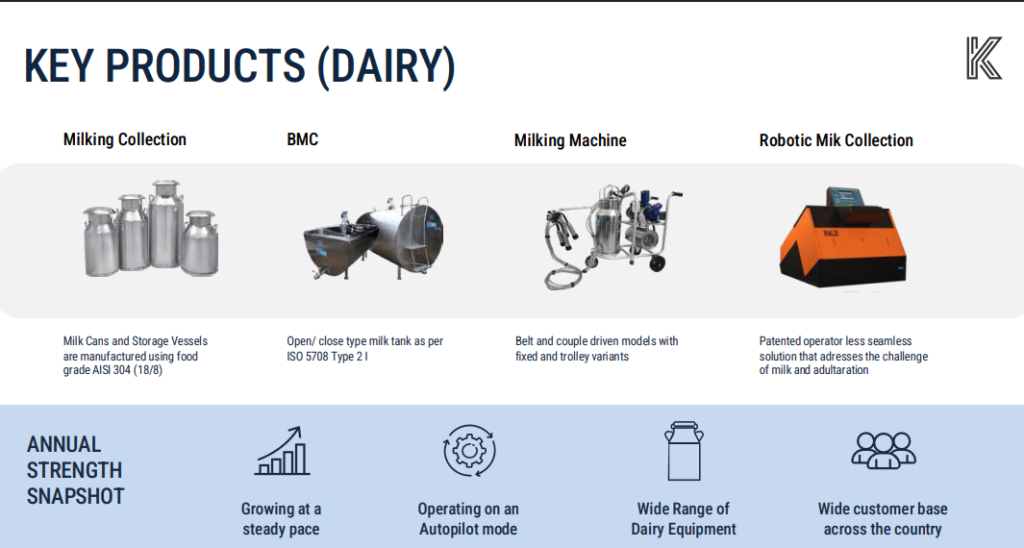
The range covers milk procurement, chilling and testing, backed by in house engineering and R&D
- Robotic Milk Collection Unit (RMCU) – The flagship product and a patented technology, with the patent valid up to 2035. It works as an automated kiosk for village milk collection societies. It measures weight, FAT, SNF, density, protein, lactose, added water, temperature and freezing point in one go. It detects adulteration and rejects sub-standard milk. It also removes manual milk handling, generates summary reports and doses cleaning chemicals and water automatically.
- Bulk Milk Coolers (BMC) – Stainless steel chilling tanks from 300 to 10,000 litres, built to ISO 5708 Type 2 standards, with energy-efficient condensing units, multiple cooling circuits and a microprocessor-controlled system. The company has also developed a Solar BMC variant.
- Stainless steel milk cans – Food-grade AISI 304 (18/8) stainless steel, in sizes from 5 to 50 litres. They are corrosion and crack resistant and easy to clean.
- Milking machines – Belt and couple-driven models, in fixed and trolley variants.
- Traded items – Milking parlour components and cow grooming brushes, bought out and sold on a continuing basis.
- Allied institutional kitchen equipment – Bulk cooking gear such as rice and dal cauldrons and distribution vessels, supplied to large mid-day meal operators including The Akshaya Patra Foundation.
Krishna Defence & Allied Industries Ltd distributes its dairy equipment across India through state milk federations, district cooperative unions, and private dairy processors via public tenders, GeM portal listings, and industry trade expos.
Customers include the Panchmahal District Co-operative Milk Producers Union, Hatsun Agro Products, Bihar State Milk Co-operative Federation (COMFED), Amritsar Milk Union (Verka), Thanjavur Milk Union (Aavin), Pune’s Katraj dairy union and Delicia Foods.
The dairy business is a traditional segment for Krishna Defence & Allied Industries Ltd that currently runs on auto-pilot mode, meaning it is self-sustaining, profitable, and requires minimal day-to-day intervention from top management, which allows them to focus heavily on defence. management has explicitly stated that they do not plan to demerge or shut down the dairy segment. It remains a valuable part of their business. Furthermore, their R&D team continues to work on upgrading this segment, currently developing new automation features that will allow dairy tanks to be cleaned automatically and remotely while maintaining a digital database of operations.
Defence Segment
Defence is now about 90% of revenue, and we think of it as two layers. The first is a set of established products that make up almost all of today’s sales are bulb bars (about 60% of FY26 revenue), weld consumables and armoured steel profiles (about 15% each) and the rest in smaller lines.
The second is a group of newer bets that are still in development or early trials and add little to revenue so far but hold good potential if executed well.
Shipbuilding and marine structural products
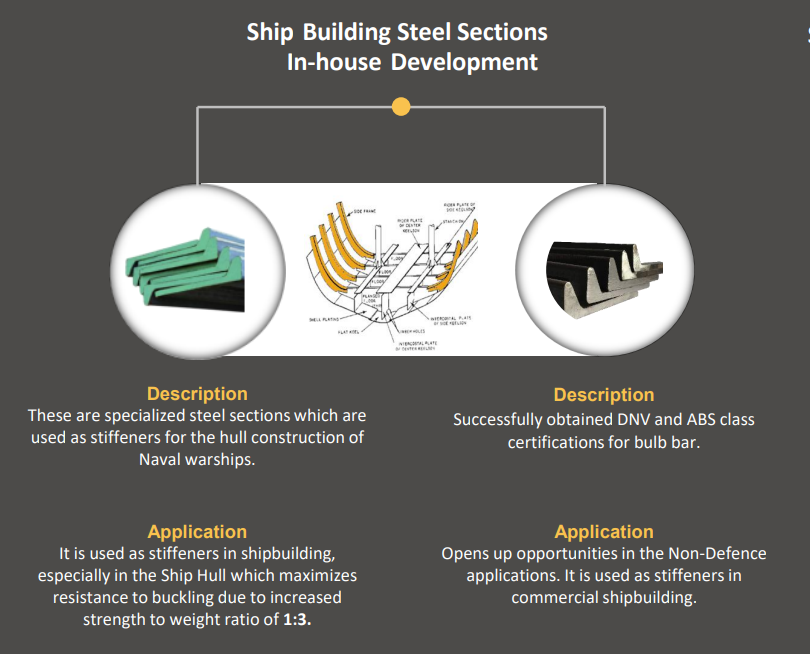
Ship Building Steel Sections (Bulb Bars) – This is the Krishna Defence & Allied Industries Ltd ‘s flagship product and oldest product in defence vertical and this product has been successfully indigenized after previously being imported solely from Russia.
These specialized DMR-249A grade steel sections act as hull stiffeners for warships, featuring a 3x strength-to-weight ratio compared to conventional steel. They allow shipbuilders to reduce deadweight, increase speed, and add stealth features and allows the ship to carry more ammunition and personnel.
A bulb bar takes that same metal and concentrates it into a rounded bulb at the top, right where the stress actually is. The web below is thinner because it doesn’t need to be thick,the stress there is tiny anyway.
- India began domestic production of bulb bars in 2011 under the Naval Indigenisation programme.
- Bulb bars are the primary revenue driver for Krishna Defence & Allied Industries Ltd, contributing roughly 50%-60% of the total defence revenue (and occasionally up to 65%-70% depending on the quarter).
- On a tonnage basis, bulb bars make up roughly 10% to 15% of a warship’s total weight (much lower in ship’s value likely less than 2%),
- An aircraft carrier typically requires approximately 4,000 tonnes of bulb bars, a standard warship around 1,500 tonnes, and a patrol vessel roughly 200 tonnes.
- Because ships require various profiles, Krishna Defence & Allied Industries Ltd manufactures 19 different sizes of bulb bars.
- Their initial capacity was 2,000 to 2,500 tons annually, which has now been expanded to 4,000 – 4,500 tons to meet growing Naval demand.
- The average realization is around ₹5 lakhs to ₹6 lakhs per ton.
- This is a highly restricted market with only two approved vendors in India (Krishna Defence & Allied Industries Ltd and Delhi-based Star Wire).
Krishna Defence & Allied Industries Ltd recently obtained IRS, DNV, ABS and AS9100D
class certifications, allowing these bars to be sold for non-defence commercial shipbuilding and Coast Guard vessels, which will drastically open up their addressable market.
DNV, IRS & ABS are independent technical organisations that inspect and certify ships, marine equipment, and naval products. Without their certificate, no product can legally be installed on a warship or commercial vessel anywhere in the world. They are the maritime equivalent of a building safety inspector except their approval is accepted globally.
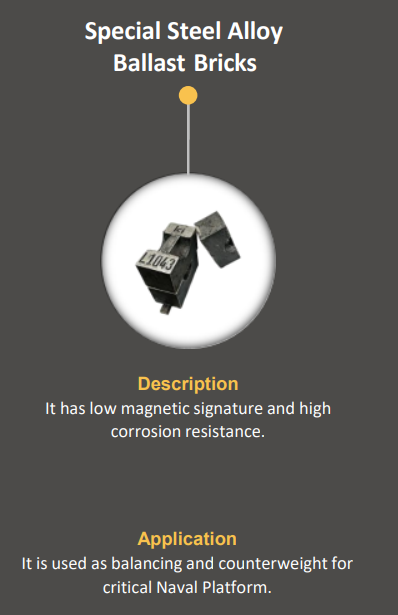
Special Steel Alloy Ballast Bricks – These are complex alloy bricks used as balancing and counterweights for critical naval platforms. Their key defining feature is their low magnetic signature (near-zero magnetic permeability), which makes the vessels extremely difficult to detect on enemy radar. They also offer high corrosion resistance, exceptional toughness, and high strength.
Special Steel Alloy Weld Consumables
Welding Wires, Electrodes & Fused Flux – Specialized welding materials formulated with complex chemistry (titanium, molybdenum, nitrogen, chromium, vanadium). Designed for high-tensile, long-seam, and robotic welding on surface warships and underwater vessels (rated for depths from 50 m to 300 m+)
A bulb bar cannot simply be bolted to a ship hull, bolts would loosen from constant wave vibration. Instead, it is permanently welded. The welding wire or electrode is the consumable (it gets used up) that melts and forms a solid alloy joint between the frame and the hull plate.
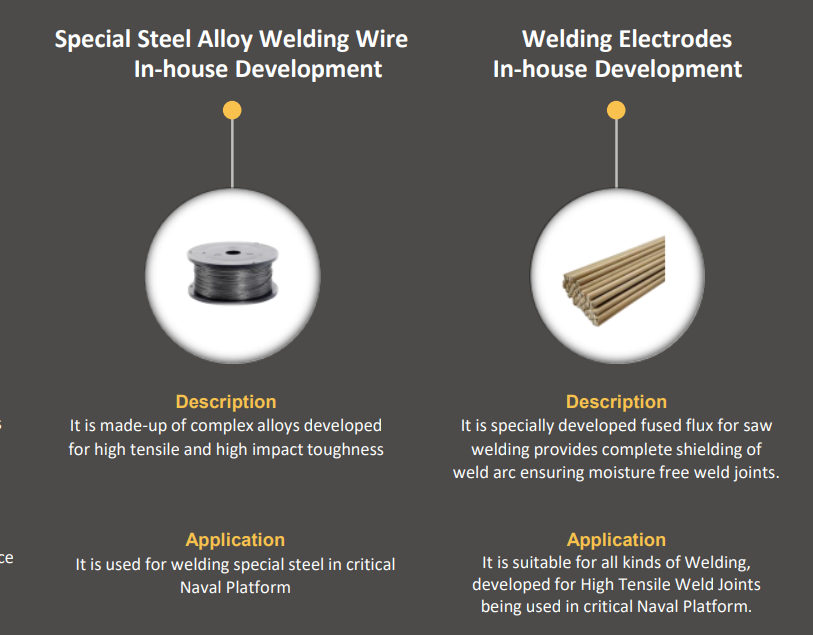
They are the second-largest product segment, contributing 15% to 20% of defence revenue on average.
There are multiple grades and each grade comes at a different price depending on what the kind of chemistry is. The range it starts somewhere in the range about Rs.20 lakhs are going onwards up to Rs.1 crore rupees a ton.
Krishna Defence & Allied Industries Ltd competes with only one other Defence Public Sector Undertaking (very likely Mishra Dhatu Nigam Ltd) for these products and enjoys a win rate of roughly 50% on incoming tenders.
Originally developed for critical naval hulls, these consumables are also being adapted for ISRO space platforms and BARC nuclear applications. Having established itself with the Navy, Krishna Defence & Allied Industries Ltd is now being approached by BARC and ISRO to develop super-alloy weld consumables that these organisations currently import. This could open up non-naval demand, though any revenue depends on development and qualification.
Land Systems & Armoured Vehicles
Armoured Steel Profiles (T-90 Tanks) – High-impact, high-tensile alloy chassis profiles supplied to the Heavy Vehicle Factory (HVF) for T-90 tank construction. Prior to Krishna Defence & Allied Industries Ltd ‘s development, these critical components were imported from Russia. They are designed to provide exceptional toughness and high strength for the army’s vehicles.
Krishna Defence & Allied Industries Ltd produces about 26 different variants and this segment contributes around 15-20% of defence revenues. The product has now officially moved into bulk supply for the Indian Army.
Homeland & Border Security Infrastructure – Modular vehicle barriers, automatic tyre killers, and IED containment vessels.
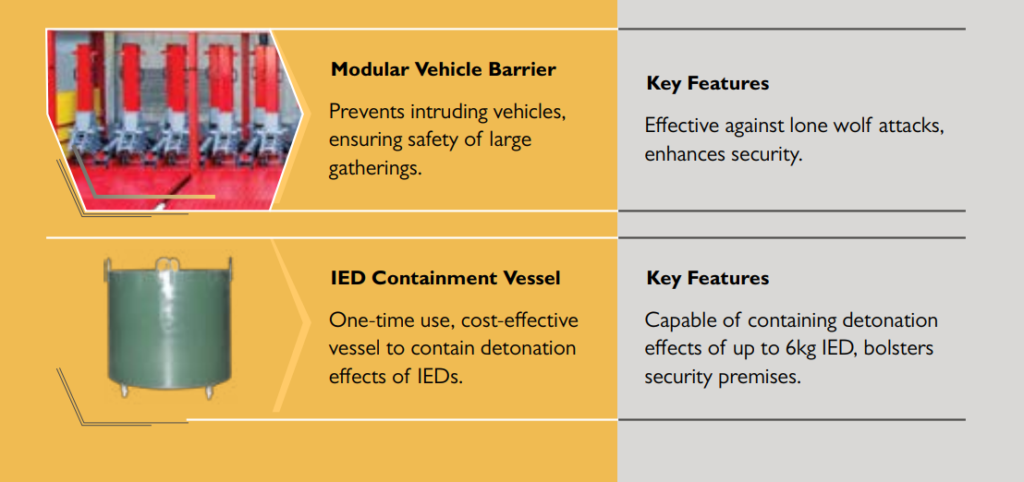
Modular Vehicle Barrier & Multi-purpose Launcher – Developed via tie-ups with companies from Belgium and the UK. The barriers are designed to prevent intruding vehicles and neutralize lone-wolf vehicle attacks during large gatherings
IED Containment Vessel – Developed in collaboration with R&DEE and DRDO, this is a cost-effective, one-time-use vessel designed to contain the detonation effects of Improvised Explosive Devices (IEDs). It is capable of safely containing the explosion of an IED weighing up to 6 kg.
Troop Comfort & High-Altitude Equipment
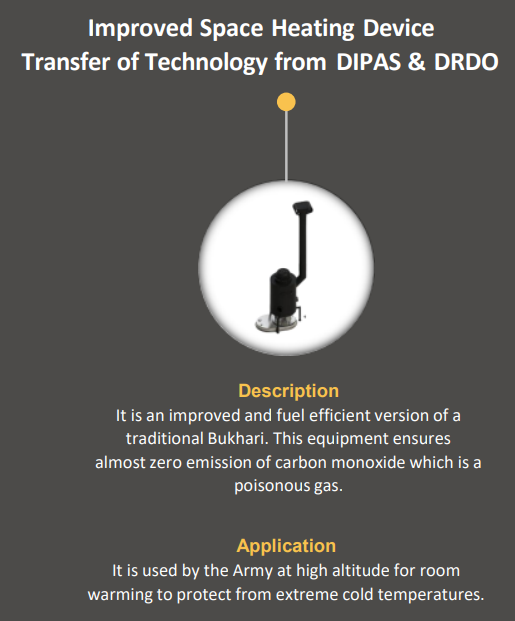
Improved Space Heating Device (Bukhari): Multi-chambered room heaters developed under DRDO (DIPAS) technology transfer. Engineered for extreme freezing altitudes (Siachen, Leh, Ladakh), their ducted design ensures complete fuel combustion without hazardous carbon monoxide emissions.
It features a small solar and electric fan ensuring complete combustion, resulting in zero emission of poisonous carbon monoxide. Its fuel consumption is 1/3 of the older models.
These heaters are used 18 hours a day, giving them a replacement lifecycle of 18 to 24 months, Krishna Defence & Allied Industries Ltd successfully secured and executed a major ₹64 crore order for them from ARMY
Raw material supply chain
Krishna Defence & Allied Industries Ltd’s main raw materials are special steel and stainless steel, and the exact input depends on the product for example –
- Bulb bars – DMR-249A grade steel plate, the core input.
- Weld consumables – Austenitic and special alloy steels containing titanium, molybdenum, nitrogen and vanadium, plus a specially developed fused flux that needs specific minerals and compounds.
- Other defence products – steel flat bars, aluminium sheets and aluminium round bars.
Because these are critical defence items, Krishna Defence & Allied Industries Ltd cannot buy steel on the open market. The special-grade plate must come from Navy-approved sources, and Krishna Defence & Allied Industries Ltd buys mainly from SAIL and Arcelor Mittal Nippon Steel (AMNS).
There are no long-term supply agreements with these vendors and purchases are made order by order, when a large defence order is won, Krishna Defence & Allied Industries Ltd books the material with the mill straight away and takes staggered deliveries, which helps manage supply and price swings. All incoming material is tested by the in-house quality team before it is cut and rolled.
Since the story is indigenisation, so sourcing is almost entirely domestic. About 97% of raw materials were indigenous and only about 3% were imported, and all stores and spares were sourced locally.
Krishna Defence & Allied Industries Ltd’s defence customers are the shipyards (MDL, GRSE, Cochin Shipyard, Goa Shipyard, Hindustan Shipyard and L&T), HVF/AVNL for armoured profiles, and the Army, with DRDO and the Navy as technology and qualification partners.
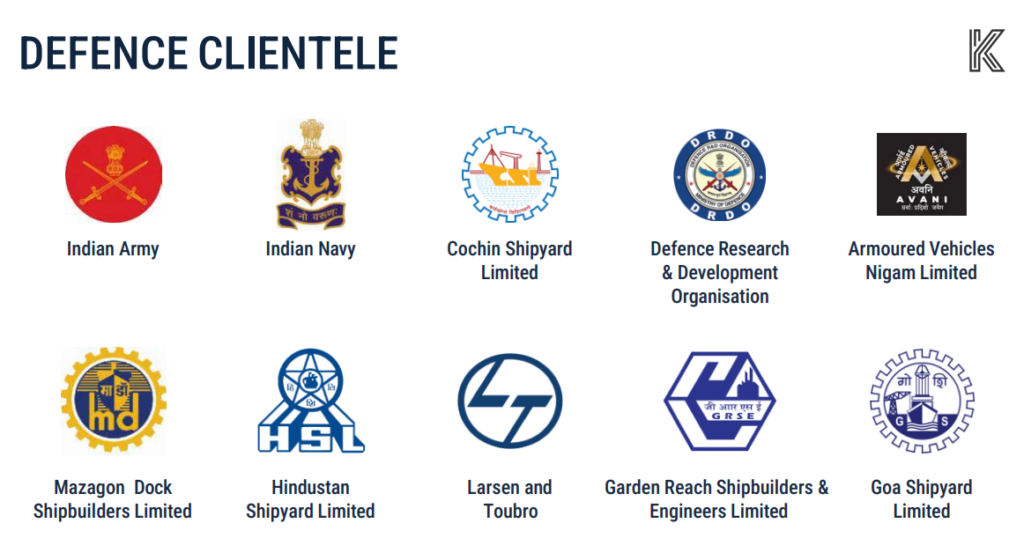
The Navy does not buy directly, it awards a warship contract to a yard, and within about a month the yard places a limited tender on GeM for hull steel with approval. The Navy and DRDO labs (DMRL, NMRL) work with Krishna Defence & Allied Industries Ltd directly on development, testing and sea trials, which lead to the vendor approvals that let it supply the yards.
Upcoming & Next-Gen Projects
Composite Doors and Hatches – Krishna Defence & Allied Industries Ltd has formed a 51:49 joint venture with VABO Composites B.V., (Dutch maker of naval composite doors that most European navies already use) to manufacture fire-resistant composite doors and hatches for the Indian Navy.
These composite products are meant to completely replace traditional heavy steel doors and hatches used by the Indian Navy. Moving to composite materials offers significant advantages, primarily drastically reduced weight and high resistance to corrosion. This weight reduction further enhances the stealth and speed features of the ship. Most advanced European navies have already transitioned from steel to composite doors for these exact reasons.
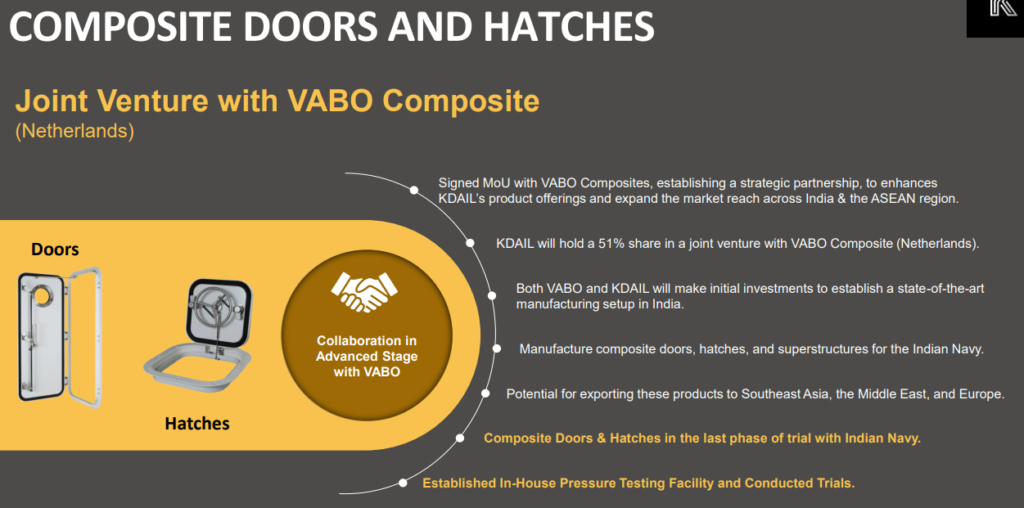
Strategic Joint Venture with VABO Composites
- To avoid starting from scratch, Krishna Defence & Allied Industries Ltd has signed a Memorandum of Understanding (MoU) and formed a Joint Venture (JV) with VABO Composites, a Netherlands-based company that is one of the largest manufacturers and world leaders in Europe for this technology.
- Krishna Defence & Allied Industries Ltd holds a majority 51% stake in this new JV company, while the foreign partner, VABO, holds 49%.
- The total initial investment to set up this operation is approximately 1 million Euros. Krishna Defence & Allied Industries Ltd is funding 50% of this investment (around ₹4.5 to ₹5 Crores), and VABO is funding the other 50%.
- This marks VABO’s first manufacturing operation outside of Europe.
TAM
- The total addressable domestic market for these composite doors and hatches is estimated to be between ₹200 Crores and ₹250 Crores. On a per-ship basis, it presents an opportunity of about ₹5 Crores to ₹6 Crores per ship, with 150 to 200 naval ships progressively coming up.
- Management anticipates this product line will independently bring in ₹50-100 Cr revenue. While initial revenues in starting might be small (around ₹10 Cr due to it being a new induction), it is expected to scale massively in the following years.
- Unlike many of Krishna Defence & Allied Industries Ltd ‘s other classified defence products (which cannot be exported), the JV with VABO was specifically structured to allow exports. By manufacturing in India, the JV will actively target export markets in Southeast Asia, the Middle East, and Europe
The Indian Navy plans to induct these new composite doors in two phases:
- Phase 1 (New Ships) – For the first 12 to 18 months, the composite doors and hatches will be exclusively installed on brand-new ships under construction to ensure the product performs flawlessly in fresh conditions.
- Phase 2 (Retrofitting) – Once proven successful on the newer ships, the Navy plans to start retrofitting and replacing the old steel doors on existing active warships. Ultimately, Krishna Defence & Allied Industries Ltd envisions a 10-year horizon where almost every Indian naval ship will be equipped with these composite doors.
Current Status – The facility for fire-resistant composite doors and hatches is in its final commissioning stages; pressure and fire tests have been completed successfully, and the products are in the last phase of Navy trials, with door production expected to begin in H2FY27
Defence Electronics
Through its associate company, Waveoptix Defence Solution Pvt Ltd (based in Bengaluru), Krishna Defence & Allied Industries Ltd has ventured into advanced electronic warfare and communication systems. Krishna Defence & Allied Industries Ltd has increased its strategic stake from 25% to 40%.
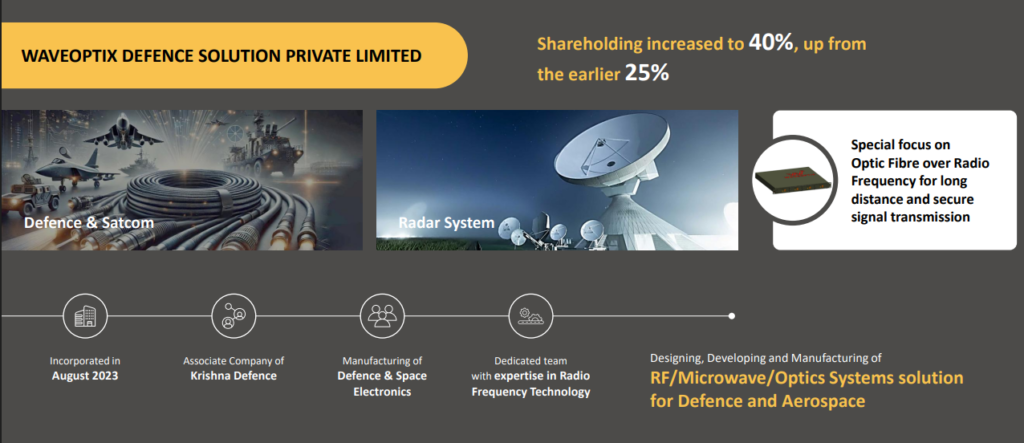
Radio Frequency over Fibre (RFoF) Systems – Waveoptix manufactures high-grade converters that translate radio frequency into optical fibre and vice-versa. This allows signal transmission to be pushed securely from 500 meters up to 30 to 40 kilometers inside borders, drastically improving the safety of frontline assets. keeping military assets and personnel safe from the front lines.
Their portfolio includes Bi-Directional RFoF for HF/VHF/UHF Radios, Multi-Link RF over Fiber for Submarine Radio Communication systems, Antenna Remoting Systems (1.5MHz to 3GHz), and 10-Channel phase-matched RFoF Links for Electronic Warfare (EW) COMINT systems.
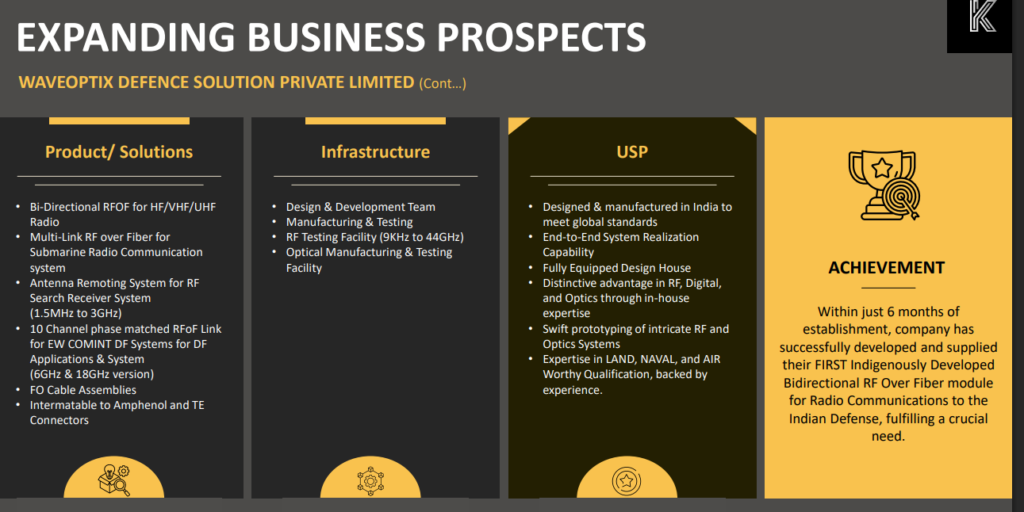
Waveoptix successfully tested 40 systems (costing ~₹9 lakh each) with the Army and anticipates bulk orders of 1,000 to 2,000 systems. They are upgrading the technology from 6 GHz to 40 GHz applications, anticipating an addressable market of ₹200 to ₹300 Cr over the next few years. Other applications include multi-link submarine radio communications and electronic warfare (EW) COMINT systems

Waveoptix 18 Cr Revenue in H1FY26 with PAT growing to roughly ₹5 Cr and Waveoptix has recently bagged first order for ₹3 Cr from L&T Defence. Waveoptix actively supplies these complex communication modules directly to meet urgent operational needs for the Indian Defence forces and the Indian Army and competes directly with two American companies for these tenders
Conceptia Software Tech (a ship/submarine design company) – Krishna Defence & Allied Industries Ltd holds a 20%
Conceptia is a ship and submarine design company based out of Bangalore with over 20 years of diversified experience handling both naval and commercial projects, Conceptia is considered perhaps the largest Indian player in the marine design market, boasting teams present across major Indian shipyards and the UAE.
Their core expertise lies in providing detailed engineering for all types of ships and offshore structures, basic vessel design, and pre-production support (such as the animation of events).
Conceptia has successfully completed more than 60 complex engineering projects for shipyards and ship-owners across the Middle East and the Asia Pacific region. Their prominent clientele includes major names like Garden Reach Shipbuilders & Engineers Ltd. (GRSE), Hindustan Shipyard Ltd., Reliance Defense & Engineering Ltd., Drydocks World Dubai, Sembawang Shipyard Pte., and Nkom-Qatar.
Conceptia printed 80 Cr revenue in FY26 with PAT of 5cr. Its order book was 25cr as of FY26-end, and management expects ~20% revenue growth in FY27.
Krishna Defence & Allied Industries Ltd bought 20% of Conceptia for ₹1.76 Cr, to move from supplying parts to offering design-to-build solutions. Conceptia’s designs can now be manufactured by Krishna Defence & Allied Industries Ltd, and Conceptia’s relationships give it a route into commercial shipbuilding and offshore projects in India and abroad. Management is open to raising the stake beyond 20% if the partnership brings in more manufacturing business.
Autonomous underwater vehicles (AUVs)
Krishna Defence & Allied Industries Ltd has two underwater programmes.
First is the C-Bot, a smaller AUV developed by CSIR-NIO Goa for ocean research. Krishna Defence & Allied Industries Ltd holds a technology transfer agreement for it, which gives the company a product it can build and sell to civilian and scientific buyers as well as to defence.
It has also formed X Sub Robotic Pvt Ltd, a joint venture with Planys (Chennai) and Conceptia Technologies (Bangalore), to build AUV capability. A dedicated AUV integration and testing facility is coming up in Chennai (~85,000 sq ft, with a 1,50,000-litre HIL testing tank and direct sea access for trials), which will also host the XL-AUV programme
KDAIL is developing AUVs using DMR 307 material, which will be able to operate at depths of up to 600 metres. Imported AUVs currently cost around INR 150 Cr per unit, while domestic production cost is expected to be roughly INR 50 Cr per AUV.
Jalkapi XLUUV
Jalkapi is India’s largest Extra-Large Autonomous Underwater Vehicle (XLUUV) 11m long, 20 tonnes, capable of diving to 300m and operating autonomously for 30-45 days on a single mission using an onboard diesel generator to recharge at sea.
The Jalkapi, is India’s largest AUV, designed by the Indian Navy for surveillance, hull inspection, mine countermeasures and seabed mapping. Krishna Defence & Allied Industries Ltd role is focused on structural fabrication of the pressure hull, leveraging its ability to roll and fabricate DMR-249A steel, the specialised naval-grade alloy used in its core bulb bar business. Steel-cutting began in June 2025, and management is targeting water trials by December 2026. It is a self-funded prototype with no grant and no binding order, only the Navy’s commitment to place follow-on orders if trials succeed. Autonomy software, sensors and power systems are outside its in-house skills, so it works with partners: SAIL for the naval grade plate, Rekise Marine (winner of the iDEX ADITI 1.0 challenge) on sub-systems and Xsub Robotics. A dedicated integration and testing facility is being set up in ChennaI
While other major defence contractors like L&T, Adani Defence, and Mazagon Dock Shipbuilders are also developing AUVs, they are working on different sizes and different platform programs based on their own capacities, meaning Krishna Defence & Allied Industries Ltd occupies its own specific niche with this massive vessel.
The Navy has earmarked about $1 Bn for autonomous underwater platforms, though that covers the whole segment and not any one product. We treat both programmes as long-dated options.
Smart ammunition
Krishna Defence & Allied Industries Ltd ‘s is working on its own ammunition for the Super Rapid Gun Mount (SRGM), the gun fitted on warships. As per management this ammunition is made today by a government ordnance factory and the Navy is reported to be unhappy with its quality and delivery, so much of the requirement is imported from Europe.
The Navy wants a domestic source, and the import ban cannot be applied until an Indian product is proven. Management sizes the need at over ₹1,000 Cr across the next 5 to 8 years. Progress has been slower than planned by management’s own account, moving more slowly than planned. Live explosives mean PESO licences and extensive military field trials, which management puts at two years or more once the design is final, and it will hold back heavy capex until then.
In May 2026, Krishna Defence & Allied Industries Ltd acquired a 46.81% stake in Taharabadkar Solutions, a company that won the Ministry of Defence’s iDEX-ADITI challenge and holds a ₹25 Cr Navy grant to develop smart ammunition for naval guns (Driven Ammunition Reduced Time of flight system) with Krishna Defence & Allied Industries Ltd investing additional 30 Cr. Development is expected to take 2-3 years.
Krishna Defence & Allied Industries Ltd Corporate Governance Analysis
Board composition – At March 31, 2026, the board had 5 directors, 3 of them are independent (60%). The chairperson, Mrs. Preyal Shah belongs to the promoter family. One whole-time director Mr. Sandeep Kadam passed away on March 27, 2026. Mr. Harshadsinh Mahida joined as whole-time director on June 17, 2026. The board is now 6, with 50% independent. The board met 9 times in FY26 with near full attendance. The audit committee is chaired by an independent director and is 2/3 independent, though the MD is a member
Promoter remuneration – The MD received ₹1.20 Cr in FY26, unchanged from FY25. That is about 3.1% of FY26 PAT vs 5.4% of FY25 PAT, and 56x the median employee’s pay. Mrs. Preyal Shah received ₹3.85 lakh in sitting fees.
Related party transactions – Krishna Defence & Allied Industries Ltd bought land and a building from Krish Industries, (where MD and the chairperson are directors) for ₹4.67 Cr, and two residential flats from the MD for ₹0.84 Cr. Krish Industries also holds a ₹0.50 Cr advance, and rent paid to it fell to ₹7.20 lakh in FY26 (vs ₹28.8 lakh in FY25). A ₹3.79 Cr advance to White Gold Technologies (director is a partner) was outstanding at March 2025 and was cleared in FY26.
Contingent liabilities – ₹37.6 Cr at March 31, 2026 (₹57.3 Cr in FY25), i.e 19.8% of standalone net worth of ₹190 Cr. Of that, ₹31.65 Cr is bank guarantees issued on the company’s behalf, for which it gave counter-guarantees, ₹5 Cr is the guarantee for Waveoptix, and about ₹0.95 Cr is disputed PF and customs claims. Excluding the bank guarantees, it is ₹5.95 Cr (3.1% of net worth). Liquidated-damages claims, which stood at ₹1.85 Cr in April 2024, are nil.
Dividend – ₹0.50 per share was paid in FY25 and the board has recommended ₹1.25 for FY26. That is roughly 5% of PAT (about ₹1.9 Cr), so the company retains most of its earnings. We read it as a sign of confidence and an early step toward shareholder returns though about 60% of it goes to the promoter group. We expect most free cash to go into growth, which is the right use at this stage.
Audit and other points – There are no auditor qualifications and no regulatory orders were reported. Krishna Defence & Allied Industries Ltd has no separate risk management committee. The cost, internal and secretarial auditors all changed this year. The consolidated accounts include ₹1.11 Cr of profit from an associate based on unaudited management figures.
A detailed corporate governance check would entail looking at these additional factors, if and when we get to writing a detailed initiation note on this business
- Intangibles involved in the business, do they form a big part of the balance sheet?
- Unit economics – do they fit into the normal range for a business of this nature?
- Is accounting complicated or simple? consistent or changes every few years?
- Consistency in disclosing FX losses/gains and MTM impact?
- Consistency in tax outgo in the cash flow statement and the P&L?
- Is the promoter family actively investing outside of the business- real estate, VC Funds?
- What other organizations are the promoters and directors associated with? Any history of defaults or frauds there?
- Any history of over the top speak by promoters/management in the media?
- Analysis of audit committee notes
- History of change/retention of statutory auditors & auditor remuneration trend
- Insights from credit rating reports
- Pending litigation against company & promoters?
It has been our endeavour over the years to enhance the scope and details of the corporate governance checks we conduct. However, the entire scope of this analysis would be an overkill at this stage of business analysis. This will be appropriate for a deep dive if and when a business is considered for inclusion in the portfolio.
Krishna Defence & Allied Industries Ltd Financial Performance
The order book rose from ₹18 Cr to a peak of ₹270 Cr in FY25, (1.75x of FY24 revenue). It then fell to ₹103.4 Cr in FY26 (0.42x of revenue).
Management has made the point in the earnings call that this dip is due to timing i.e 4-5 month procurement pause after Operation Sindoor pushed orders and shipyards now order in smaller batches with roughly 6 month delivery windows (against about 12 earlier). Bids under evaluation (₹289 Cr at June 2026) are not counted, and most are expected to convert in FY27.
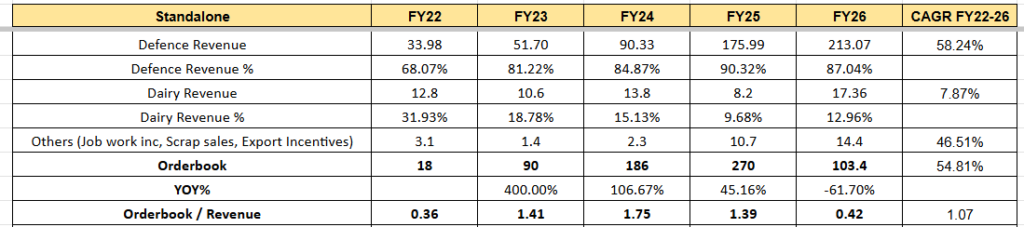
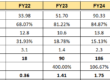
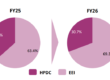
From FY22 to FY26, Defence revenue grew from ₹34 Cr to ₹213 Cr, a 58% CAGR, while dairy grew modestly at >8% CAGR. The mix has therefore shifted completely towards defence. The share has risen from about 68% of segment revenue in FY22 towards 90% in FY26.
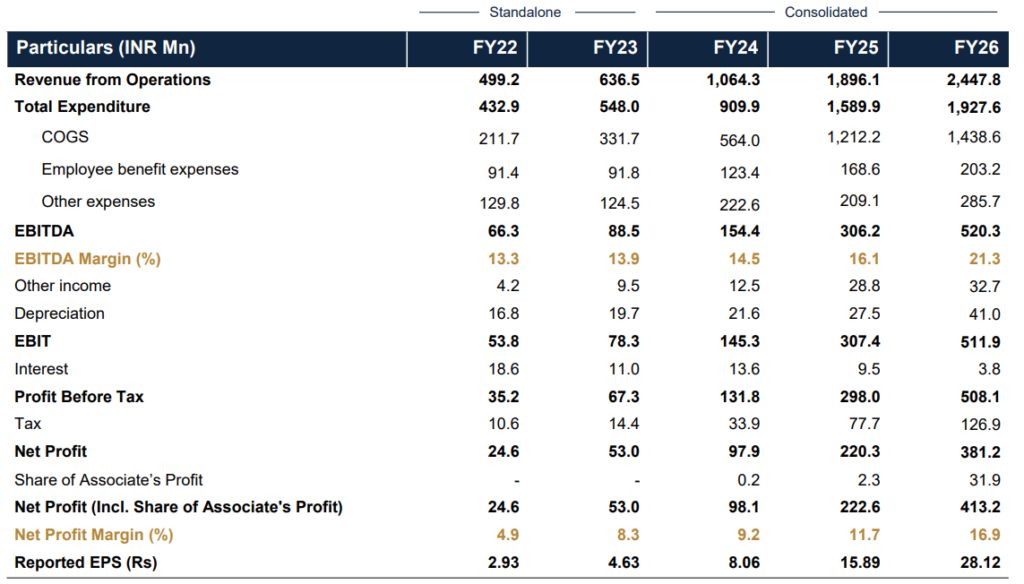
EBITDA grew at a 67% CAGR and margin expanded by 800 bps up to, the gain came from operating leverage, as employee and other costs fell from 44% to 20% of revenue on higher throughput. In FY26, overheads were flat and the gain came from COGS. Net profit grew higher at 102% CAGR, PAT outpaced EBITDA because due financial operating leverage as finance cost dropped sharply as Krishna Defence & Allied Industries Ltd repaid borrowings (through equity raise) and became debt free.
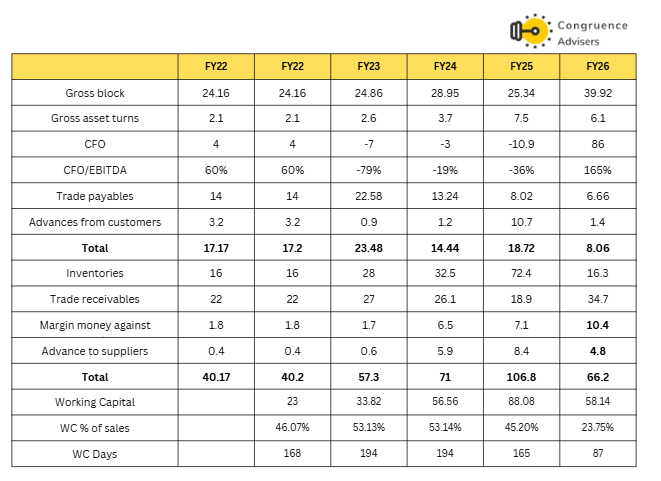
Cash conversion is the one area where Krishna Defence & Allied Industries Ltd needs to improve, and in that respect it looks like any other defence company. OCF was negative in the last 3-4 years to FY25, with working capital at 46-53% of sales. In FY25 inventory rose from to ₹72 Cr as they stocked material for a record order book and ramped up the new plant. FY26 looks like a sharp turnaround, with operating cash flow of ₹86 Cr (165% of EBITDA) and working capital down to 24% of sales, but part of that is timing. Inventory was only ₹16 Cr at March because a raw material shipment arrived in the first week of April, and management puts normal inventory at around ₹40-50 Cr. Restating at ₹40-50 Cr lowers FY26 operating cash flow by about ₹24-34 Cr to roughly ₹50-60 Cr, still positive, and lifts working capital to about 33-40% of sales.
Krishna Defence & Allied Industries Ltd is investing in automation and overlapping cycles to reduce inventory days. Payments generally happen as per agreed timelines except during year end, when payments are delayed due to Budget rollover.
Krishna Defence & Allied Industries Ltd Comparative Analysis
To understand Krishna Defence & Allied Industries Ltd investment potential, we have conducted a comprehensive analysis. This analysis includes comparing Krishna Defence & Allied Industries Ltd to its competitors (peer comparison) on various fundamental parameters and Krishna Defence & Allied Industries Ltd share performance relative to relevant benchmark and sector indices.
Krishna Defence & Allied Industries Ltd Peer Comparison
Krishna Defence & Allied Industries Ltd has no direct listed peer. In bulb bars, the other approved supplier to the Navy is understood to be Star Wire (India) Ltd, an unlisted special-steels maker (castings, forgings and rolled products) with FY25 revenue of roughly ₹1250-1500 Cr, about 5-6x Krishna Defence & Allied Industries Ltd’s size. In weld consumables, management says it competes with one defence PSU, believed to be MIDHANI. MIDHANI is listed, with FY26 revenue of ₹1,209 Cr (about 5x Krishna) and an order book of ₹2,290 Cr. It is a diversified specialty-metals company (specialty steels, superalloys and titanium), so weld consumables are a small part of its business. Neither company gives a like for like benchmark. The best comparison is MIDHANI’s financial profile: its EBITDA margin about 23% is close to Krishna Defence & Allied Industries Ltd ‘s 21%, but management guides to about 15% growth for FY27 against Krishna’s 30%+
Krishna Defence & Allied Industries Ltd Index Comparison
Krishna Defence & Allied Industries Ltd share performance vs S&P BSE Small Cap Index, as the index benchmark comparison is a fundamental tool for understanding the investment potential and making informed decisions in the context of the broader market
Table – T2
Why should you consider investing in Krishna Defence & Allied Industries Ltd ?
Krishna Defence & Allied Industries Ltd offers compelling reasons to track closely, and to consider for investors who want exposure to domestic defence, especially the Navy and shipbuilding.
Direct beneficiary of the Indian Navy’s warship pipeline – Domestic defence manufacturing is expanding under Atmanirbhar Bharat and the positive indigenisation lists, and the Navy plans to grow its fleet from about 132 to 175-200 warships by 2035. Krishna Defence & Allied Industries Ltd supplies hull stiffeners (bulb bars), so every frigate, destroyer or corvette awarded to the public shipyards (MDL, GRSE, Cochin Shipyard) creates demand for its product. Bulb bars account for roughly 10-15% of a ship’s steel by weight, so demand scales directly with the number of hulls built.
Hull material is needed first, so management says it receives its purchase order within about a month of the yard winning the ship order, and supplies mostly within the first two years of the build. Krishna Defence & Allied Industries Ltd is therefore paid early in the cycle, well before a ship is delivered, and a ship that takes four or five years to complete does not delay its revenue.
Venture into new verticals- Krishna Defence & Allied Industries Ltd evolving into a broader defence products provider, with composite doors and hatches, AUVs, tactical electronics and design-and-build capability all in progress. None of this is in current earnings, so each is an option. If executed well, these ventures can raise the mix of higher-value revenue, lift margins and widen the addressable market well beyond hull steel. Management expects them to reach commercial scale in FY28, and that could support the next round of re-rating. The upside depends on execution.
High entry barriers and an import-substitution moat – Krishna Defence & Allied Industries Ltd is one of only two approved domestic suppliers of DMR-249A grade steel bulb bars to the Indian Navy. The product was developed with DRDO’s DMRL and replaces sections that were earlier imported from Russia. Management says the supplier base has stayed at 2 players for 12-13 years. Qualifying a naval structural component takes roughly 24 to 36 months of trials and DGQA approvals, so a new entrant cannot appear quickly, and a customer has little reason to replace a vendor that is already approved and delivering. This gives Krishna Defence & Allied Industries Ltd a durable position in its largest product line, which was about 65-70% of defence revenue.
Krishna Defence & Allied Industries Ltd has also added certifications that open markets beyond the Navy. It holds class approvals from ABS, Bureau Veritas and DNV, which let it supply commercial shipbuilders, the Coast Guard and export-oriented builds (it already supplies Cochin Shipyard for a vessel being exported), and it holds AS9100D aerospace certification, which supports its move into aerospace components.
Clear medium-term growth guidance – Management guides to a 30%+ revenue CAGR over the next 3-5 years and aims to cross ₹500 Cr of revenue over the medium term, against ₹244.8 Cr in FY26. The target is consistent with the guidance at 30% a year, FY29 revenue would pass ₹500 Cr in about three years (about ₹538 Cr). The Navy’s fleet plans and the shipbuilding pipeline described earlier support the demand case. Krishna Defence & Allied Industries Ltd has also delivered growth close to this pace over a longer period with revenue up about 5x between FY22 and FY26.
Promoter alignment and management access – The promoters invested in both preferential rounds, The MD is a production engineer who joined in 2000 and understands the metallurgy that decides whether the company wins and executes orders.
Management is also accessible and candid. They take part in every earnings call. On the H1FY26 call they answered direct questions on late-delivery charges, job-work costs and the falling order book and they have been willing to say what they don’t know. The MD advised investors not to build in AUV revenue and acknowledged that not every product succeeds. Guidance has also been trimmed rather than stretched. Candour of this kind helps investors judge the story and it supports confidence in what management says. Krishna Defence & Allied Industries Ltd has also started paying a dividend, which shows early shareholder friendly intent.
What are the Risks of investing in Krishna Defence & Allied Industries Ltd ?
Investors need to keep the following risks in mind if they choose to invest into this business. Risks needs to be weighed in combination with the advantages listed above to arrive at a decision that is optimal for your portfolio construct
No long-term off-take guarantees – Krishna Defence & Allied Industries Ltd has no long-term purchase agreements with its government and shipyard customers. Business is won tender by tender or order by order, so revenue depends on continuing new order wins
Reliance on Transfer of Technology (ToT) agreements – Several of Krishna Defence & Allied Industries Ltd’s core products are made under licences and Transfer of Technology agreements from DRDO laboratories (DMRL and NMRL). These include the specialised bulb bars, the Bukhari space heating device and IED containment vessels. Bulb bars alone made up about 65-70% of defence revenue in H1 FY26, so their most important product line rests on a technology it does not own outright.
The agreements typically run for 5-10 years. If a licence is terminated, revoked for non-compliance, or not renewed on favourable terms, their right to manufacture that product would be at risk. Krishna Defence & Allied Industries Ltd is also expanding through new ToTs, such as the NIO Goa agreement for the C-Bot, which adds more dependence on government-owned technology.
Strict quality control and dual-vendor policy – Defence products must clear mandatory inspection by the Directorate General of Quality Assurance (DGQA) and the Directorate of Quality Assurance (Naval), and tolerance for defects is very low. A failed audit or a rejected batch can lead to order cancellation, warranty claims or, in the worst case, loss of vendor status. The Navy also follows a dual-vendor policy for core items, splitting orders between two approved domestic suppliers to avoid single-source dependence. This caps Krishna Defence & Allied Industries Ltd’s share of the addressable market for those items at roughly 50%, however well it performs.
Lumpy order execution and long tendering cycles – Defence procurement moves slowly. Orders pass through long evaluation phases and multi-stakeholder clearances, and tendering can pause for several months at a time (4-5 months in some cases). Order awards therefore arrive in bunches and not evenly through the year. Management has said that most of the action happens in H2 of the year.
While developing and qualifying a new defence component takes about 24 to 36 months of testing and yard approvals before commercial orders arrive. The same long cycle that keeps new competitors out also slows the company’s own expansion.
High working capital intensity – Defence is a working capital heavy business with long production cycles, so revenue growth needs a matching rise in working capital. This is why Krishna Defence & Allied Industries Ltd went to the market for preferential capital rounds after listing. Winning contracts also requires financial and performance bank guarantees, backed by cash collateral with banks. That cash is encumbered and cannot be used in operations.
New ventures are unproven and carry execution risk – Krishna Defence & Allied Industries Ltd is expanding into new ventures like AUVs, composite doors and hatches, tactical electronics (Waveoptix) and smart ammunition (Taharabadkar). These need skills Krishna Defence & Allied Industries Ltd has not yet shown at scale. Any delay in absorbing the technology, completing field trials or scaling production could reduce the return on the capital invested, and they are committing capital to several of these at once.
In FY25, Krishna Defence & Allied Industries Ltd paid ₹5.25 Cr in late-delivery charges, mainly on an ₹80-84 Cr MDL order where it was developing a new profile for the first time. Management attributed it to initial development. Some of these new products involve first-time development, so similar delays are possible. On the AUV, management has said there is no grant and no binding order, only a commitment from the Navy to place further orders if the prototype works. The composites JV is still in trial manufacturing, with commercial revenue expected from FY27. Management itself acknowledges that “every product we make is not a successful product” and that the company has failed with some products before. Investors should track these developments closely, since they feed directly into the FY28 inflection in our outlook. Running several new initiatives in parallel further constrains management bandwidth, which could affect execution.
Krishna Defence & Allied Industries Ltd Future Outlook
Management guides to 30%+ revenue CAGR over the next 3-5 years. (Tone has been revised towards the lower end of the earlier 30-40% range) On margins, it expects EBITDA% to hold around the current range supported by operating leverage and favourable product mix. (Management is no longer signalling a sharp move in EBITDA%, as it did in the past.)
Near term (FY27-28) growth will continue to come mainly from the established, indigenised product lines like Shipbuilding steel sections (bulb bars), special steel alloy weld consumables and armoured steel profiles and defence infrastructure and Existing infrastructure can support revenue of 400-500 Cr providing adequate capacity through FY28. Profitability expected to remain broadly stable at current level through this period with product mix remaining largely unchanged.
Management expects FY28 to be the operational inflection point, when the new high-margin verticals, such as autonomous underwater vehicles (AUVs) and composite naval doors, reach commercial scale alongside the core steel products.
Other building blocks beyond FY28 are Electronics and smart ammunition: 40% in Waveoptix (RF systems) and about 47% in Taharabadkar (smart ammunition), a Ministry of Steel MoU for strategic steels under the PLI scheme, and a 20% stake in Conceptia for marine design, which supports design-and-build bids.
The guidance looks credible given the past track record, but visibility is the area to watch. The ₹117 Cr order book (as of Q1FY27) needs to build up and together with the ₹289 Cr of tenders under evaluation it comes to about 1.7x FY26 revenue. The 30%+ path therefore depends on winning a good share of that pipeline. We will track tender conversion and the first commercial revenue from the new verticals through FY27, ahead of the indicated FY28 inflection.
Krishna Defence & Allied Industries Ltd Technical Analysis
We consider technical analysis to be a useful input in taking medium-term investment decisions. Many a time price action tends to lead to fundamental developments; this is too important an aspect to be ignored by retail investors who do not have access to management outside of common forums like investor calls & AGM.
At Congruence Advisers we like to consider both the long-term weekly chart and the daily chart to arrive at a view on price action. Combined with our understanding of fundamentals, we usually end up being better placed to be able to judge both the business cycle and the stock cycle. Playing the stock cycle right is extremely important for investors looking to extract significant alpha over the medium term.
Krishna Defence & Allied Industries Ltd Price Charts
We will begin with the weekly chart
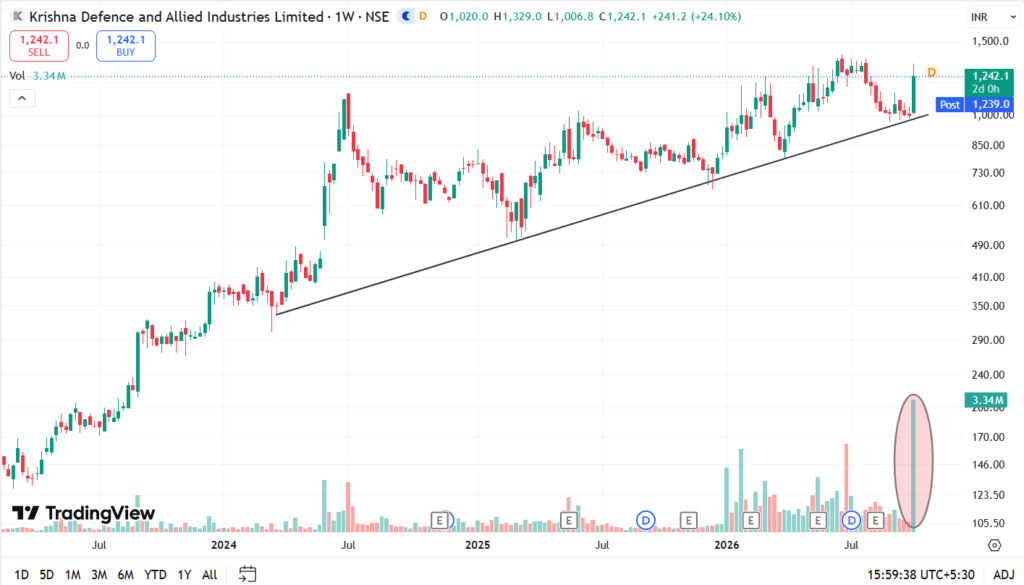
The weekly chart indicates that the medium term uptrend is intact, the recent high volume spike confirms this. The trend has been healthy since the 2024 peak in a relative sense, many defence and shipbuilding names have shown a weak trend in the same period. Krishan Defence & Allied industries has held up very well in the rather tumultuous 2 year period since the 2024 peak, the ascending trend line is an encouraging sign for long term investors.
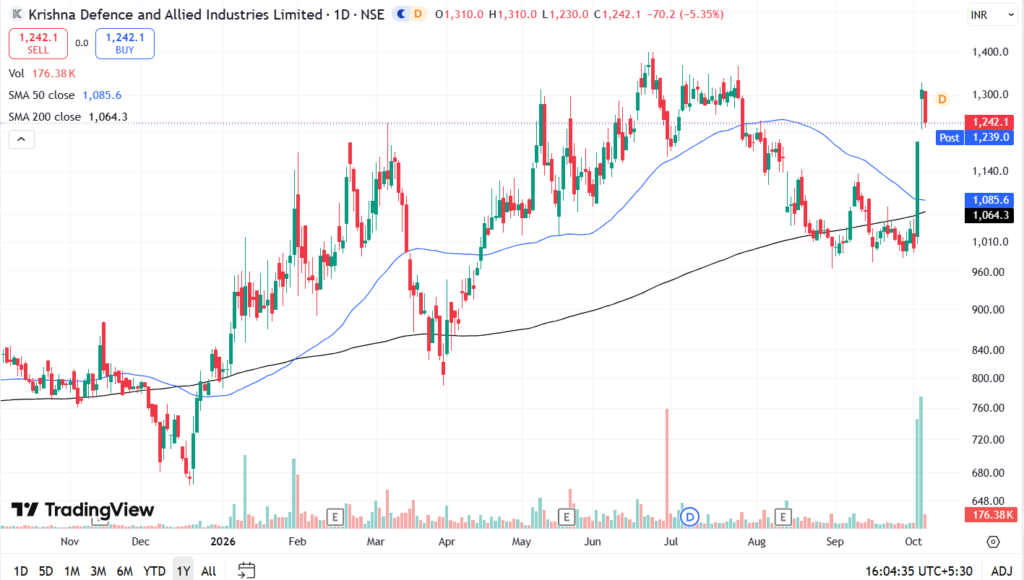
The day chart indicates a choppy trend over the past 12 months, the secular takeaway is that the price has spent most of the time above the 200DMA in a very choppy market. Interestingly the March 2026 interim bottom was a higher low from the earlier one made in December 2025, the series of higher lows shows promise of strength in the chart.
A word of caution, at a market cap of 1,850 Cr, a couple of large, isolated trades can completely change the nature of the price chart. The recent high volume trades on Oct 6, 2026 appear to be driven by some algo trading firms rather than by investors.
The shareholding pattern indicates that there has been a fresh influx of new investors in CY 2026 so far. At a total investor base of < 20,000 shareholders, one can safely say that institutional investors won’t have an easy time accumulating this stock. Substantial institutional holding will take time to build and may need the stock to go up at least 3x from CMP

Krishna Defence & Allied Industries Ltd Latest Latest Result, News and Updates
Krishna Defence & Allied Industries Ltd Quarterly Results
Krishna Defence & Allied Industries Ltd Q1 FY27 shows the lumpy execution typical of a defence supplier. Revenue was ₹57.6 Cr, down 15.2% YoY (and 11.2% QoQ), While they have delivered its highest ever EBITDA and net profit margins in their history.
Defence revenue is recognised on the execution and delivery of large orders, so a single quarter can swing sharply in either direction depending on dispatch and inspection timing. Q1FY27 was also measured against a strong base (Q1FY26 revenue of ₹67.9 Cr), which exaggerates the YoY decline.
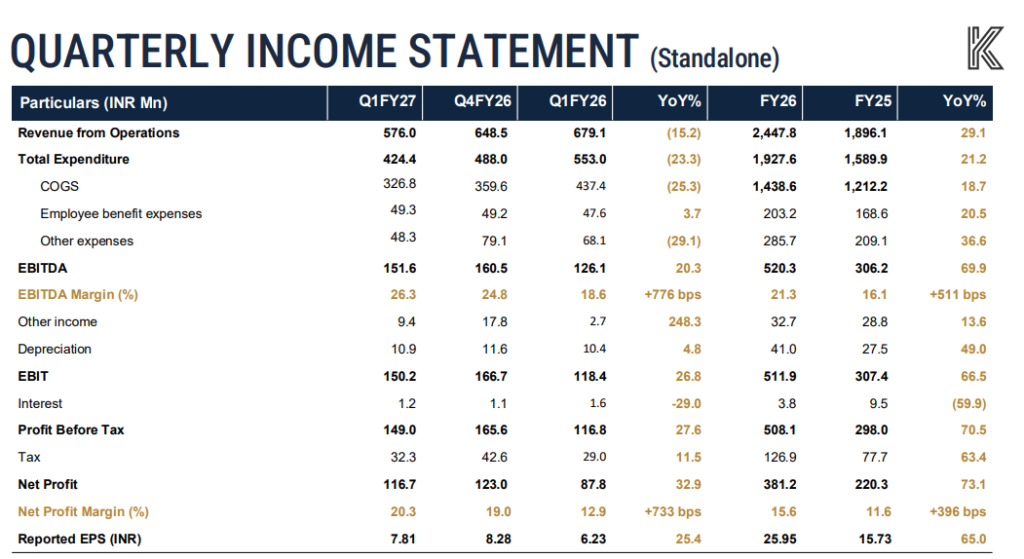
The unexecuted order book was ₹117 Cr as of June 30, 2026, with ₹289 Cr of submitted tenders under evaluation.
Beyond the numbers, Q1FY27 was also a quarter of portfolio building. Management took steps to broaden the defence offering by buying 46.81% in Taharabadkar Solutions Pvt. Ltd, Commissioning of Composite Manufacturing Facility and currently in advanced talks with a foreign OEM on underwater domain awareness platforms.
Final thoughts Krishna Defence & Allied Industries Ltd
Krishna Defence & Allied Industries Ltd has shown a respectable transformation from a dairy manufacturer to a niche defence manufacturer, and has shown tremendous improvement in financials too. The Navy’s fleet target, the indigenisation push and a large shipyard order along with India commercial shipbuilding pipeline all support the story, and the new verticals could improve both mix and margin from FY28. The Government has also undertaken several policy reforms to strengthen the domestic shipbuilding industry. Exports are not an opportunity today, since most of its products are classified and cannot be exported, so any export upside rests on the newer products. Their strategy is to target niche products and hold a dominant share, but for this to keep growing at 30%, the company needs to keep adding newer products, as each niche has a limited TAM and can accommodate only few players.
We think of the dairy segment as a small, stable and cash-generating business, not a growth driver. Its value to the investment case is that it offers a degree of diversification and funds itself without calling on management attention or capital. We would not assign it much value in our estimates, and we think the story rests on defence.
The first round of re-rating, on capacity and market position, is now largely priced in. The market, and we too are waiting for the next round of execution in the newer segments. We believe the newer segments will take time to deliver numbers, so this is an FY28 and beyond story. Management’s growth guidance rests on the existing products, so the new ventures are upside to it and offer great optionality.
From that point of view, one needs to track new shipbuilding and Navy orders, which are a first-level indicator (have been on the rising trend). We would also track conversion of the tender pipeline into Krishna Defence & Allied Industries Ltd’s order book, OCF conversion, and the first commercial revenue from composites and the AUV. The main risks are execution across many new ventures at once and valuation too as the stock trades at a 40+ trailing P/E and leaves little margin for error. At the right price or at the right inflection point, this can be an interesting play.
Disclaimer – This note is part of a business research & analysis series on small companies, there is no BUY/SELL recommendation or target price issued as part of this to a general audience. There is no assurance that this stock makes for a good investment, there is no guarantee that this stock will continue/be included in the coverage universe of Congruence Advisers. The note contains some forward-looking statements and insights drawn from the historical results, annual reports and investor presentations; they are to be viewed only within this context and not as a prediction of future performance of the business or the stock covered.
While due care has been taken to ensure that the information here is as accurate as possible, Congruence Advisers disclaims any liability in case of any unintentional inaccuracies.
The content does not constitute investment advice.