SG Finserve Ltd is a tech-enabled, RBI- registered Non-Banking Financial Company (NBFC) listed on BSE and NSE, headquartered in Delhi/NCR, India. As part of the APL Apollo Group, the Company has established itself as a specialised provider of supply chain financing solutions, with a strong focus on empowering India’s MSME ecosystem.
Table – t1
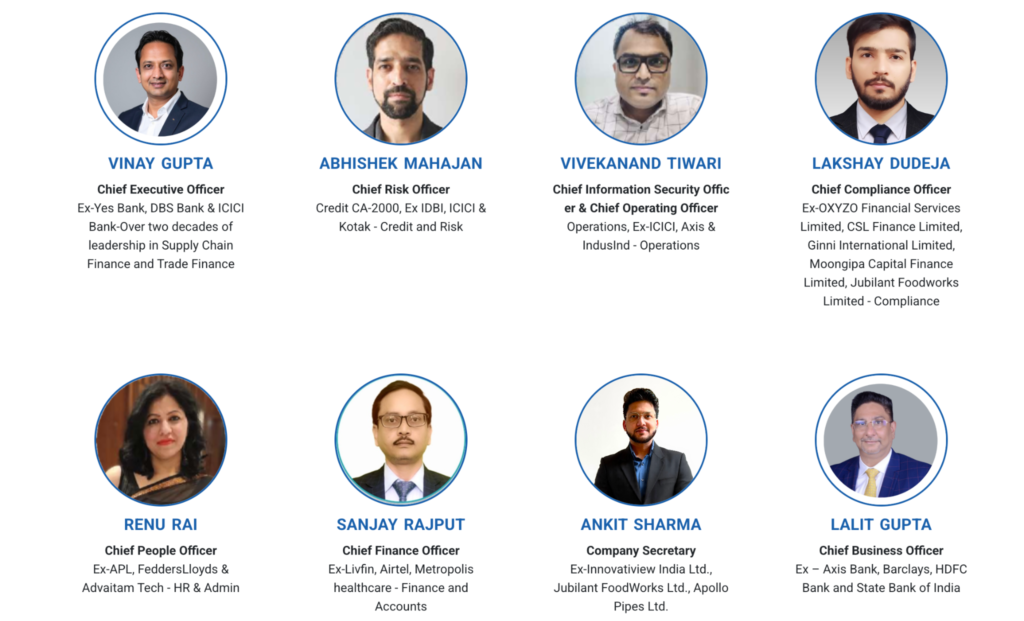
SG Finserve Ltd was a single product company until recently which placed limits on its growth rate, while asset quality, operating efficiency and access to capital were never a challenge. After the recent management change, SG Finserve Ltd has shown the first signs of product portfolio expansion while staying with the core value chain that the business understands very well. With the asset base growing at an aggressive pace for two quarters now while asset quality remains comforting, book value accretion could turn out to be very strong over the next 2-3 years if the execution is good. SG Finserve can benefit from the expansion of the supply chains of India’s largest business houses without taking on incremental risk. In our assessment, this makes SG Finserve Ltd a business to be actively tracked and favorably considered, based on other factors like market conditions and the current portfolio construct.
SG Finserve Ltd Company Summary
SG Finserve Ltd operates as an integrated financing partner across supply chains, catering to dealers, distributors, retailers, vendors, and suppliers associated with leading Indian corporations. Its core offerings include dealer financing, constituting the majority of its portfolio, vendor financing, and a recently introduced factoring business following regulatory approval, enabling expansion into broader B2B trade financing.
SG Finserve Ltd ’s differentiated strength lies in its ‘digitally native’ operating model. Through a fully integrated technology platform, SG Finserve Ltd digitises the entire lending lifecycle, from onboarding and credit assessment to disbursement and monitoring. Direct integration with the ERP systems of anchor corporations ensures end-use control, faster turnaround times, and scalable, high- velocity operations.
With a pan-India presence across 30 locations, SG Finserve Ltd has built a robust ecosystem through partnerships with around 50 leading corporations, including marquee names such as the Tata Group, Adani Group, JSW Group, Vedanta Limited, and Mahindra & Mahindra. This anchor- led model provides access to a diverse, high-quality borrower base.
SG Finserve Ltd Management Details
SG Finserve Ltd , originally known as Moongipa Securities Limited, was established in 1994. The promoters of APL Apollo Group, namely Mr. Rahul Gupta and Mr. Rohan Gupta, acquired a 56.25% stake in SG Finserve on August 20, 2021, after which an open offer was made, which concluded on July 22, 2022.
The company was originally acquired to serve as a financing unit of the APL Apollo group, primarily catering to the group’s ecosystem. Over time, however, it expanded its lending activities beyond the group and now extends financing to external borrowers too. The entity had a Type I NBFC license until September 25, 2024, which was later converted into a Type II NBFC license on October 3, 2024.
SG Finserve Ltd is promoted by the Gupta family, one of India’s most respected capital allocators, best known for building APL Apollo Tubes from a small pipe trader into a ₹52,000 crore large-cap compounder.
SG Finserve Ltd – Industry Overview
Indian Non-Banking Financial Services Sector
India’s NBFC sector is poised to outperform traditional banking over the long term, driven by structural advantages and evolving credit demand. Nomura projects NBFC credit to grow at a CAGR of approximately 17% from 2025 to 2035, compared to around 12% for banks.
Although banks currently hold over 70% of total credit, NBFCs are steadily expanding their market share due to greater agility, flexibility, and focus on underserved segments. A key growth driver is India’s low credit-to- GDP ratio relative to developed economies. As financial inclusion deepens, NBFCs are well-positioned to broaden access to formal credit, particularly for MSMEs and first- time borrowers, supported by faster turnaround times and flexible underwriting
Sectoral Assets Under Management (AUM) grew by 14 to 16%, led by secured lending, vehicle finance, and supply chain financing. Growth moderated slightly due to tight liquidity and an elevated interest-rate environment
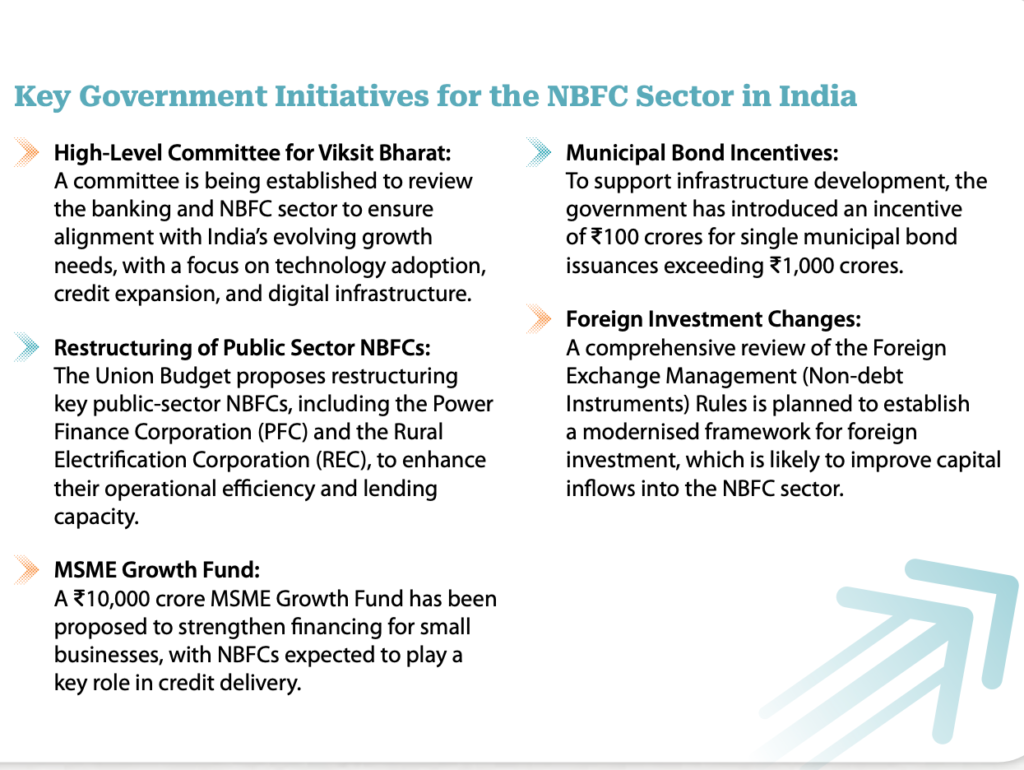
Source: SG Finserve Annual Report
India’s Industrial Sector
India is on a transformative growth path, driven by its dual objectives of becoming a developed economy by 2047 under the Viksit Bharat vision and achieving Net Zero emissions by 2070. Central to this transition is the industrial sector, a key driver of economic growth, productivity, employment, and long-term structural development. With accelerating industrialisation, urbanisation, and rising living standards, India’s demand for materials and energy is projected to surge, and its GDP is expected to reach D2,550 lakh crores by 2047. Aligning this growth with Net Zero commitments requires a strategic shift toward affordable, reliable, low-carbon energy solutions that ensure energy security and create jobs.
The industrial sector is gaining strong momentum, with Industry GVA growing 7% year-on-year in H1 FY 2025- 26. Industrial production accelerated to 7.8% growth in December 2025, led by an 8.1% manufacturing expansion, driven by high-growth segments including electronics and automobiles. Manufacturing GVA remained robust at 7.7% in Q1 and 9.1% in Q2, underpinned by technology adoption, infrastructure upgrades, and formalisation. Forward indicators remain positive, with the PMI at 55.4 in January 2026, reflecting sustained sector expansion and growing business confidence.
The government’s industrial agenda for 2026, as outlined in the Union Budget FY 2026-27, aims to raise manufacturing’s share of GDP to 25% through self- reliance, plug-and-play infrastructure, and the National Mission on Manufacturing (NMM). Key initiatives include the Biopharma SHAKTI program with a D10,000 crores allocation, Semiconductor Mission (ISM) 2.0, and the development of over 100 industrial hubs focused on localised production, technology-driven manufacturing, and large-scale employment generation.
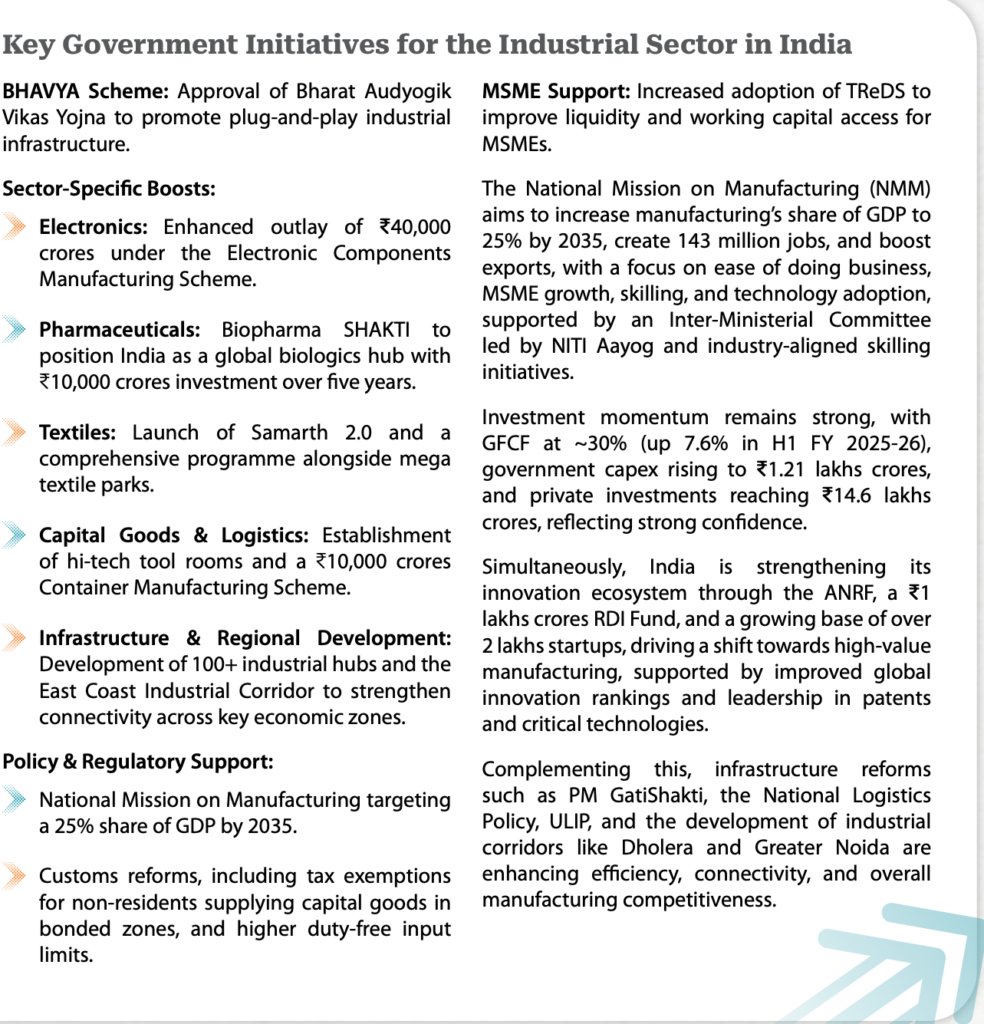
Source: SG Finserve Annual Report
Outlook
India’s manufacturing sector is poised for sustained expansion, driven by the Government’s vision of Atmanirbharta and the strategic priorities outlined in the Union Budget FY 2026– 27. Continued emphasis on competitiveness, technology adoption, supply chain integration, and skill development is expected to strengthen the sector’s resilience and global positioning.
Looking ahead, manufacturing is set to play a central role in India’s economic transformation, emerging as a key driver of growth, employment, and export competitiveness, while supporting the country’s journey towards becoming a globally integrated and self-reliant economic powerhouse.
India’s MSME Sector
India’s Micro, Small, and Medium Enterprises (MSME) sector is a vital economic pillar, driving employment, industrial output, and exports. With over 7.47 crore enterprises employing 32.82 crore people, MSMEs are the second-largest source of employment after agriculture, contributing 31.1% to GDP, 35.4% to manufacturing output, and 48.6% to exports.
The Union Budget FY 2026–27 prioritises MSMEs through a focused strategy on equity support, liquidity enhancement, and capacity building, aiming to develop globally competitive‘Champion MSMEs’while promoting inclusive growth.
To improve access to capital, the government has launched a Rs 10,000 Cr MSME Growth Fund and expanded the Self-Reliant India Fund for risk capital. Liquidity support is strengthened through the Trade Receivables Discounting System (TReDS), which has unlocked over D7 lakh crores, as well as credit guarantees and integration with government procurement systems.
Outlook
India’s MSME sector is well-positioned for sustained growth, supported by strong policy backing, digital transformation, and increasing integration with global value chains. As key enablers of manufacturing and supply chains, MSMEs will continue to drive employment.
innovation, and export growth, reinforcing their role at the heart of India’s journey towards a resilient, inclusive, and globally competitive economy.
India’s Supply Chain Financing Sector
Supply Chain Financing (SCF) in India has emerged as a fast-growing, technology-enabled solution that optimises working capital cycles across businesses, particularly benefiting MSMEs. Built on the principle of reverse factoring, SCF enables financial institutions to facilitate early payments to suppliers by leveraging the credit strength of large corporate buyers, thereby reducing financing costs and improving liquidity. This mechanism enables suppliers to access funds within 30 to 90 days, while buyers retain the flexibility of extended payment cycles, creating a balanced and efficient ecosystem.
Structural and policy-led initiatives are driving the growth of SCF in India. Platforms such as the RBI’s Trade Receivables Discounting System (TReDS) have introduced transparency, efficiency, and competitive invoice discounting through digital marketplaces. Additionally, government programmes such as Make in India, the National Logistics Policy, and the increasing formalisation of the economy are accelerating adoption by expanding manufacturing activity and strengthening supply chain linkages. These developments are fostering deeper financial inclusion by bringing small and mid- sized enterprises into the formal credit system.
Despite its strong growth trajectory, the SCF ecosystem faces certain challenges. Limited digital adoption among smaller enterprises, relatively high operational costs, and concerns around data security and fraud risks continue to constrain scalability. However, with ongoing digitisation, regulatory support, and increasing participation from financial institutions and fintech players, SCF is poised to play a critical role in enhancing supply chain resilience, improving cash flow management, and supporting sustainable growth across India’s industrial landscape.
The Union Budget FY 2026–27 places strong emphasis on enhancing supply chain resilience, improving manufacturing competitiveness, and reducing logistics costs. The government has outlined a robust capital expenditure plan of D12.2 lakh crores, marking a ~9% increase over the previous fiscal year, highlighting its continued focus on infrastructure-led growth.
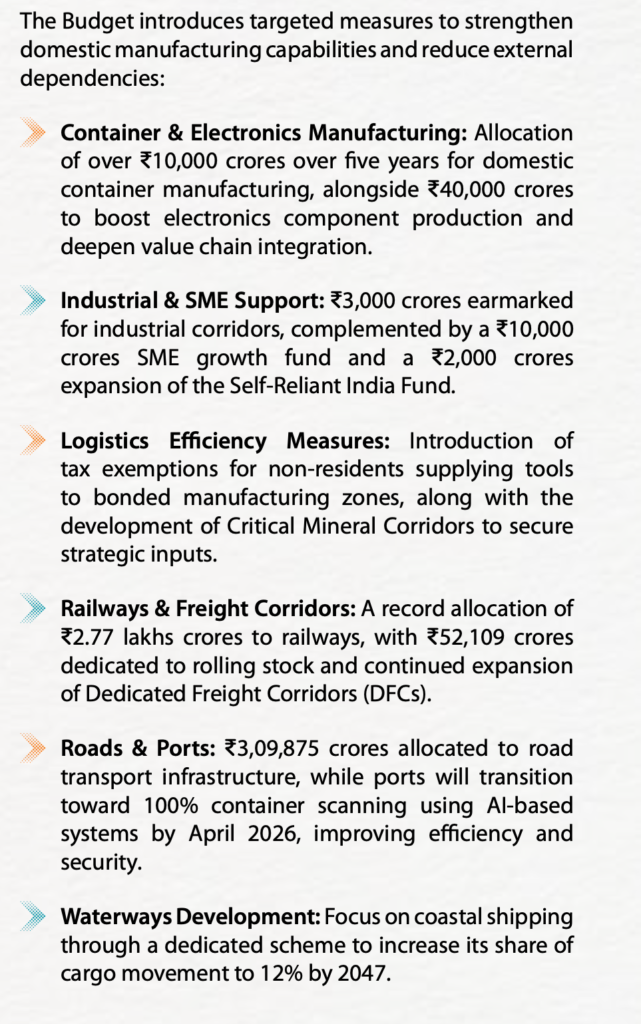
Source: SG Finserve Annual Report
Outlook
India’s domestic SCF market is poised for healthy growth at a CAGR of ~9.2%between FY24-31. TReDS platforms, powered by e-invoicing, UPI, and new fintech entrants, will drive exponential MSME invoice financing, building on 2025’s Rs 2.33 lakh crores milestone.
PLI schemes, Make in India, and ESG-linked programs will boost working capital solutions across the auto, pharma, renewables, and electronics sectors. AI-enabled platforms will deepen supplier inclusion and resilience. By 2030, SCF will unlock critical liquidity for domestic value chains, supporting 7%+ GDP growth and inclusive manufacturing. Policy continuity remains key to scaling deep-tier financing
SG Finserve Ltd Business Overview
SG Finserve Ltd,originally known as Moongipa Securities Limited, was established in 1994. The promoters of APL Apollo Group, namely Mr. Rahul Gupta and Mr. Rohan Gupta, acquired a 56.25% stake in SG Finserve Ltd on August 20, 2021, after which an open offer was made, which concluded on July 22, 2022. It is engaged in providing loans to channel partners, dealers, distributors, retailers, suppliers, and transporters/ Logistics. The company was originally acquired to serve as a financing unit of the APL Apollo group, primarily catering to the group’s ecosystem. Over time, however, it expanded its lending activities beyond the group and now extends financing to external borrowers too. The entity had a Type I NBFC license until September 25, 2024, which was later converted into a Type II NBFC license on October 3, 2024.
SG Finserve Ltd ’s differentiated strength lies in its ‘digitally native’ operating model backed by the marketing might of the APL Apollo group. Through a fully integrated technology platform, SG Finserve Ltd digitises the entire lending lifecycle, from onboarding and credit assessment to disbursement and monitoring. Direct integration with the ERP systems of anchor corporations ensures end-use control, faster turnaround times, and scalable, high- velocity operations.
With a pan-India presence across 30 locations, SG Finserve Ltd has built a robust ecosystem through partnerships with around 50 leading corporations, including marquee names such as the Tata Group, Adani Group, JSW Group, Vedanta Limited, and Mahindra & Mahindra. This anchor- led model provides access to a diverse, high-quality borrower base. APL Apollo group, led by Sanjay Gupta has been well entrenched in the steel ecosystem in India and has an excellent working relationship with steel majors like JSW Steel, Jindal Steel and Tata Steel. Their understanding of the steel supply chain has propelled the promoters to seed multiple businesses within the building and construction materials sectors in India – APL Apollo Tubes, Apollo Pipes, SG Finserve, SG Mart are all strong players within their chosen sub sectors of operation within the larger construction and building materials sector in India.
How SG Finserve Ltd works
Picture a paint dealer in Nashik who stocks up on ₹25 lakh of paint every month from a large manufacturer. The manufacturer wants payment within days of dispatch. The dealer’s customers, contractors, and housing societies often take 45 to 60 days to settle their bills. The dealer is selling well but constantly short of working capital.
SG Finserve Ltd steps into that gap. The manufacturer is the “anchor” in the chain, and the finance works like this
- Order placed: The dealer orders stock from the anchor, which has already been vetted.
- Anchor paid upfront: SG Finserve Ltd settles the invoice with the anchor straight away, so the dealer doesn’t have to find the cash.
- Goods dispatched: The anchor ships the stock to the dealer as usual.
- Dealer repays: Once the stock is sold, the dealer repays SG Finserve Ltd plus interest, typically within 45 to 60 days, at an annual rate of 10-13%.
This is supply chain finance: short-term credit that keeps stock flowing from factory to shelf. The anchor gets paid in full without waiting. The dealer gets breathing room to sell before paying. SG Finserve Ltd earns interest on a loan that is repaid and re-lent within about two months.
This short cycle matters for the benchmarking. SG Finserve Ltd money turns over every 45 days or so, and the risk sits mostly with established anchors such as APL Apollo and other players, which is why its NPAs are negligible. It is also why its yields are lower than peers that lend to small borrowers over longer periods. Supply chain finance has been traditionally dominated by large NBFC’s and banks, though overall penetration within India continues to be low.
Key Financial Services & Products Offered
While reported under a unified financing segment, SG Finserve offers specialized working capital and supply chain finance products across the B2B ecosystem:
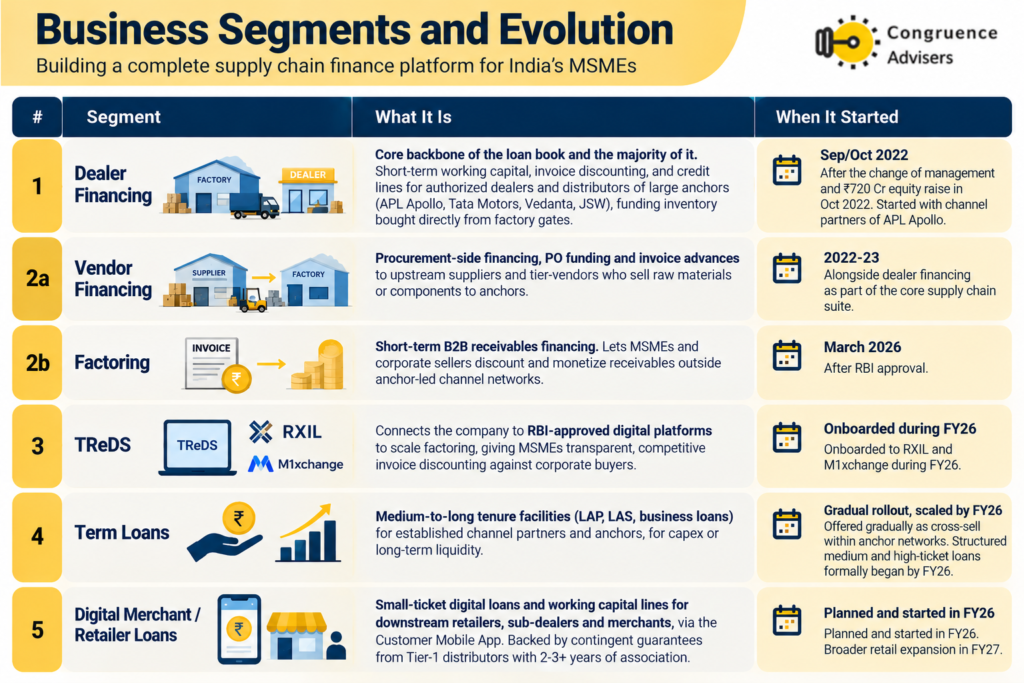
What is Dealer Finance?
Dealer Financing product offered by SG Finserve Ltd is a specialized financial solution designed to support dealerships in acquiring and managing inventory. The product caters to various industries such as metals, automotive, building materials, agricultural machinery, consumer durables, and more.
Distributors and dealers form an important link in the supply chain network. We aim to provide need-based financial assistance to such distributors and dealers via a line of credit. The funding is secured by the purchases made by the dealer or distributor from the Corporate. This gives dealers and distributors access to additional working capital, enabling them to drive business growth and increase the sales penetration for the Corporate
Brief overview of the dealer financing product offered by SG Finserve Ltd
- Inventory Financing: SG Finserve Ltd provides financing to dealerships for the purchase of inventory, including vehicles, machinery, equipment, and other goods. This funding helps dealers maintain sufficient stock levels to meet customer demand without tying up their working capital.
- Flexible Terms: SG Finserve Ltd offers flexible terms tailored to the specific needs of dealerships. This includes competitive interest rates, customizable repayment schedules, and loan amounts based on the value of the inventory.
- Quick Approval Process:SG Finserve Ltd has a streamlined application and approval process to provide dealerships with fast access to financing. This enables dealers to seize opportunities, such as purchasing seasonal inventory or taking advantage of manufacturer incentives/cash discounts.
- Collateral- free Financing: Dealer financing by SG Finserve Ltd is secured by the inventory itself, thus a collateral-free loan for the dealerships.
Overall, the dealer-financing product offered by SG Finserve Ltd plays a vital role in supporting the growth and success of dealerships by providing them with the necessary capital and resources to manage their inventory and operations effectively.
At the same time, it is our view that dealer finance is a plain vanilla offering that doesn’t call for sophisticated underwriting or risk management skills. Getting empanelled with an anchor client to operate in their ecosystem is the biggest step, post which delivering the offering has low relative complexity compared to other products in lending. SG Finserve will rarely be the only/first player to get empanelled in the supply chain, large banks and NBFCs like Aditya Birla Capital, Tata Capital have been actively servicing this space for decades now. Logically, larger banks and NBFC cost of capital will be lower compared to a standalone small player like SG Finserve, which necessitates choosing the right segments for a player like SG Finserve to scale. We suspect that this is the reason SG Finserve has a much higher net worth relative to the size of the asset book, because equity has a zero cost of capital in an accounting sense, thereby enabling SG Finserve to offer competitive rates in the market.
What is Vendor Supplier Financing for Corporate?
Empowering Corporates to Support Their Vendors/Suppliers for a More Efficient Supply Chain: Loan against Invoice/Purchase Order/Work Order to support pre-shipment financing requirements
Vendor financing is a financial arrangement where a company provides financing to its suppliers, allowing them to access capital to support their operations. This form of supply chain finance offers several benefits for both buyers (the company providing financing) and suppliers.
Brief overview of the retailer financing product offered by SG Finserve Ltd:
- Improved Cash Flow for Suppliers: Vendor financing provides suppliers with access to capital, helping them manage cash flow gaps, purchase inventory, invest in equipment, and fund other business activities.
- Strengthened Supplier Relationships: Offering financing to suppliers can enhance relationships and build loyalty, as it demonstrates a commitment to their success and supports their growth.
- Reduced Cost of Capital: Suppliers may obtain financing at more favorable rates compared to traditional lending sources, reducing their cost of capital and improving profitability.
- Enhanced Supply Chain Resilience: By ensuring suppliers’ financial stability, vendor financing helps mitigate supply chain risks, such as disruptions due to supplier insolvency or production delays.
- Streamlined Procurement Process: Vendor financing can streamline the procurement process by providing suppliers with the resources needed to fulfil orders promptly, reducing lead times and improving overall efficiency.
- Competitive Advantage: Offering financing as part of the purchasing process can differentiate a company from competitors and attract high-quality suppliers seeking financial support.
What is Logistics/ Transporter Financing?
Logistics or transporter financing is a specific type of supply chain finance tailored to meet the financial needs of logistics companies, freight carriers, and transporters. This form of financing helps these businesses manage their cash flow, invest in fleet maintenance and expansion, and navigate the challenges of operating in the logistics industry.
Logistics/ Transport Finance sits at the heart of the end-to-end Logistics offering, supporting & empowering transport companies. Uncover inefficient supply chain operations and allow SG Finserve Ltd to finance freight/ transport invoices.
Brief overview of the logistics/transporter financing products offered by SG Finserve Ltd:
- Improved Cash Flow: Logistics financing provides immediate access to capital, allowing companies to address cash flow gaps and meet financial obligations without disrupting operations.
- Asset Ownership: Financing enables logistics companies to acquire vehicles and equipment without tying up large sums of capital, preserving liquidity and financial flexibility for other strategic initiatives.
- Scalability: Access to financing supports the scalability of logistics operations, allowing companies to respond quickly to changes in demand, expand into new markets, or pursue strategic opportunities.
- Long-term Planning: With stable financing in place, logistics companies can focus on long-term planning, investment, and innovation, rather than being constrained by short-term cash flow challenges.
- Customer Satisfaction: Improved fleet reliability, on-time deliveries, and enhanced service quality resulting from financing investments contribute to higher customer satisfaction and retention rates.
In summary, logistics/transporter financing plays a vital role in supporting the growth, resilience, and competitiveness of logistics companies by providing access to capital, enabling investment in assets and technology, and mitigating financial risks inherent in the industry.
What is Retailer Financing?
Retailer financing in deep-tier supply chain finance involves the retailer offering financial support to suppliers that are not directly connected but are part of the extended supply chain network.
The primary goal of retailer financing in deep-tier supply chain finance is to ensure the stability and resilience of the entire supply chain. By providing financing to lower- tier suppliers, retailers help mitigate financial risks, reduce disruptions, and maintain the flow of goods and services.
Digital Platform in place, enabled to include deep-tier financing solutions to Retailers of the Corporate/ Dealers/ Distributors, i.e., lowest possible tier financing. Tailoring financing solutions to the lowest possible tier in a seamless manner.
Brief overview of retailer financing product offered by SG Finserve Ltd:
- Improved Cash Flow: Retailer financing helps lower-tier suppliers access much-needed capital to fulfil orders, manage production, and invest in growth initiatives.
- Enhanced Relationships: Offering financing demonstrates a commitment to the success of suppliers, fostering stronger and more collaborative relationships throughout the supply chain.
- Risk Mitigation: By supporting lower-tier suppliers financially, retailers reduce the risk of disruptions caused by supplier insolvency, production delays, or quality issues.
- Supply Chain Resilience: Deep-tier financing contributes to the overall resilience of the supply chain by ensuring that all tiers of suppliers remain financially stable and capable of meeting demand.
Logically, retailer financing carries higher risk and higher spreads compared to the core dealer finance offering. Disbursements can also be of a smaller ticket size, implying higher operating cost to Asset base for this segment. As a paradox, because of the higher risk and higher operating complexity involved, this segment has lower penetration by large financiers like banks and NBFCs.
Tailor-Made Term Lending Solutions
Collateral-backed term loans are offered by SG Finserve Ltd as a financial arrangement wherein a business entity secures a loan by pledging a property, typically an immovable asset. The loan amount is generally a percentage of the property’s market value, and the funds obtained can be utilized for operational expenses or any other business-related purposes.
Similarly, without collateral term loans by SG Finserve Ltd offer essential credit to SMEs/ MSMEs without the hassle of collateral. These loans offer flexible financing options tailored to meet specific business needs, such as expanding operations and managing working capital.
SG Finserve Ltd earns a spread between the interest it receives from borrowers and the cost of raising funds.
- It earns around 13% on its lending book, including roughly 12.5% interest income and 0.5% in fees.
- At the same time, it raises funds from banks and other lenders at a cost of below 8%.
- The difference between these two rates forms the core of its earnings, from which operating expenses and taxes are paid.
The important part is the funding mix. SG Finserve Ltd does not fund its entire loan book through borrowings. Roughly two-thirds of its loans are financed through borrowed funds, while the remaining one-third comes from shareholders’ equity, which does not carry an interest cost. This makes the effective spread on the overall loan book wider than the simple 13% lending yield versus sub-8% borrowing cost suggests. As a result, management reports a net interest margin (NIM) of around 7-7.5%.
Asset financing (primarily LAP) comes with much higher illiquidity and correspondingly higher NPA ratios compared to the core business of working capital loans. LAP financing usually needs some amount of underwriting skill and the ability to choose the right segments. The product is of longer tenor with much higher tail risks, though the product is secured in nature. This is where APL Apollo group’s network of distributors, dealers and SME business owners can come handy since the segment is not a homogeneous one by design. Choosing the right set of clients to build a collateral backed, longer tenor lending book calls for building a high amount of confidence in the SME promoter before putting capital at risk. Being diversified both geographically and across sectors assumes paramount importance in this segment since tail risks are high within a geography/sector. This is a relatively new segment for SG Finserve and will need a tremendous amount of management involvement in the initial few years.
What kind of risk mitigation does SG Finserve Ltd have?
The stop-supply rule is a risk-mitigation arrangement embedded in the formal Memorandum of Understanding (MoU) signed between SG Finserve Ltd and its corporate anchor partners. Under this clause, if a dealer, distributor, or vendor delays or defaults on their loan repayment obligations to SG Finserve Ltd, the corporate anchor immediately suspends all further product and inventory supplies to that borrower.
How the Stop-Supply Mechanism Works
- Top-Down MoU Agreement: SG Finserve Ltd agrees with the corporate anchor and onboards dealers based on the anchor’s recommendation and contractual terms.
- Immediate Enforcement on Default: If a borrower delays or defaults on a payment, SG Finserve triggers the stop-supply clause, requiring the corporate anchor to halt shipments to that specific dealer.
- Livelihood & Business Continuity Risk: Because the dealer’s business relies on receiving inventory from the corporate anchor, a supply stoppage immediately halts their core business operations.
- Self-Enforcing Recovery: Channel partners who have operated dealerships for 5, 10, or 15 years rarely risk losing their relationship with the principal anchor, prompting them to clear overdues quickly when supply is suspended.
Last to be Used: Dealers typically maintain standard bank lines (such as Cash Credit or Overdraft facilities) for general liquidity. SG Finserve Ltd invoice discounting line acts as a specific, pay-as-you-use working capital line tied directly to fresh inventory orders from the corporate anchor. SG Finserve Ltd is the first creditor to be repaid. This is enforced through the Stop-Supply Clause in SG Finserve Ltd’s agreement with the corporate anchor.
Loan Rollover – Each loan is secured against a single bill with a fixed due date. Since the bill cannot be refinanced and the date cannot be extended, repayment stress becomes visible within weeks rather than years.
A Very Lean Lender – 4,552 Cr of loans. 102 employees. No Physical branches. Loans are processed digitally, often straight from the anchor’s billing software. The cost-to-income ratio is about 13-14%; of every ₹100 earned, only ₹13-14 goes to operations. The management claims each employee brings in over ₹2 Cr in annual profit in Q1FY27.
Some of these aspects are very different from traditional lenders where the complexity of lending is much higher (underwriting skills and analytics) and the tenor of the loans much higher. Lean operations at cost to income of just ~14% is much lower compared to even large banks since this is not a granular business, in fact this functions like a B2B business where customization is the exception rather than the rule. Given the short term nature of the loan and the ability to easily assess the value of the underlying inventory, lending can be digitized and standardized to a great extent. The stop supply arrangement puts a lid on customer defaults and makes NPA management relatively easy, barring tail events.
SG Finserve Ltd Geography Mix
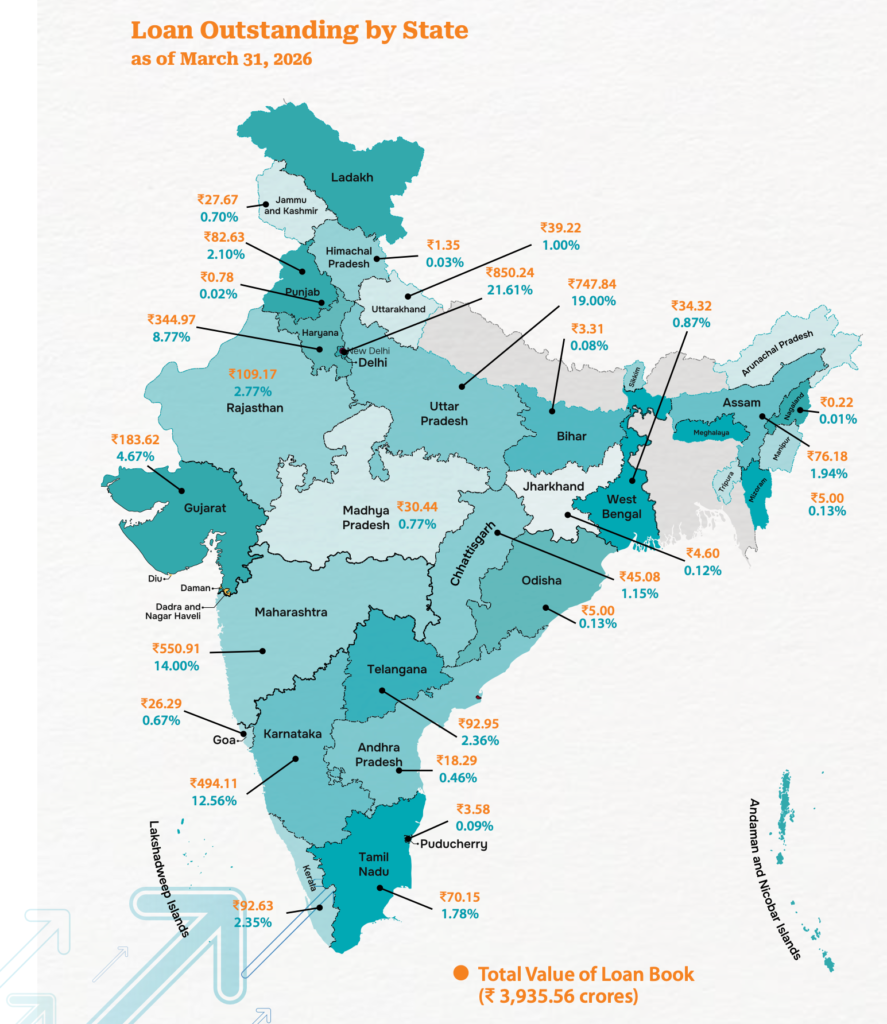
In the last four years, the business expanded further, spreading across India and expanding to 30 locations. Delhi, Uttar Pradesh, Maharashtra, and Karnataka are the top four states, which account for 67% of the outstanding loan book as of March 2026. All the loan disbursements are within India only.
Physical operations are supported by regional hubs in Delhi NCR, Mumbai, Kolkata, Bengaluru, and Chennai, staffing local Relationship Managers to handle regional commercial nuances
Source: SG Finserve Annual Report
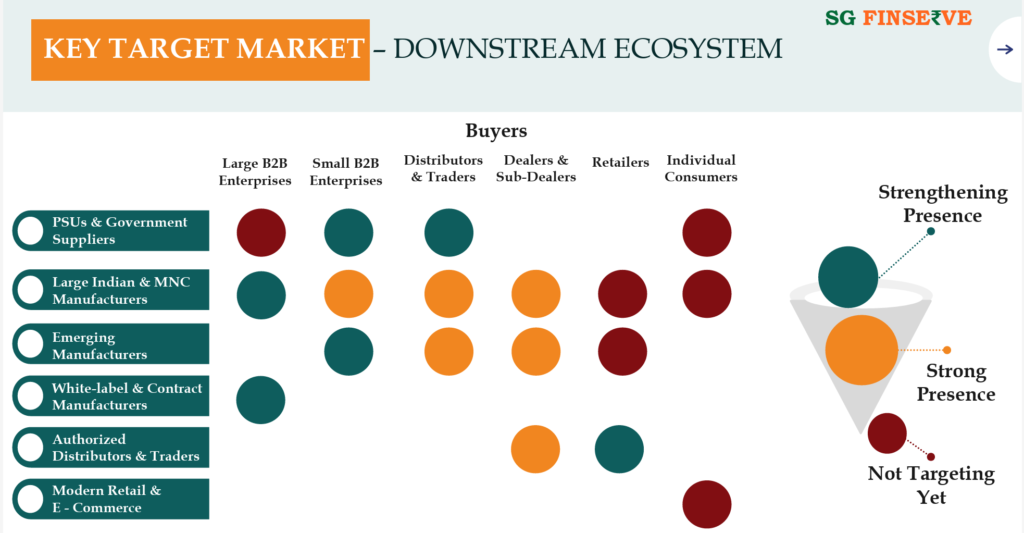
SG Finserve Ltd serves two core customer layers across the corporate value chain:
1) Corporate Anchors: Large corporate buyers, sellers, and conglomerates across sectors like building materials, automobiles, and IT peripherals (e.g., APL Apollo, Tata Group, JSW, Vedanta, Oppo, Redington, Tata Motors, Ashok Leyland).
2) Channel Partners / MSMEs: Downstream distributors, dealers, sub-dealers, retailers, as well as upstream vendors, sub-suppliers, and transporters.
Four New Proposed Strategic Subsidiaries
To expand fee-based revenue streams, SG Finserve Ltd’s board approved plans to explore four dedicated subsidiaries:
- Asset Reconstruction Company (ARC): Foraying into distress debt resolution and asset reconstruction.
- Alternative Investment Funds (AIF) / AMC: Establishing an Asset Management Company to manage AIFs from a wealth management and private debt perspective.
- Insurance Broking (Life & Non-Life): Setting up a wholly-owned subsidiary to obtain an IRDA license, allowing cross-selling of insurance products (e.g., trade credit, health, and keyman insurance) across its corporate anchor and dealer network.
- FinTech Entity: Developing an AI-led tech platform to manage proprietary Loan Origination Systems (LOS) and Loan Management Systems (LMS).
SG Finserve Ltd Financial Performance
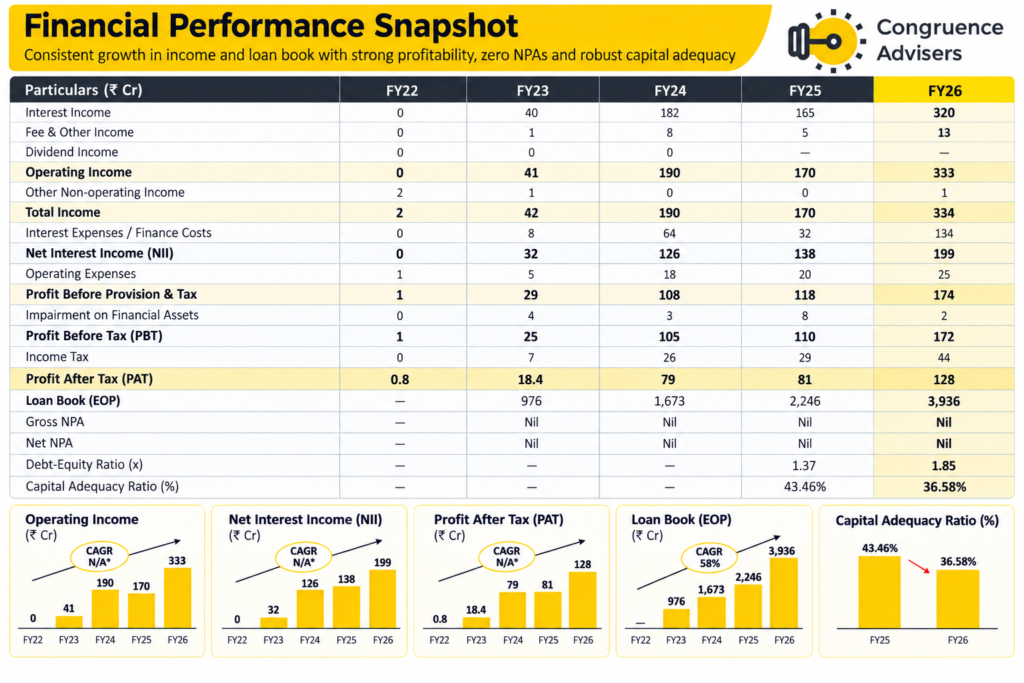
SG Finserve Ltd delivered a strong financial performance during FY 2025–26, marked by sustained profitability, rapid expansion of its lending portfolio, and continued operational efficiency.
SG Finserve Ltd recorded healthy growth in income streams, supported by a scalable, high-velocity business model and disciplined cost management, resulting in robust margins and returns. Its ability to maintain superior asset quality, underpinned by a largely secured portfolio and prudent risk management practices, remained a key strength despite accelerated growth.
A strong capital base and conservative leverage profile further reinforced its balance sheet, providing adequate headroom for future expansion. Overall, SG Finserve Ltd’s performance reflects a well-balanced approach to growth, profitability, and risk, positioning it for continued momentum in the supply chain financing space.
SG Finserve Ltd Comparative Analysis
We will attempt to perform a comparative analysis of SG Finserve Ltd with other listed peers, though it will not be easy due to the differentiated business model of the company.
SG Finserve Ltd Peer Comparison
There is no direct peer listed for SG Finserve Ltd; we compared the business with emerging companies in the NBFC sector, like SBFC Finance, Five Star Business, Northern Arc, Fedfina, and UGRO Capital. While large NBFCs like Aditya Birla Capital and Tata Capital have supply chain finance verticals, the lack of supply chain finance specific financials makes it difficult to perform a meaningful comparison with the larger players.
While the peers we are examining here aren’t focused on the supply chain finance segment, they are much more similar to SG Finserve in terms of scale and business model maturity. In lending, it is important that we consider as many business models as possible to come to a mature understanding of the particular business.
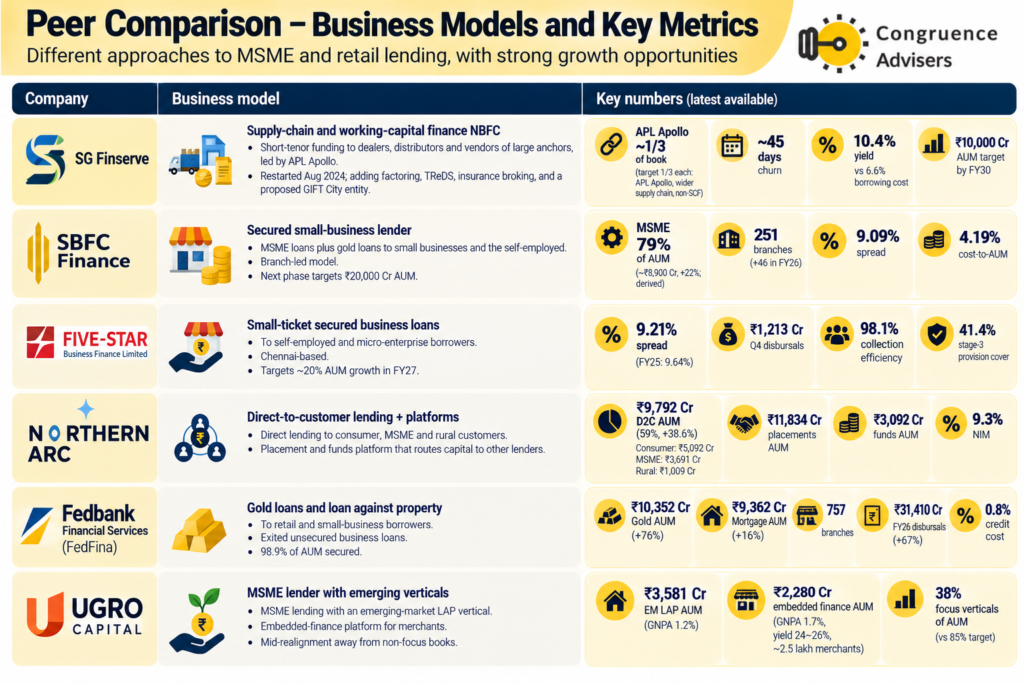
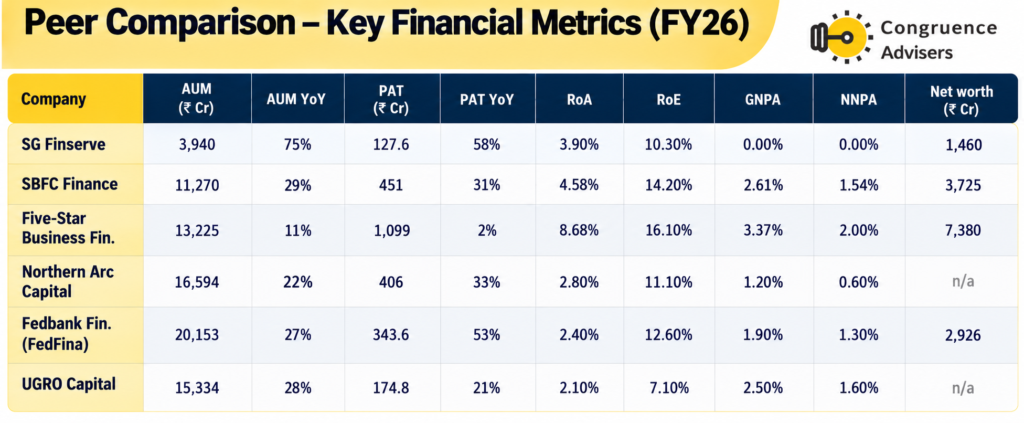
It is important to note that SG Finserve operates at a conservative leverage ratio which results in an optically sub par ROE of 10-11% due to the higher equity base. This however is a feature of the business since the zero cost of capital (in an accounting sense) enables the business to make a good spread and deliver a ROA of close to 4% while offering competitive rates in the supply chain finance segment.
Since the business model of SG Finserve is very different compared to the rest of the peers considered here and all other listed lenders, we will not delve too much into comparative numbers.
SG Finserve Ltd Peer Comparison
SG Finserve Ltd share performance vs S&P BSE Small Cap Index, as the index benchmark comparison is a fundamental tool for understanding the investment potential and making informed decisions in the context of the broader market
Table – T2
Why You Should Consider Investing in SG Finserve Ltd
SG Finserve Ltd offers some interesting reasons to track closely and to consider investing if one is looking to play a niche, high growth NBFC
Access to the APL Apollo group network – This is the strongest positive in favour of SG Finserve since they have proprietary access to the strong relationships and knowledge base built by the APL Apollo group over decades. APL Apollo group’s strong market position across the steel tubes and pipes, plastic pipes and fittings, downstream steel distribution segments has the potential to create a strong business flywheel for SG Finserve. Interestingly, the chief strategy office of APL Apollo is fully involved in setting the growth strategy for not just SG Finserve but SG Mart as well. This shows commitment of the promoter group towards this business.
Superior Asset Quality & Zero NPAs – SG Finserve Ltd has consistently maintained NIL Gross NPAs across its portfolio, backed by credit underwriting discipline. Approximately 80% to 87% of the total loan portfolio is secured through a primary charge on funded inventory and receivables generated from actual sales transactions. The business model itself keeps NPA episodes to a minimum compared to other segments of lending.
Embedded Risk Controls & End-Use Supervision – SG Finserve Ltd enters into formal stop-supply arrangements with corporate anchors, which halt further product supply to dealers if a payment delay or default occurs. Funds are disbursed directly into corporate anchor ERP systems (such as SAP) rather than to individual dealers, ensuring total control over the end-use of capital.
Good Efficiency & Low operating cost structure – Operating a digitally native platform that automates the lending lifecycle from credit appraisal to automated disbursements keeps the cost-to-income ratio below 15%. Sourcing pre-approved borrower leads directly through corporate anchor partnerships allows SG Finserve Ltd to eliminate Direct Selling Agent (DSA) charges and third-party acquisition payouts.
Strong Credit Ratings & Prudent Leverage – SG Finserve Ltd holds high credit ratings of AA / AA (CE) for long-term debt and A1+ for short-term debt and commercial paper from CRISIL and ICRA. SG Finserve Ltd maintains a conservative balance sheet with a Debt-to-Total Net Worth (TNW) ratio of 1.9x.
Strong loan Book growth & Good Returns – The loan book expanded from ₹1,673 Cr in March 2024 and ₹2,246 Cr in March 2025 to ₹3940 Cr in FY26; SG Finserve Ltd generated an annualised Return on Assets (RoA) of 4.80% and a Return on Equity (RoE) of 12%.
First signs of product line expansion – After the recent management team change, SG Finserve has laid out a roadmap for expansion into multiple areas like ARC, Factoring finance, AIF based wealth management and fin tech initiatives. While venturing into Factoring finance is a logical extension of the current business model, the other initiatives will need to be monitored over time for product market fit and good execution before coming to any conclusions.
What are the Risks of Investing in SG Finserve Ltd
Investors need to keep the following risks in mind if they choose to invest in this business. Risks need to be weighed in combination with the advantages listed above to arrive at a decision that is optimal for your portfolio construct
Sectoral & Credit Concentration Risk – SG Finserve Ltd maintains high exposure concentrated in specific industries, particularly the construction, building materials and automobile sectors. The loan book carries significant borrower concentration, with advances to the twenty largest borrowers accounting for 38.89% of total advances as of March 31, 2026 (down from 49.76% as of March 31, 2025).
Regulatory & Compliance Risk – Tightening regulatory policies and compliance requirements from the Reserve Bank of India (RBI) may increase capital and operational expenses. Evolving regulatory frameworks or licensing requirements present ongoing compliance and operational adaptation challenges.
Market Competition & Margin Compression – SG Finserve Ltd faces intense competition from commercial banks, fintechs, and digital-first NBFCs entering the MSME supply chain financing space. Competitive pricing dynamics alongside rising borrowing costs could exert pressure on Net Interest Margins (NIM) and spreads.
Macroeconomic & Interest Rate Volatility – Macroeconomic volatility, liquidity tightening, and elevated interest rate environments can adversely affect borrower cash flows and supply chain demand. While loans are predominantly secured by inventory, receivables, and stop-supply agreements, credit risk remains present if counterparties encounter severe financial stress.
Strategic Expansion & Management Risk – Expanding into new financial verticals—such as Asset Reconstruction (ARC), Alternative Investment Funds (AIF), Insurance Broking, and B2B factoring carries execution risks that could temporarily dilute core focus. Rapid operational growth and executive leadership transitions require ongoing alignment of internal controls with increasing organizational complexity. A rapid scale up in the Loan Against Property (LAP) segment could increase risk since the collateral is highly illiquid.
Higher leverage may reveal some inefficiencies – The current debt to equity ratio is ~1.9-2x which enables SG Finserve Ltd to keep its cost of capital low in an accounting sense and compete in the market. Higher debt to equity ratio can improve the ROE no doubt but the spread is likely to come down since the cost of borrowing for SG Finserve cannot compete with the larger peers like banks and NBFCs. The business model is yet to be tested at a higher debt to equity ratio, though we aren’t worried about asset quality in the current business model.
In a lending business, investors need to get a good handle on risk before getting excited about high growth. Our suggestion is to track the business and the management commentary for a few quarters before taking a decision on a small cap lending business.
SG Finserve Ltd Future Outlook
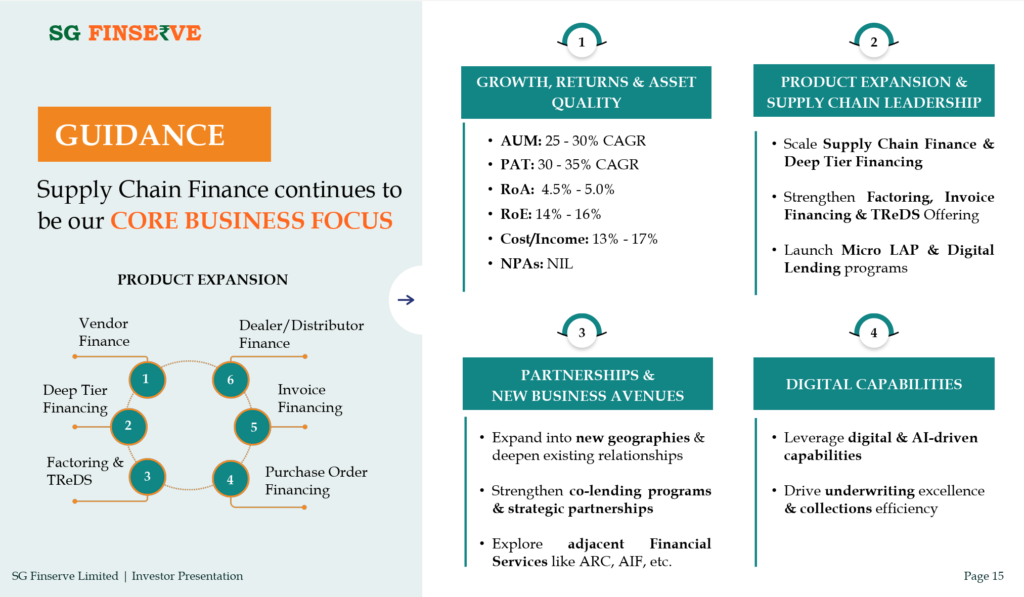
SG Finserve Ltd management has outlined a clear growth roadmap for FY27 and FY28, built on scaling supply chain financing, maintaining high return ratios, and expanding into adjacent financial verticals.
Source: company
- FY27 AUM Targets: SG Finserve Ltd is targeting an exit loan book/AUM of ₹5,500 Cr to ₹6,000 Cr by the end of FY27. For FY27 specifically, management projects an AUM growth rate of 35 to 40%. SG Finserve Limited has announced that it has closed H1FY27 with a loan book of approximately INR 5,694 Cr, up 98% YoY.
- Long-Term AUM CAGR: Management maintains a long-term AUM CAGR guidance of 25 to 30%, targeting a loan book of ₹7,500 Cr by FY30 with long-term potential to reach ₹10,000 crore.
- Profitability is expected to compound at a PAT CAGR of 30 to 35%, working toward a PBT target of ₹500 crore by FY30.
- Management targets a Return on Assets (RoA) of 4.5% to 5.0% (achieving 5.1% in Q1 FY27) and a Return on Equity (RoE) of 14% to 16%.
- SG Finserve Ltd aims to keep its cost-to-income ratio between 13% and 17%.
- SG Finserve Ltd maintains a strict operational commitment to NIL Gross NPAs.
- New Product Offerings: Scaling B2B factoring (leveraging its RBI factoring license), invoice financing, TReDS platforms, Micro LAP, and digital lending programs.
- Subsidiary Diversification: Setting up four proposed strategic subsidiaries in Asset Reconstruction (ARC), Alternative Investment Funds (AIF), Insurance Broking, and an AI-led FinTech platform to expand fee-based income
The interesting aspect to note is that the management had reduced guidance by H1 FY26 which had disappointed many investors. Once the management team changed in Q3 FY26, the guidance was increased post Q4 FY26 which gave fresh wings to the business and the aspirations of the investor community.
SG Finserve Ltd Technical Analysis
We consider technical analysis to be a useful input in taking medium-term investment decisions. Many a time, price action tends to lead to fundamental developments; this is too important an aspect to be ignored by retail investors who do not have access to management outside of common forums like investor calls & AGM.
At Congruence Advisers, we like to consider both the long-term weekly chart and the daily chart to arrive at a view on price action. Combined with our understanding of fundamentals, we usually end up being better placed to be able to judge both the business cycle and the stock cycle. Playing the stock cycle right is extremely important for investors looking to extract significant alpha over the medium term.
SG Finserve Ltd Price charts
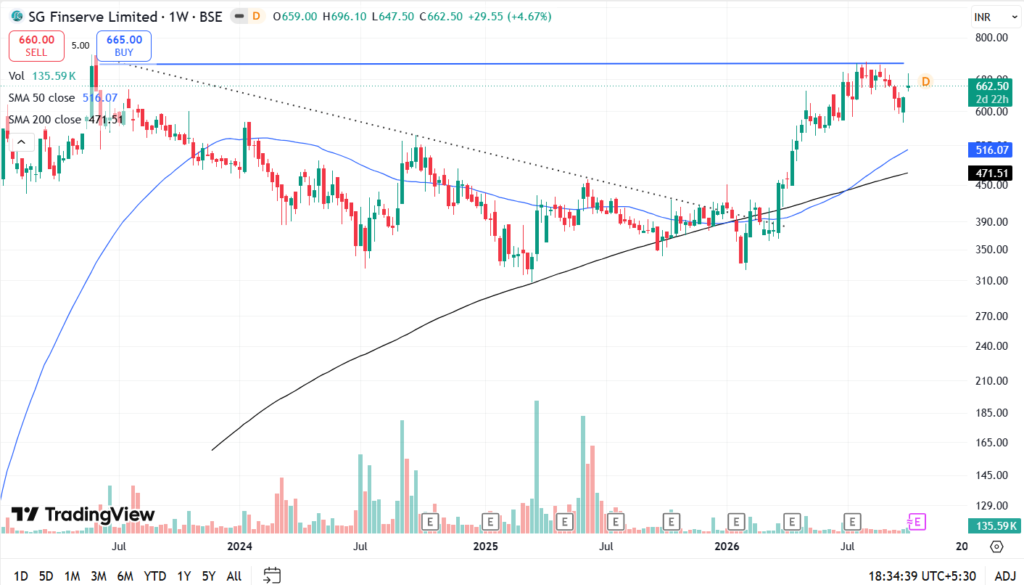
On a weekly chart, SG Finserve Ltd price trend is on the verge of breaking into fresh territory. There was a lot of hype after the entry of many institutional investors in 2023 post which the price went into parabolic territory. Since then, the trend was in a steady downtrend until the aggressive guidance by the new management came through around the Q4 FY26 results season in March 2026. This led to the price breaking the long term trend line (dotted line) following which the price made a dash for the previous ATH in August 2026.
The long term will look very bullish if the price goes past the previous ATH and sustains there.
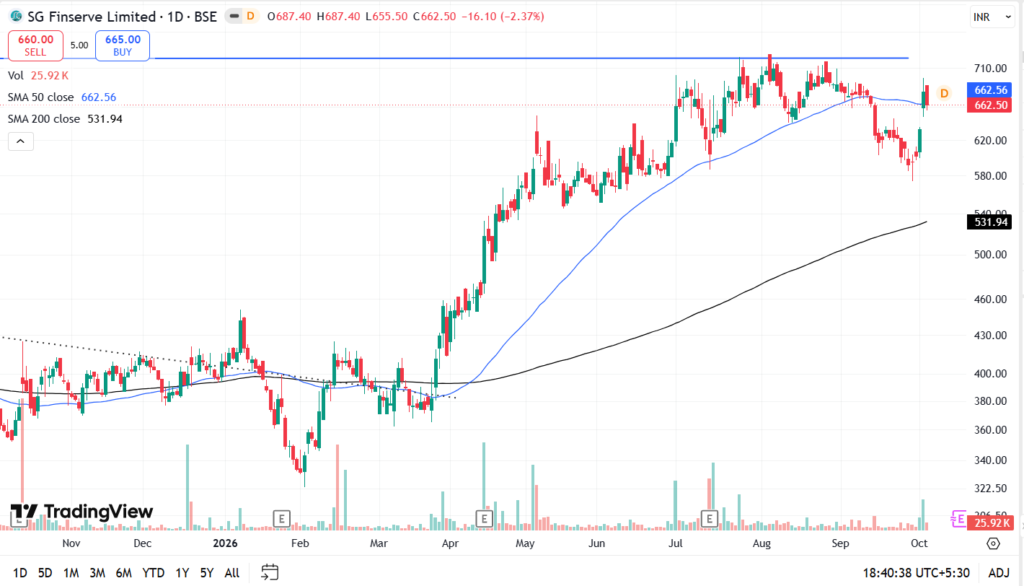
The day chart confirms a tangible shift in the trend since March 2026, the price saw a sharp uptick and has been trading above the 50DMA for the most part since then. In the recent bout of volatility, the price took a sharp knock (as did many other small caps that have outperformed since March 2026) but the price has rebounded above the 50DMA at the first sign of stability in the NIFTY 50.
As per our framework, we would classify this as a strong stock in the current market which will need sustained fundamental numbers for the trend to continue.
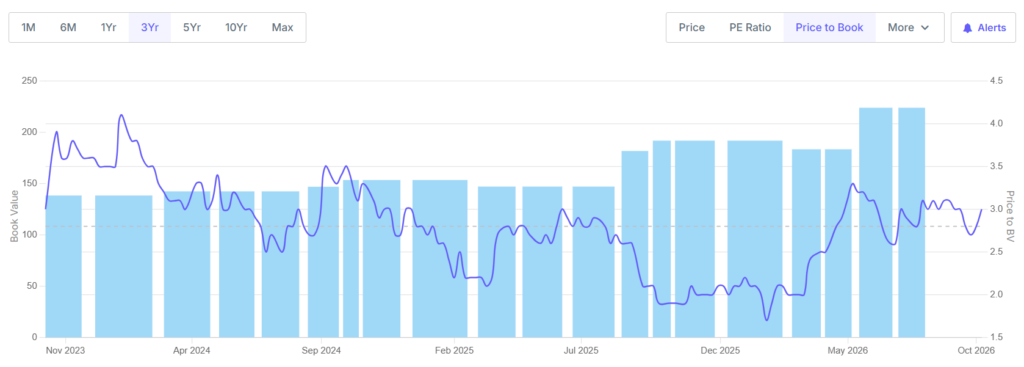
On the fundamental front, the price to book multiple has rebounded in 2026 back to the ~3x range. The market is clearly willing to pay a growth premium to this business on the back of the aggressive growth in loan book through H1 FY27.
SG Finserve Ltd Latest Results, News and Updates
SG Finserve Ltd Quarterly Results
Closing loan book crossed ₹4,552 Cr as of June 30, 2026, representing a 16% QoQ growth (vs ₹3,936 Cr in Q4 FY26) and 82% YoY growth (vs ₹2,504 Cr in Q1 FY26). Total Operating Income expanded to ₹136 Cr, up 29% QoQ and 100% YoY. Interest Income (NII) rose to ₹82 Cr, marking a 31% QoQ increase and a 92% increase YoY.
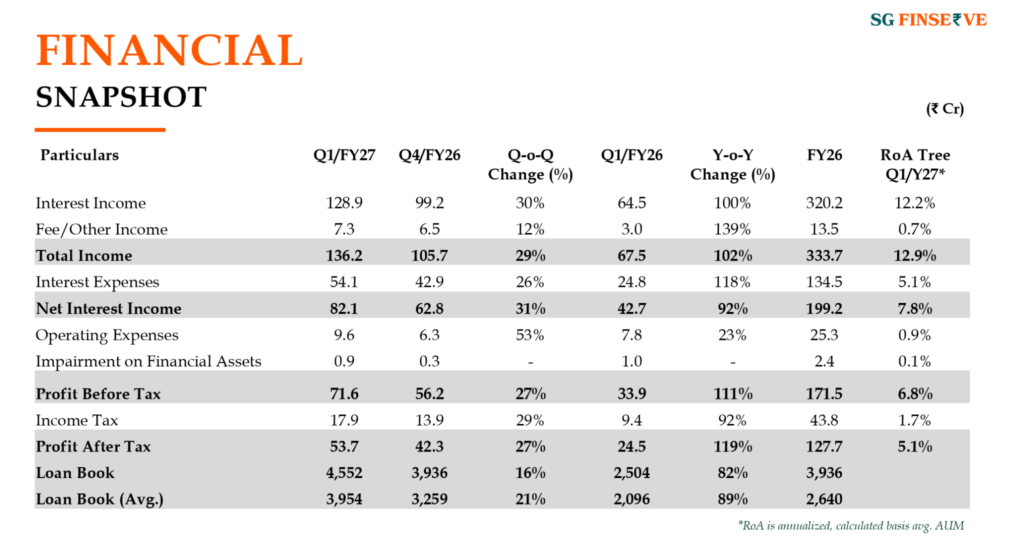
On the balance sheet side, closing net worth stood at ₹1,539 Cr with a conservative debt-to-equity leverage ratio of 2.2x (up from 1.9x as of March 31, 2026). Capital Adequacy Ratio (CRAR) remained strong at 32%, providing substantial headroom for future growth without requiring immediate fresh equity capital.
The company established SG Insurance Brokers; commercial operations are subject to regulatory approvals and are expected to launch in 2-3 quarters.
Final Thoughts on SG Finserve Ltd
SG Finserve Ltd shows high growth potential now that the management team is back to pushing the pedal aggressively. One of the reservations we had about the business all these days was on the fact that it was primarily a one product business with a heavy reliance on a few large corporate houses concentrated in a few sectors. With supply chain finance being a no frills, plain vanilla offering that doesn’t lend itself to any great differentiation, we were wary of investing into a small lending business that was already priced to reflect the business prospects. We have always had a high regard for the APL Apollo group, call it a lucky charm of ours if you want to. But we wanted to see some progress on product expansion and a reversion to high growth before taking a favourable view on the business.
Over the past two quarters, the business has shown tremendous growth on both a YoY and QoQ basis. What is more encouraging is the fact that the team is now broadening its solution footprint across more products and more client segments within the existing ecosystem of large anchor clients they are already empanelled with. We would not be surprised if the high growth continues for a few more quarters, the business will get a tailwind from higher GDP growth, if it materializes across the core sectors in India. This business is a clear beneficiary of higher inflation, the way the Government becomes a beneficiary of higher GST collections when inflation spikes.
The final piece of the puzzle that investors need to get a handle on is valuation. At ~3x price to book, one could say that the price isn’t cheap but how many lending businesses do we know of where loan book growth will be aggressive at minimal asset quality issues? Moreover, this aggressive loan book growth can be driven by higher leverage ratio from the current level without having to dilute equity for a couple of years. While we do understand that higher debt levels may reduce the spread by a bit since equity doesn’t have a cost of capital in an accounting sense, this will only improve the ROE of the business from the current level.
What has kept us from investing so far is the fact that we already have exposure to APL Apollo group companies in each one of our offerings – Emerging Business research (small cap heavy) and Flexicap research. We keenly look forward to the Q2 FY27 results and the management commentary to get a sense of the business momentum for FY27 and FY28. We will also look for qualitative inputs on the new verticals that the business intends to launch through FY27 and FY28. More diversified the revenue streams, the better can be the risk adjusted return for investors over the next 3-5 years. Pure lending businesses are always at the mercy of market cycles, a more diversified revenue profile while continuing to scale aggressively can make the business look more interesting.
At a market cap of hardly ~4,400 Cr at CMP, the business has a lot of positive possibilities to look forward to.
Disclaimer – This note is part of a business research & analysis series on small companies, there is no BUY/SELL recommendation or target price issued as part of this to a general audience. There is no assurance that this stock makes for a good investment, there is no guarantee that this stock will continue/be included in the coverage universe of Congruence Advisers. The note contains some forward-looking statements and insights drawn from the historical results, annual reports and investor presentations; they are to be viewed only within this context and not as a prediction of future performance of the business or the stock covered.
While due care has been taken to ensure that the information here is as accurate as possible, Congruence Advisers disclaims any liability in case of any unintentional inaccuracies.
The content does not constitute investment advice.