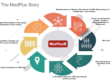
Rishabh Instruments Ltd is a global leader in manufacturing & supply of analog panel meters, low voltage current transformers. Rishabh Instruments Ltd manufactures instruments for electrical automation, metering, measurement, precision engineered products, roof top solar string inverters that are used in power substations, automotive and industrial sectors and is its core business. Rishabh Instruments Ltd also makes high pressure die castings for automotives, EV industry and for Industrial automation which is its non-core business. Rishabh Instruments Ltd serves a global customer base of over 3,000 across 100+ countries
Table T1
Rishabh Instruments Ltd is interestingly poised since the business offers the following characteristics – operates in the extended power supply chain, is just coming off a healthy capex cycle at minimal debt and the possibility of operating leverage over the next 2-3 years. While there is a possible stake sale overhang going by news in the public domain, financials can see a healthy growth over FY27-28 if the management team is able to execute well on the rooftop solar foray and improve utilization in the European die-casting business. At a market cap of hardly 2,500 Cr, the business has a strong competitive position in the global market and offers the possibility of a valuation rerating if the investment thesis plays out.
Rishab Instruments Ltd Company Summary
Rishabh Instruments was founded by Narendra Goliya, born in Jodhpur into a Marwari business family originally from Rajasthan. He completed his B.Tech in Electrical Engineering in 1974 from IIT Bombay. Further, he pursued his M.S. at Stanford University. Upon returning to India, Goliya initially assisted his father, Johrimal Goliya, in the family’s electrical equipment trading business. In 1983, he decided to start a small-scale industry in Nashik. He secured a 58lakhs loan from SICOM and established a 10,000 sq ft. factory in the Satpur industrial area under the brand “Rishabh”.
This venture faced immediate hardship. High interest rates (18%) and poor market response for his first product, an advanced analogue meter, led to a severe liquidity crisis. By 1989, his debt had ballooned to 91 lacs due to compound interest. The business was saved by Mr. Srinivasan, the then-MD of SICOM (State Industrial and Investment Corporation of Maharashtra Ltd), instead of seizing the assets, Srinivasan provided a “lifeline” loan of 9 lacs for working capital, which allowed the unit to become healthy and eventually repay all debts.
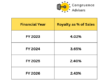
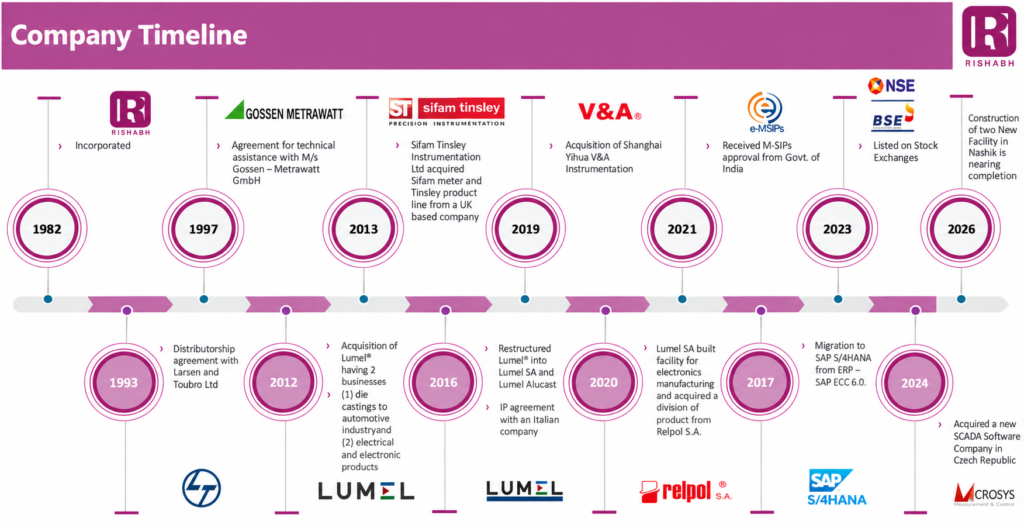
A major turning point occurred during a technical collaboration with the German company Metrawatt in 1997. When Rishabh Instruments Ltd was unable to pay agreed-upon royalties, Goliya proposed a “win-win” arrangement: instead of Metrawatt manufacturing products in Germany, Rishabh Instruments Ltd would manufacture them in India and sell them to Metrawatt. This proposal allowed Metrawatt to profit from the price difference in low-cost manufacturing, while helping Goliya settle his debts through exports. This success established Rishabh Instruments Ltd as a high-quality global supplier and shifted the relationship from royalty-based fees to a commercial partnership centred on cost-saving.
How did Rishabh Instruments Ltd expand its presence and design capabilities?
In 2012, as part of expansion, Rishabh Instruments Ltd acquired Lumel, a 7-decade old Poland company which is into the same electrical instrumentation business. As part of this acquisition, the company also acquired Lumel’s high pressure die casting business. In 2016, Rishabh Instruments Ltd restructured this die casting business as a separate subsidiary called Lumel Alu cast.
Rishabh Instruments Ltd continuation of expansion plan
- In 2013-14, acquired Sifam Meter & Tinsley meter product line to expand into the UK &US.
- In 2019, acquired V&A Instrumentation, a China based company, expanding its portfolio to portable Test & Measurement Instruments
- In 2020, acquired medium-voltage protection relays/controllers and radiation-monitoring products division from Relpol S.A., a Poland company
- In 2024, added SCADA software capabilities through acquisition of Microsys, a Czech Republic company
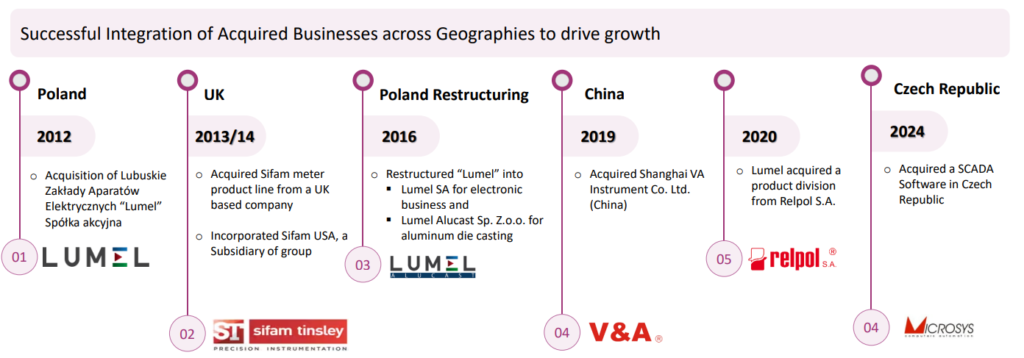
Apart from expanding into different geographies, if we look at their acquisitions, it is consistent with Rishabh Instruments Ltd’s strategy of either developing the required technology in-house or acquiring companies that already have the necessary technology, as seen in the case of Microsys.
Their acquisitions remained in the same line of business as that of Rishabh Instruments Ltd and rather made their portfolio complete, as now Rishabh Instruments Ltd can upsell SCADA software for the same new customers that Rishabh Instruments Ltd caters to.
Key events in Rishabh Instruments Ltd history
Rishabh Instruments Ltd IPO Details
Rishabh Instruments Ltd got listed in September 2023 at a premium of 4% over its issue price of 441 per share at an issue Size of 491crs. Of 491crs, 75crs towards fresh issue where 63crs is towards Nashik capex. Balance 416crs is OFS where promoter group and a private equity firm South Asia Clean Energy Fund (SACEF) were the selling shareholders.
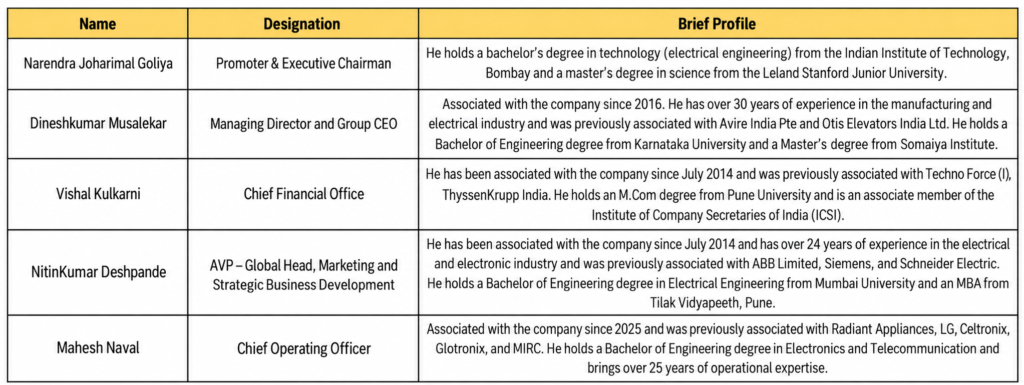
Rishabh Instruments Ltd Management details
Rishabh Instruments Industry Landscape
Electrical Automation Market Overview
The shift in Electrical automation is largely driven by the growing emphasis on digitalisation, energy efficiency, and smart infrastructure. Globally valued at approximately USD 210 Billion in 2024, the market is projected to cross USD 400 Billion by 2033, growing at a CAGR of 6.7%. Indian Electrical automation market size in 2024 is 7.56Bn$ and is growing at a CAGR of 8.6% taking the market size to 15.96 Bn$ in 2033.
Growth Drivers
Adoption of Industry 4.0 – Widespread digital transformation with the integration of AI, IoT, robotics, and cloud computing is reshaping industrial operations, enabling predictive maintenance, remote monitoring and operational efficiency
Focus on Energy Efficiency – The rising need to reduce energy consumption and transition to renewable energy is driving the demand for advanced automation in power systems and utilities.
Rise in Infrastructure Investments – Public and private investments in transportation, urban infrastructure, and electrification are creating strong demand for automation and electrical control systems.
Expansion of the Electric Vehicle (EV) Ecosystem – The growing electric vehicle market is accelerating the need for automated charging stations and grid management systems.
Metering, Control, and Protection Devices Market – The metering, control and protection devices, such as analog/digital panel meters, multi-function meters, current transformers, APFC relays, and protection relays, among others, are used in a centralized system to measure, control, record, analyse and protect the electrical system.
In 2024, globally, the market stood at USD 36.71 Billion and is set to reach USD 43.04 Billion by 2027, clocking in at a CAGR of 4.8%. In India, the market reached USD 723.9 Million in 2024 and is projected to record a CAGR of 5.5% to reach USD 864.5 Million by 2027.
Growth Drivers – Increased investments in renewable energy, transmission and distribution networks, metro and smart city projects, and industrial expansion. Furthermore, government initiatives like rural electrification and infrastructure development have supported the market’s penetration in Tier II and Tier III cities.
Portable Test and Measurement Instruments Market
Portable Test & Measurement Instruments (TMI) are used to test and measure the various electrical parameters like voltage, current, and power, among others, on site.
In 2023, globally, the market stood at USD 5.3 Billion and is set to reach USD 6.6 Billion by 2027, clocking in at a CAGR of 5.1%. In India, the market reached USD 172.9 Million in 2023 and is projected to record a CAGR of 6.9% to reach USD 228.6 Million by 2027.
Growth Drivers – With the rise of smart manufacturing, miniaturisation of electronics, and increased reliance on automated systems, portable instruments such as handheld multimeters, power analysers, and spectrum analysers are becoming indispensable. They aid predictive maintenance, ensure safety compliance, and help optimise operational performance, especially in distributed or remote infrastructures
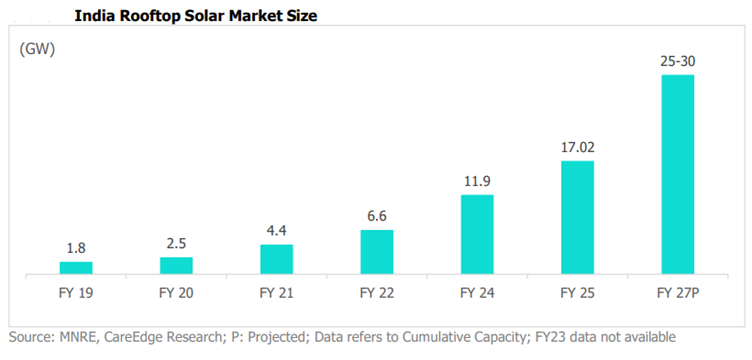
India’s Roof Top Solar Market
India’s rooftop solar energy capacity is projected to surge, rising from 17 GW to an estimated 25–30 GW between FY25 and FY27. Increasing awareness among businesses about reducing operating costs and meeting sustainability targets is fuelling this adoption.
Solar Inverters Market
Solar inverters convert DC electricity generated by solar panels into usable AC power, making solar energy usable across homes, businesses, and industries.
Domestically, the market is projected to clock in a CAGR of 7.89% from 2025 to 2033.
Growth Drivers – The global demand for solar inverters is rapidly increasing, fuelled by the widespread adoption of renewable energy and government initiatives to reduce carbon emissions. This trend is supported by government initiatives such as the PM Suryaghar Muft Bijli Yojana and the Grid-Connected Rooftop Solar Programme, which aim to increase solar capacity and provide affordable electricity to millions of households
PM Surya Ghar Yojana: Energising Residential Rooftop Adoption – The PM Surya Ghar Muft Bijli Yojana, aimed at installing rooftop solar in 1 crore households with subsidies up to Rs 78,000, is expected to provide strong support to residential adoption.
Aluminium High-Pressure Die Casting (HPDC) Market
HPDC is a manufacturing process that enables large-scale production of lightweight, complex aluminium components, making it particularly suitable for high-volume applications.
The global HPDC market was estimated at USD 92.6 Billion in 2024. It is expected to further reach USD 112.9 Billion by 2027, registering a CAGR of 6.1%. India’s HPDC market has matured and valued at USD 4.9 Billion in 2022, the market is expected to reach USD 7.38 Billion by 2027, at a CAGR of 8.4%
Growth Drivers – Rising focus on vehicle lightweighting and the surge in EVs have boosted demand for aluminium parts like structural frames, engine blocks, and battery housings.
Rishabh Instruments Ltd Product Portfolio
The following are the Rishabh Instruments Ltd key products:
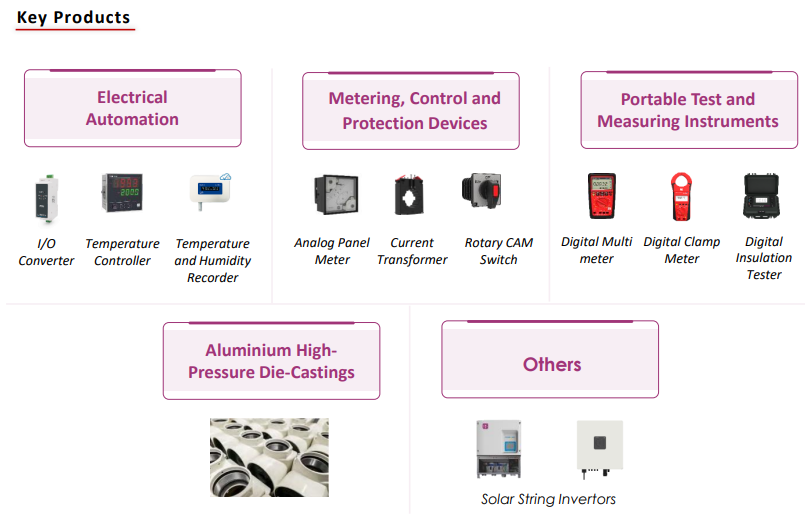
Electrical Automation: It refers to manufacturing products which streamline industrial systems, monitors, converts and control various applications for power up and down on command, process monitoring and controlling.
Metering, Control and Protection Devices: Metering, control and protection devices are used for measuring, controlling, recording, analysing and protecting the electrical power system
Portable test and measuring instruments: It refers to manufacturing of products which are used by our customers to inspect, test, calibrate, and measure parameters of a system, facility, instrumentation or process.
Solar String Inverters: These are used with solar arrays to convert the energy that is generated (direct current) to usable electricity (alternating current) and also has micro-grid applications. These solar string inverters include power classes from 10 kW to 50 kW.
Which industries do Rishabh Instruments Ltd products fit in?
Power substations/ Power heavy industries – Rishabh Instruments Ltd makes the measurement, monitoring, testing and protection equipment that helps a power substation measure electricity, detect faults, protect equipment and maintain reliable power supply. Their products fit in Power transformer bays, circuit breakers, control rooms, Battery rooms, Genset backups.
Data centres – Fits mainly into instruments that monitor server hall conditions (temperature/humidity recorders), support field commissioning (digital multimeters, insulation testers), manage power reliability, backup generator controllers, and transfer switches for mains-to-genset switching.
Small Solar plants – Rishabh Instruments Ltd’s products, on the string inverter segment— the point where DC from solar panels is converted to AC. Their Radius range (iUNO, RNEO) spans 0.85 kW residential rooftop units up to 50 kW C&I/industrial inverters
Rishabh Instruments Ltd Manufacturing Facilities
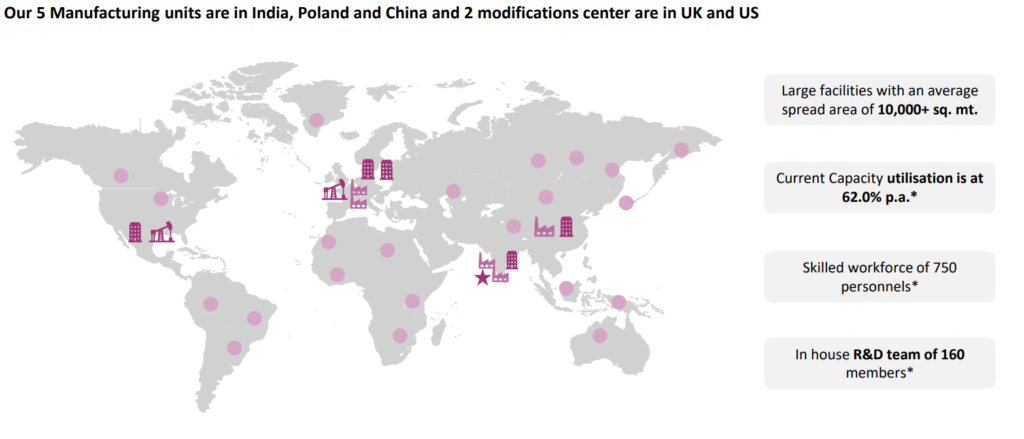
Rishabh Instruments Ltd consolidated business operated at 62% utilization as of FY26
Rishabh Instruments Ltd has 5 Plants –
- 2 in India (Nashik I and II, all are Leased)
Products Manufactured: Metering, Control & Protection Devices. Solar String Inverters, Portable Test & Measurement Instruments, Electrical Automation products
- 2 in Poland (Lumel SA & Lumel Alu cast, all are owned)
Lumel SA – Products manufactured are Industrial Automation & Measurement & EMS assembly.
Lumel Alu cast – Products manufactured: High pressure aluminium Castings
- 1 in China (Shanghai VA Instruments), leased one.
Products Manufactured: Portable Test & Measurement Instruments
Rishabh Instruments Ltd is doing a capex of 60crs in Nashik facility which will be operational in H2FY27 and will double the existing Indian production Capacity
- Focus is on Current Transformer expansion from 6000/day to 10000/day
- Solar inverters to achieve revenue of 100 Cr in next 3-4yrs from the current 46 Cr
Rishabh Instruments Ltd Corporate Governance Details
We have considered some of the aspects of corporate governance as a dip test to evaluate the corporate governance at Rishabh Instruments Ltd.
Key man Risk – Narendra Goliya is 75yr old and there exists a keyman risk, however, his son Rishab Goliya is working as Director of Business Excellence at Rishabh instruments.
Board Independence – The Board comprises 7 members, with 5 Independent Directors. Mr. Goliya serves as the executive chairman
RPT transactions – Related party transactions exist but aren’t material or worth flagging
Remuneration – KMP remuneration is 9% of FY26 PAT which is acceptable
Contingent Liability – Contingent liabilities are minimal at 1% of net worth which can be ignored
A detailed corporate governance check would entail looking at these additional factors, if and when we get to writing a detailed initiation note on this business
- Intangibles involved in the business, do they form a big part of the balance sheet?
- Unit economics – do they fit into the normal range for a business of this nature?
- Is accounting complicated or simple? consistent or changes every few years?
- Consistency in disclosing FX losses/gains and MTM impact?
- Consistency in tax outgo in the cash flow statement and the P&L?
- Is the promoter family actively investing outside of the business- real estate, VC Funds?
- What other organizations are the promoters and directors associated with? Any history of defaults or frauds there?
- Any history of over the top speak by promoters/management in the media?
- Analysis of audit committee notes
- History of change/retention of statutory auditors & auditor remuneration trend
- Insights from credit rating reports
- Pending litigation against company & promoters?
It has been our endeavour over the years to enhance the scope and details of the corporate governance checks we conduct. However, the entire scope of this analysis would be an overkill at this stage of business analysis. This will be appropriate for a deep dive if and when a business is considered for inclusion in the portfolio.
Rishabh Instruments Ltd Financial Performance
Segmental Reporting
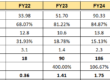
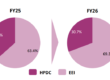
Rishabh Instruments splits its revenue reporting across the EEI and HPDC verticals. Products of electrical automation, metering, control and protection devices, portable test and measuring instruments, solar inverters are segmented as EEI (Electrical and Electronic Instruments) by the company and EEI segment generates 70% of its revenues whereas its casting business generates 30% and is segmented as HPDC (High pressure die castings).
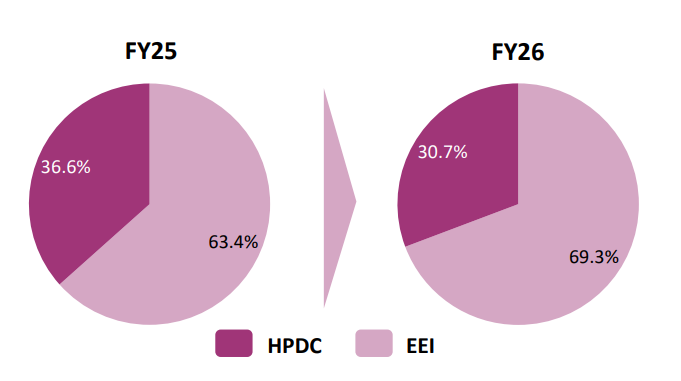
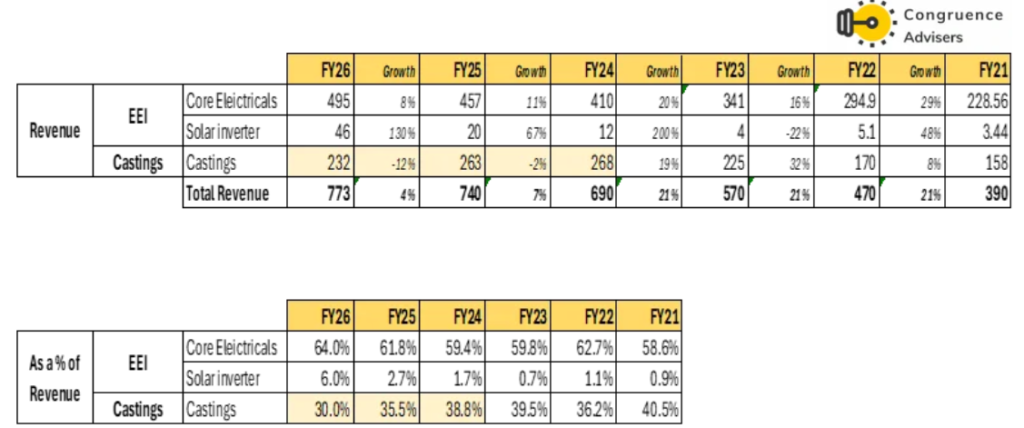
Due to Ukraine Russia war, Rishabh Instruments Ltd’s casting business has been badly hurt as it used to have major revenues from automotive casting business as most of the European automotive companies moved their casting work to China due to rise in labour and power costs in Europe which made Rishabh Instruments Ltd to gradually scale down their automotive segment of their casting business and as of FY26, Rishabh Instruments Ltd ‘s casting business is at breakeven in terms of EBITDA margins and intends to do revenue of ~ 180crs and maintain EBITDA breakeven in FY27 as well. By FY28, Rishabh Instruments Ltd plans to do double digit EBITDA margins in their casting business.
Rishabh Instruments Ltd Historical Financials
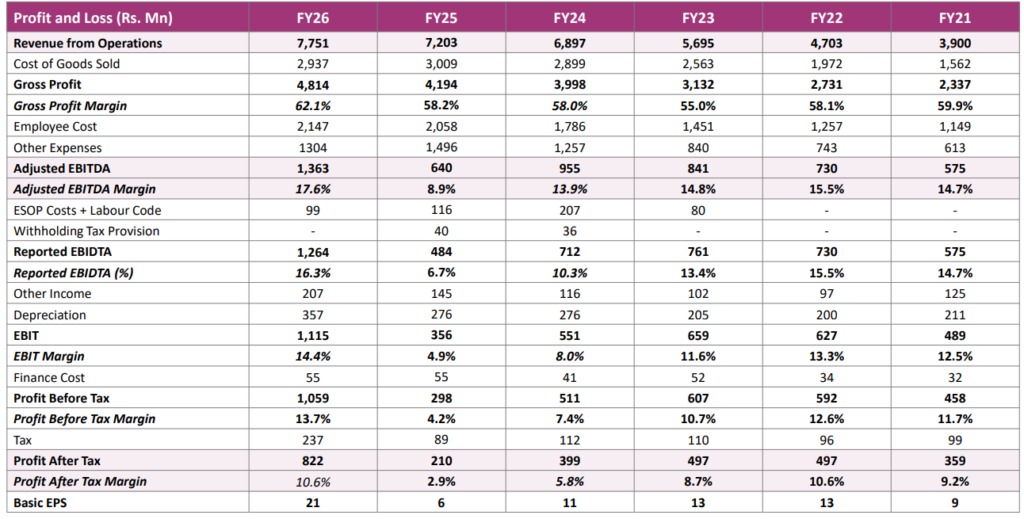
Rishabh instruments Ltd, in FY25, was going through a rough patch where they were cutting down their automotive segment of their casting business, as of FY26, which led to only 6% revenue CAGR from FY24 to FY26.
Their automotive and non-automotive share in their casting business is 50:50, Rishabh Instruments Ltd intend to bring this share to 25:75 in the next couple of yrs, accordingly the company had guided for 180crs of castings business revenue in FY27.
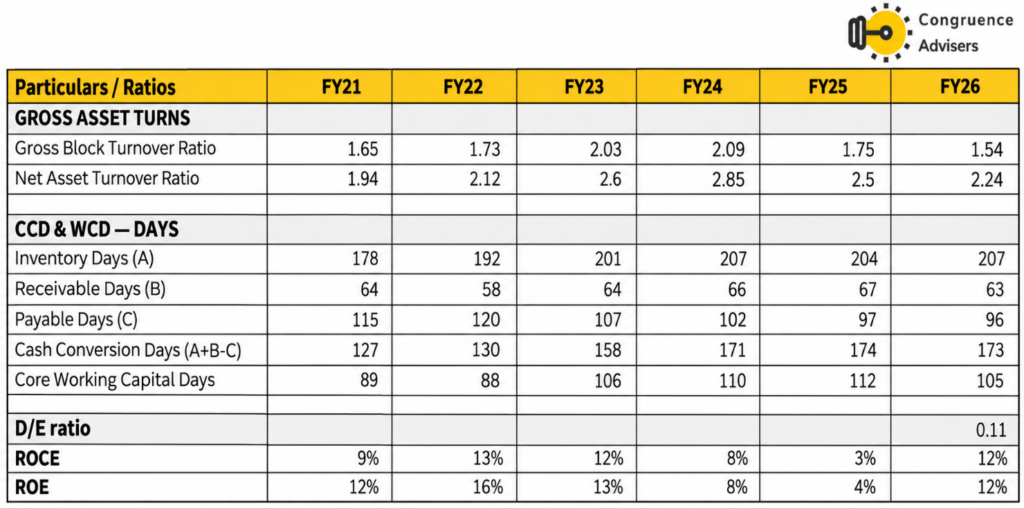
Though their revenue growth in the last 2yrs is not so phenomenal, Rishabh Instruments Ltd was able to keep their core working capital days intact, which is remarkable considering what the company was going through in the last 2 yrs.
Other Key metrics
Rishabh Instruments Ltd Comparative Analysis
To understand Rishabh instruments Ltd investment potential, we have conducted a comprehensive analysis. This analysis includes comparing Rishabh instruments Ltd to its competitors (peer comparison) on various fundamental parameters and Rishabh instruments Ltd share performance relative to relevant benchmark and sector indices.
Rishabh Instruments Ltd Peer Comparison
As there is no direct listed competitor to Rishabh instruments Ltd who has both the businesses of Electrical products and casting business, hence, we benchmarked it against its closest peer Masibus automation which is only into electrical products and another peer Schneider electric which is a global giant and far ahead of Rishabh in terms of electrical products
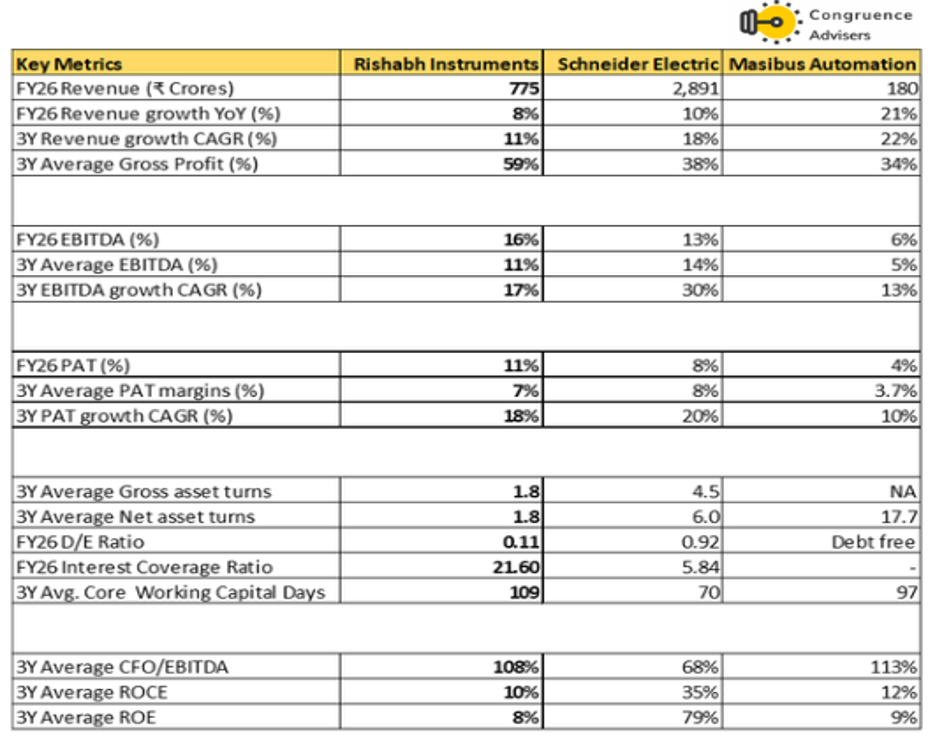
When Rishabh instruments Ltd is compared with Masibus automation, Rishabh instruments Ltd is bigger in terms of revenue and margins are far superior even though Rishabh instruments was going through a business mix change in the last two years. However, Rishabh instruments Ltd working capital days remain stretched when compared to Masibus automation.
Due to the paucity of listed peers, this section should not be seen as an exhaustive view on Rishabh Instruments.
Rishabh Instruments Ltd Index Comparison
Rishabh instruments Ltd share performance vs S&P BSE Small Cap Index, as the index benchmark comparison is a fundamental tool for understanding the investment potential and making informed decisions in the context of the broader market
Table – T2
Why You Should Consider Investing in Rishabh Instruments Ltd?
Turnaround of the HPDC business expected boost to EBITDA going ahead – Nearly 35-40% of Rishabh instruments Ltd ’s revenue i.e., Solar inverter and their HPDC (Lumel Alu cast) business achieved breakeven in FY26. Management says FY27 remains a year where they plan to cut HPDC revenue from 230crs in FY26 to 180crs in FY27. So, FY28 onwards, around 30% of business i.e. HPDC posting double digit margins would boost to it EBITDA

Capex at their Nashik facility – Management has carried out a capex of nearly 60crores in Nashik, which will double their Indian production capacity and expected incremental depreciation hit from this is around 5crs which would hardly dent their P&L but would rather support its management guidance to grow their revenues at 25% in FY27
Balance sheet strength through cash Balance of 200crs and quality of receivables – Remarkable as to how Rishabh instruments Ltd was able to maintain their receivables, almost with hardly any change in their receivables whereas their revenues have grown from 690crs in FY24 to 775crs in FY26.
20% of their balance sheet i.e. 200crs of cash sitting in their balance sheet as on 31st March 2026 after incurring capex of 60crs in Nashik facility, interesting as to how Rishabh instruments Ltd uses these funds, though the Rishabh instruments Ltd has taken small steps in EMS by doing pilot batch of 1,000‑unit order of laptop PCB assembly that incorporates Intel processors, as of FY26, their EMS revenue is negligible.
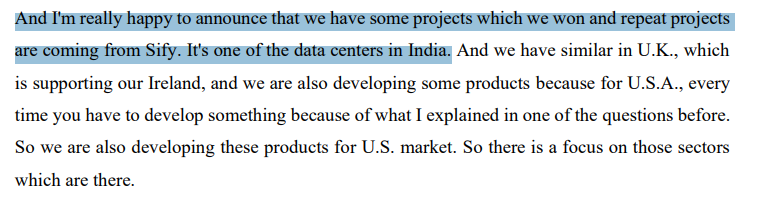
Marquee customer base – Rishabh instruments Ltd has marquee customer lists such as ABB, Siemens, Hitachi energy etc who are often the beneficiaries of ongoing data centre boom. Rishabh Instruments Ltd has also been able to obtain repeat orders from Sify Technologies.
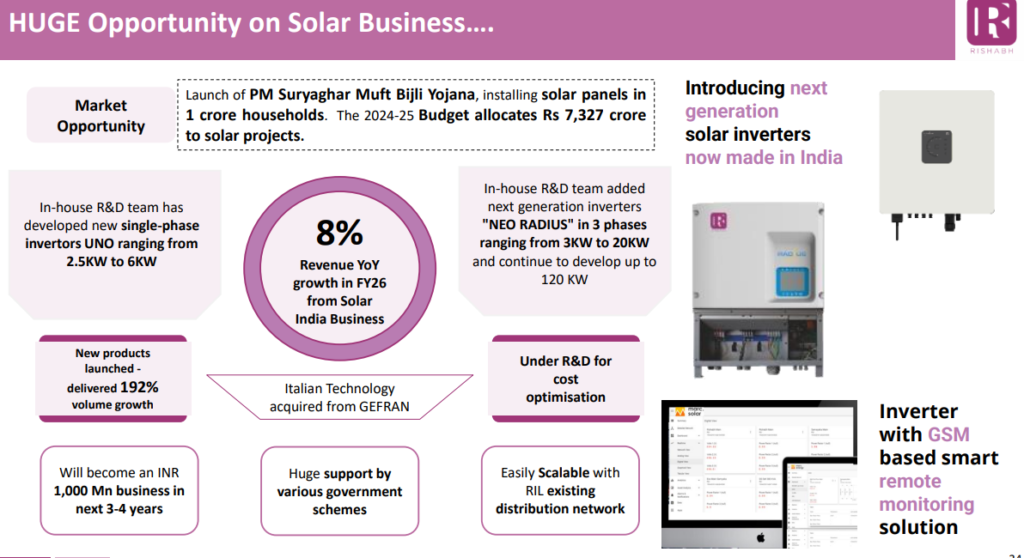
Solar string inverters – Of Top 5 solar string inverters that are sold in India, 4 are Chinese (Sungrow, growatt etc), there exists a huge import substitution opportunity for Rishabh Instruments Ltd as their solar string inverters are completely in house designed and manufactured in India. Rishabh instruments Ltd’s solar string inverter business posted 46crs and achieved breakeven in FY26 and management intends to take this to 100crs in next 3-4 yrs
What are the Risks of Investing in Rishabh Instruments Ltd?
Stake sale by promoters – Recent rumours in the financial markets suggest that the promoters are looking to sell a majority stake in the company at a valuation of INR 3000Cr for the company. While it is impossible to know at this stage whether such a transaction would be beneficial or detrimental to the minority shareholders of the company, it is necessary to flag this as a potential key event.
Failure to turn around their HPDC business – Though management deliberately is cutting down their automotive segment of their HPDC business, a key risk is to successfully replace the lost automotive volumes with non-automotive ones, could result in revenue pressure from FY28 onwards.
Commoditized products – Nearly 30% of Rishabh instruments Ltd’s portfolio of products are commoditized such as analog panel meters, rotary cam switches etc which has low technology and differentiation play,
Recent price rally has captured a lot of the upside – Recent stock rally from INR400 to INR 800+ – A lot of management’s stated aspirations such as 25% revenue growth in FY27 and EBITDA turnaround in FY27 along with posting double digit EBITDA margins in FY28 in their HPDC business, got priced in the recent rally, any negative news such as delaying their double digit HPDC EBITDA margin aspirations could be bad for the stock.
Forex Translation Risk – With 60% of revenues generated through its Polish subsidiaries, Lumel SA and Lumel Alucast, Rishabh instruments Ltd remains exposed to PLN/INR translation risk. A depreciation of the PLN against the INR could negatively impact the INR-reported revenues and profitability of the company, partially offsetting the benefits seen during periods of PLN appreciation
Rishabh Instruments Ltd Future Outlook
Rishabh Instruments Ltd does quarterly earnings calls and this makes it easy for investors to keep track of the guidance by the management. We are summarizing the management guidance and business outlook from the latest earnings call and presentation.
1. Overall EEI Business
- Core EEI business to grow by around 20% in FY27. Management kept the guidance unchanged even though Q1 growth was much stronger at around 34% YoY.
- For margins, management is looking at around 20–22% EBITDA margins for the EEI business for the full year.
- Lumel Alucast
- The focus here is mainly on improving utilisation of the existing capacity.
- Management expects the business to reach adjusted EBITDA breakeven during FY27.
- Over the next couple of years, as more capacity gets filled with better-value non – automotive orders, they expect margins to gradually come back to double-digit levels.
2. Capacity Expansion
- The Nashik expansion is partly operational already, and the remaining work is expected to be completed in the next 1–2 months.
- This expansion should give them enough capacity to increase overall production by more than 2.5x over the next 4–5 years.
- Current Transformers
- Rishabh instruments Ltd is also increasing its low-voltage CT capacity.
- Current capacity is around 5,000–6,000 units per day, which is being increased to around 8,000–10,000 units per day.
- The demand is being supported by areas like AI data centres, power infrastructure and grid modernisation, so management sees this as an important growth opportunity.
3. M&A
- Apart from organic growth, Rishabh instruments Ltd is also looking for acquisitions in India,US and Europe.
- The potential deal sizes are for roughly ₹50 crore to ₹150–200 crore, depending on the opportunity.
Rishabh Instruments Ltd Technical Analysis
We consider technical analysis to be a useful input in taking medium-term investment decisions. Many a time price action tends to lead to fundamental developments; this is too important an aspect to be ignored by retail investors who do not have access to management outside of common forums like investor calls & AGM.
At Congruence Advisers we like to consider both the long-term weekly chart and the daily chart to arrive at a view on price action. Combined with our understanding of fundamentals, we usually end up being better placed to be able to judge both the business cycle and the stock cycle. Playing the stock cycle right is extremely important for investors looking to extract significant alpha over the medium term.
Rishabh Instruments Ltd Price Charts
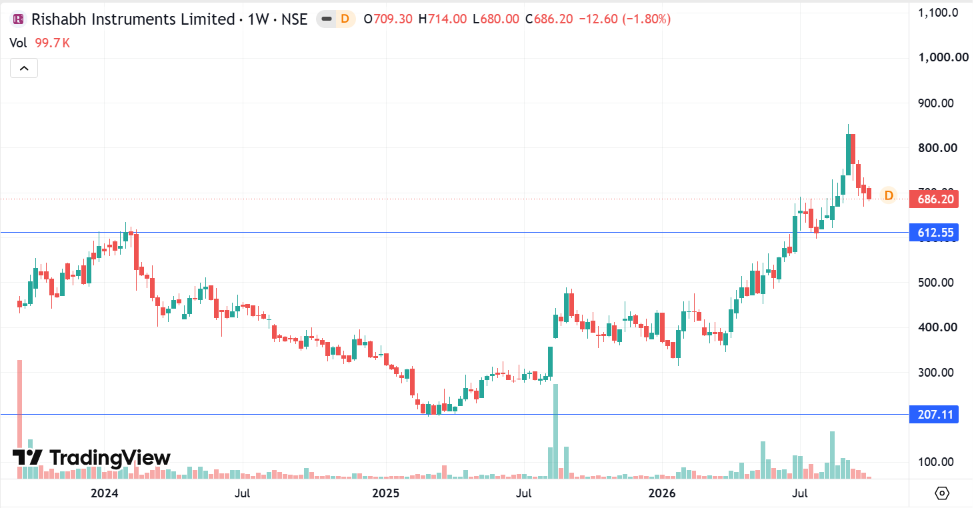
Rishabh Instruments was listed in Sep 2023 and the above weekly chart captures the entire 3Y price action since listing. The company listed just as stress was starting to build up in its Polish subsidiary. FY24 and FY25 were very poor years in terms of reported profitability as one-time tax provisions and severe cost inflation and operational challenges hit the Polish die-casting subsidiary. ESOP costs added further pressure to margins. EBITDA margins plunged from 13% in FY23 to 6.7% in FY25. This is reflected in the one-way downmove of the stock from post-IPO Feb 2024 highs to March 2025 lows.
The stock bottomed out around Q4 FY25 and went up sharply on high volumes after margins returned to 15% in Q1 FY26 after several quarters of single digit EBITDA margins. Starting from Q1FY26, the company reported 5 straight quarters of strong 16-17% margins but by this time, geopolitics and market liquidity flows started determining its price action rather than fundamentals. The stock grinded lower but never quite touched the pre Q1 FY26 price levels of 300.
Finally, as the bear market in small and microcaps ended in March 2026, the stock rapidly took off, more than doubling in just 5 months as the last several quarters of great execution got gradually priced in. Since then the stock has corrected about 20%. As uncertainty regarding the ownership of the company gets resolved, the price action should follow suit one way or the other. Any retests of the 610 breakout levels could be a buying opportunity (If an investor does not care about the promoter change risk)
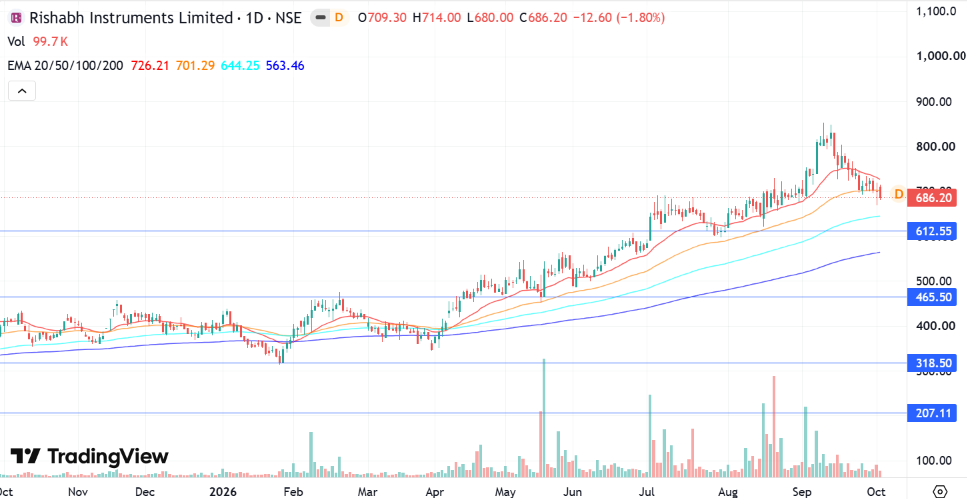
The daily chart captures the last one year’s price action. The stock broke out of the long horizontal consolidation between 320-465 in April, giving a retest in May and finally escaping the consolidation for good after strong Q4 FY26 results were declared in mid May.
The stock then proceeded to take out the IPO base levels of 610 in July before giving a retest in August. The strong Q1 FY27 numbers once again cleared the stock above the support levels decisively and it quickly moved up to 850 levels.
Since then the stock has corrected ~20% and is presently consolidating near the 50DMA averages. The 100DMA levels and IPO base breakout levels of 610 should act as strong support if results are along expected lines. The resolution of the ownership question will of course have a strong impact on the price action based on how the market sees it.
The latest shareholding pattern indicates that the number of shareholders has been within a range for the past many quarters. We see it as a sign of limited froth in the share price since a sudden spike in the retail investor count along with a steep price rise can indicate distribution. We see no such indicator as of now

Rishabh Instruments Ltd Latest Result, News and Updates
Rishabh Instruments Ltd Quarterly Results
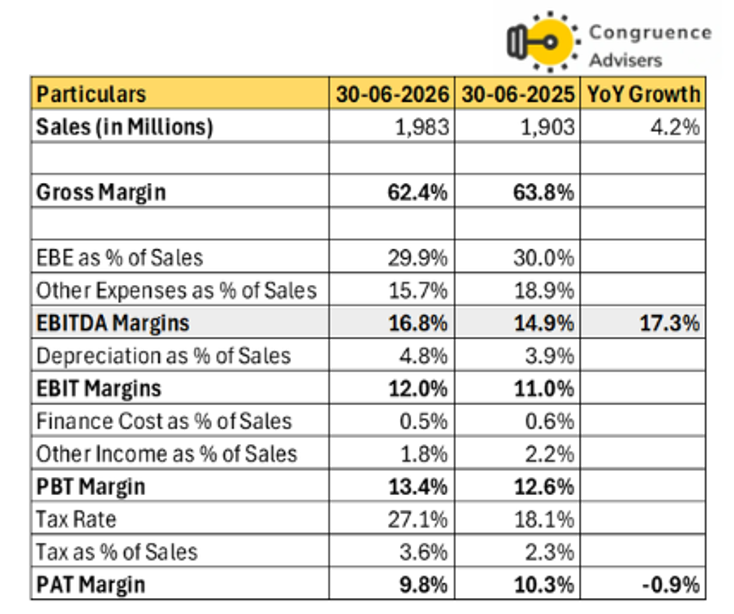
In Q1 FY27, Rishabh Instruments Ltd has achieved profitability in their solar inverters segment and added 3-phase iNEO models up to 12 kW, models up to 50 kW and hybrid inverter solutions are under development. Rishabh Instruments Ltd remains net debt-free with net cash and cash equivalents of 160crs as of June 30, 2026
Other Q1 FY27 Updates
- Secured 3-4 data center projects in India, with another 10 projects currently quoted in AI data centres
- Rishabh instruments ltd is evaluating 4–5 strategic M&A opportunities in India, the US, and Europe in the ticket size range of INR 50 crore to INR 150–200 crore
- Over 15 new products launched in the past two years, with more than 15 additional product launches scheduled for FY27
Final thoughts Rishabh instruments Ltd
Rishabh Instruments has built a compelling electrical components business based out of India and Europe over the last 2 decades. Their strength is electrical instrumentation and measurements and their products are used across substations and data centers. They are a natural proxy to the current global electrical grid buildout and thus have strong tailwinds in their favour. One of the most impressive features of this business is the extremely good cash flow conversion. The high amounts of cash generation has ensured that debt has remained negligible even as gross fixed assets have almost 3x’d in 6 years.
While the electrical side of the business has strong tailwinds and is doing very well, the consolidated margins and growth have disappointed primarily due to the die-casting business in Europe. European casting, forging and machining companies have notoriously bled and underperformed over many years with the Russia-Ukraine war making things worse via fuel inflation. This business has been a drag on growth as well as margins with FY26 delivering EBITDA level losses. The planned EBITDA breakeven and double-digit-margins-for-FY27 targets for this business need to be closely tracked. The rooftop solar business should also start reporting positive EBITDA from FY27.
Once these two issues get sorted out, Rishabh is capable of reporting 20%+ EBITDA margins. That should help ROCEs inch towards late teens from mid teens currently.
As investors, an obvious key event to track here is succession with Mr. Narendra Goliya being 75 years old and his son Rishabh not being part of the Board yet. Recent rumours in the financial markets suggest that the promoters are looking to sell a majority stake in the company to strategic investors at a valuation of INR 3000Cr for the company. The company has not confirmed this news yet.
Disclaimer – This note is part of a business research & analysis series on small companies, there is no BUY/SELL recommendation or target price issued as part of this to a general audience. There is no assurance that this stock makes for a good investment, there is no guarantee that this stock will continue/be included in the coverage universe of Congruence Advisers. The note contains some forward-looking statements and insights drawn from the historical results, annual reports and investor presentations; they are to be viewed only within this context and not as a prediction of future performance of the business or the stock covered.
While due care has been taken to ensure that the information here is as accurate as possible, Congruence Advisers disclaims any liability in case of any unintentional inaccuracies.
The content does not constitute investment advice.